
Consistency in parenting and boundary setting is one of the most challenging yet crucial aspects of raising well-adjusted children. While most parents understand the importance of setting limits, following through consistently remains one of the greatest struggles. This comprehensive guide explores why consistency matters, what undermines it, and how to develop the skills to maintain boundaries effectively.
Why Consistency in Parenting Matters for Child Development
Consistency forms the foundation of effective parenting and healthy child development. When children experience predictable responses to their behavior, they develop a sense of security and understanding about how the world works. This predictability allows their brains to form stable neural pathways related to cause and effect, self-regulation, and decision-making.
Research in developmental psychology demonstrates that children raised with consistent boundaries show significantly better outcomes across multiple domains. They exhibit stronger emotional regulation, better academic performance, reduced anxiety, and improved social skills compared to children who experience inconsistent parenting.
Consistency teaches children that actions have reliable consequences. When limits remain stable, children learn to trust their environment and the adults who care for them. This trust becomes the foundation for secure attachment, which influences relationships throughout life. Without consistency, children remain in a state of uncertainty, constantly testing boundaries to determine what rules actually apply.
Understanding the Psychology Behind Setting Boundaries
Boundaries serve as invisible structures that define acceptable behavior and protect both children and adults. From a psychological perspective, boundaries help children develop what psychologists call an “internal locus of control”—the understanding that their choices directly influence outcomes.
When adults set clear boundaries, they communicate expectations about behavior, safety, and respect. These limits aren’t arbitrary restrictions but rather frameworks that help children navigate complex social environments. Boundaries answer fundamental questions children have: What’s safe? What’s expected of me? What happens when I make certain choices?
The human brain, especially the developing prefrontal cortex in children, relies on repetition and consistency to form habits and internalize rules. Each time a boundary is enforced consistently, neural pathways strengthen. When boundaries shift unpredictably, the brain receives conflicting information, making it difficult to establish stable behavioral patterns.
Common Reasons Parents Struggle With Consistent Discipline
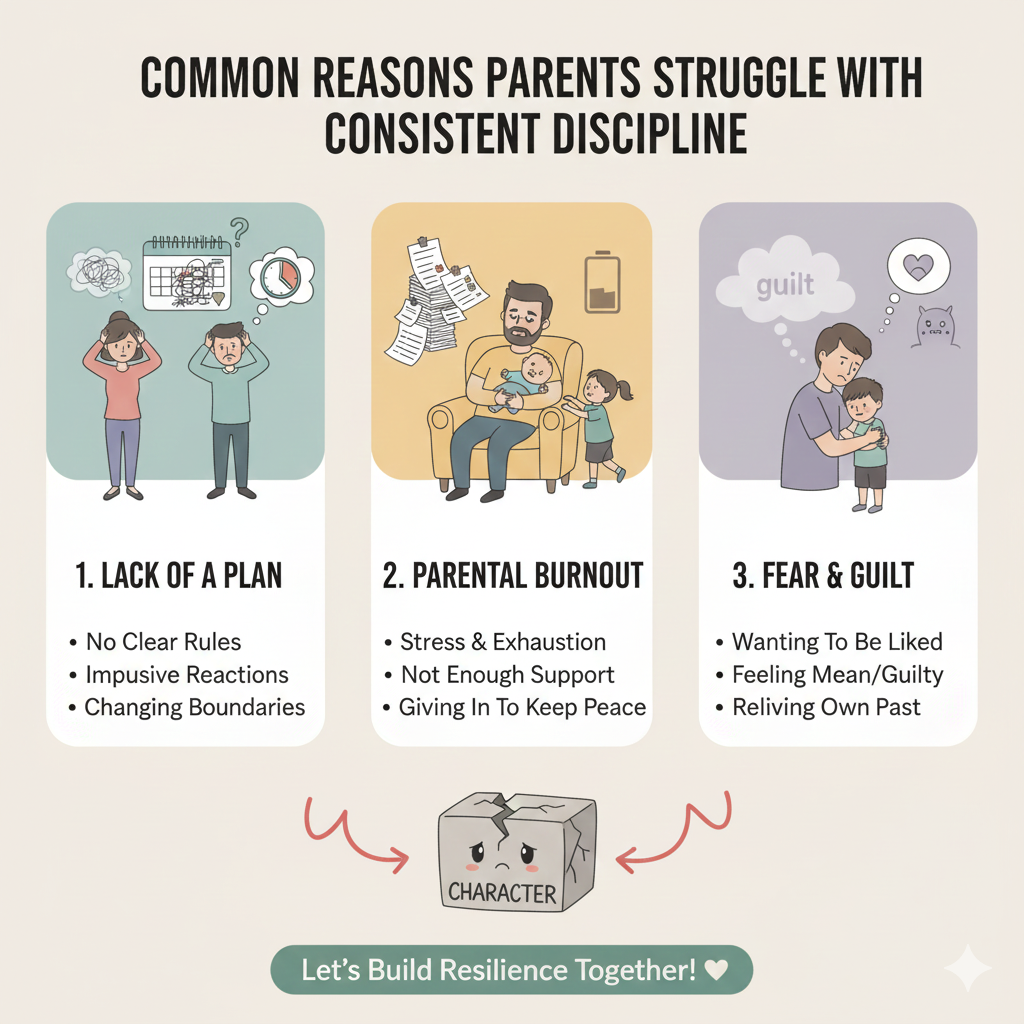
Despite understanding the importance of consistency, many parents find it extraordinarily difficult to maintain. Several factors contribute to this challenge:
Emotional exhaustion ranks among the top reasons. Parenting requires constant decision-making and emotional regulation. When tired or stressed, adults often take the path of least resistance, giving in to avoid conflict even when they know they shouldn’t.
Guilt and overcompensation particularly affect working parents or those going through difficult times like divorce. They may relax boundaries to make up for perceived shortcomings or to be the “fun” parent.
Partner disagreements create inconsistency when caregivers enforce different rules or undermine each other’s authority. Children quickly learn which parent to approach for which requests.
Social pressure and comparison lead parents to question their own judgment. Seeing other families with different rules can make parents doubt whether their boundaries are too strict or too lenient.
Desire for peace motivates many parents to avoid confrontation. Enforcing boundaries often triggers tantrums, arguments, or emotional outbursts that exhaust parents who simply want harmony.
Inconsistent personal boundaries in adults’ own lives make it difficult to maintain them for children. Parents who struggle with saying no to others often struggle with maintaining limits at home.
How to Set Clear Expectations and Family Rules
Effective boundary setting begins with clarity. Vague expectations lead to confusion and inconsistent enforcement. Follow these principles for establishing clear family rules:
Make rules specific and observable. Instead of “be good,” try “use kind words and gentle hands.” Children need to know exactly what behaviors are expected. Specificity eliminates ambiguity and makes enforcement straightforward.
Keep the list manageable. Too many rules become impossible to remember and enforce. Focus on 5-7 core family values and rules that reflect those values. Quality matters more than quantity.
Explain the reasoning behind rules. When children understand why boundaries exist, they’re more likely to internalize them. “We don’t hit because it hurts people and makes them feel unsafe” provides context that “no hitting” lacks.
Involve children in age-appropriate rule-making. Older children and teenagers benefit from participating in discussions about household rules. This involvement increases buy-in and teaches negotiation skills.
Post rules visibly for younger children. A simple chart with pictures helps remind both children and adults what expectations are. Visual reminders reduce the need for constant verbal repetition.
Distinguish between negotiable and non-negotiable boundaries. Some things—like safety rules or respect requirements—aren’t open for debate. Others—like bedtime on weekends or screen time limits—might have flexibility. Knowing the difference helps you stand firm when it matters most.
Developing a Consistent Parenting Strategy That Works
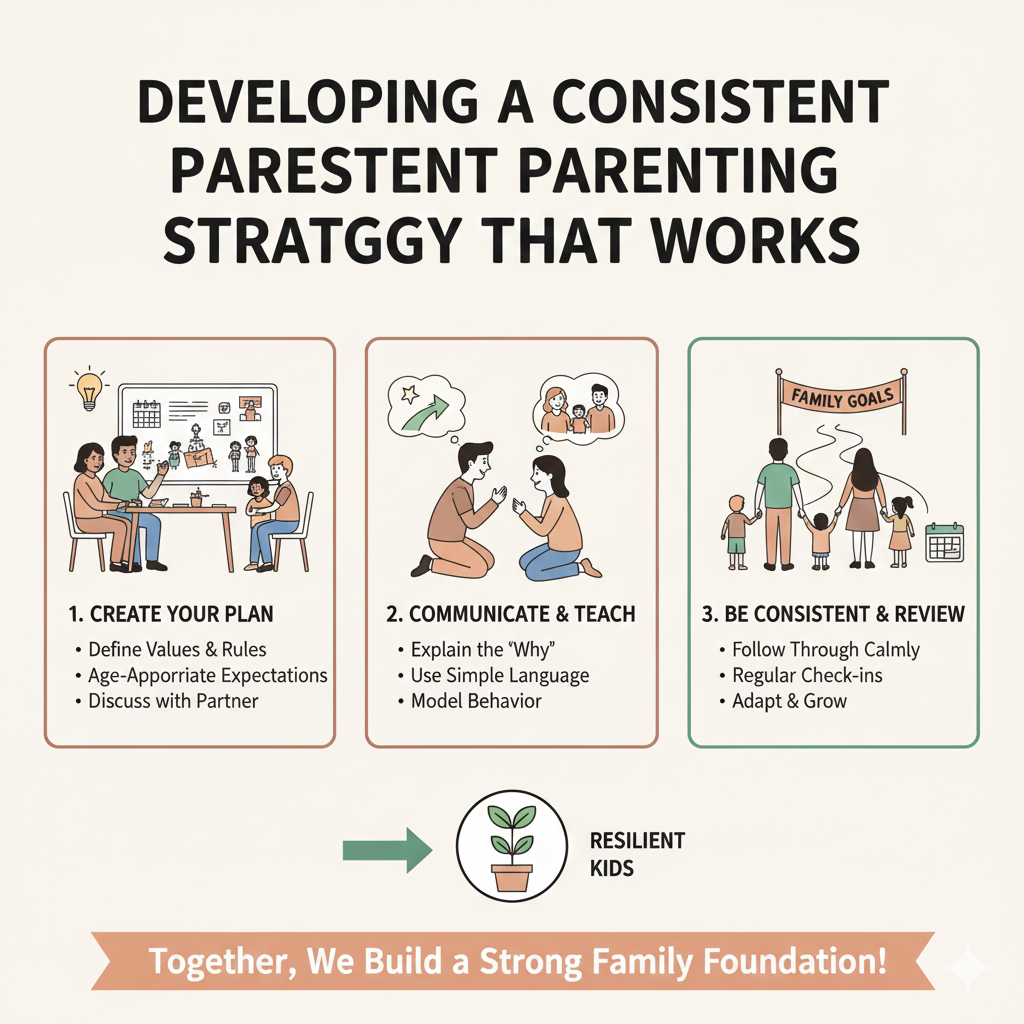
Creating consistency requires a strategic approach rather than moment-to-moment decision-making. A well-developed parenting strategy serves as your guide when emotions run high.
Start by identifying your core values. What matters most to your family? Respect? Responsibility? Kindness? Honesty? Your boundaries should reflect these values. When limits align with deeply held beliefs, you’ll find it easier to maintain them.
Develop a decision-making framework for common situations. For instance: “When my child refuses to do homework, I will: (1) acknowledge their feelings, (2) remind them of the consequence, (3) follow through with the stated consequence if they still refuse.” Having predetermined responses eliminates in-the-moment uncertainty.
Create routines that reduce the need for constant decision-making. When bedtime follows the same sequence every night, it becomes automatic rather than negotiable. Routines are boundaries in action—they establish predictable patterns that children can rely on.
Anticipate challenging situations and plan your response in advance. If grocery store tantrums are common, decide before entering the store what you’ll do if one occurs. This preparation prevents reactive, inconsistent responses.
Build in accountability for yourself. Share your parenting goals with a partner, friend, or parenting group. External accountability helps you stay consistent even when it’s difficult.
Overcoming Parental Guilt and Emotional Exhaustion
Guilt and exhaustion are perhaps the greatest enemies of consistency. Parents often cave on boundaries because they feel guilty about working long hours, going through divorce, or simply because maintaining limits feels emotionally draining.
Recognize that consistency itself is an act of love. Boundaries provide security and teach essential life skills. When you feel guilty about enforcing a limit, reframe it: “I’m teaching my child important lessons” rather than “I’m being mean.”
Address guilt at its source. If you feel guilty about work hours, find meaningful ways to connect during available time. But don’t compensate with lax boundaries—this creates insecurity rather than closeness.
Manage exhaustion proactively. Parenting from an empty tank makes consistency nearly impossible. Prioritize sleep, accept help, simplify where possible, and recognize that self-care isn’t selfish—it’s necessary for effective parenting.
Practice self-compassion. You won’t be perfectly consistent. Instead of harsh self-criticism when you slip, acknowledge the mistake, repair with your child if needed, and commit to doing better next time. Progress, not perfection, is the goal.
Remember that short-term conflict from enforcing boundaries prevents long-term problems. The tantrum today teaches lessons that prevent bigger issues tomorrow. Keep the long view in mind.
Creating a United Front: Co-Parenting and Consistency
Inconsistency between caregivers undermines even the best-intentioned boundaries. Children quickly learn to exploit disagreements, asking the more permissive parent or playing caregivers against each other.
Schedule regular co-parenting meetings. Set aside time weekly to discuss rules, consequences, and any challenges you’re facing. This prevents in-the-moment disagreements in front of children.
Present a united front, even when you disagree. If you have concerns about your partner’s decision, support it in the moment and discuss it privately later. Undermining each other teaches children that rules are negotiable through manipulation.
Develop shared language and consequences. When both parents use the same phrases and enforce identical consequences, children receive consistent messages. Create a simple chart listing common misbehaviors and agreed-upon responses.
Respect each parent’s judgment in the moment. The parent present makes the call. Second-guessing each other creates uncertainty for everyone. Trust that you’re both working toward the same goals.
Address fundamental disagreements before they affect consistency. If you have different parenting philosophies, work through these differences with a therapist or counselor. Unresolved conflicts will inevitably create inconsistency.
Extend consistency to all caregivers. Grandparents, babysitters, and other caregivers should understand and support your core family rules. Provide them with written guidelines if helpful.
Practical Tools for Maintaining Boundaries Under Pressure
Maintaining consistency requires practical strategies, especially during challenging moments. These tools help you follow through when it’s hardest:
The pause technique: When your child pushes back on a boundary, take a breath before responding. This brief pause prevents reactive inconsistency. Say “I need a moment to think about that” if necessary.
If-then statements: Prepare clear if-then statements in advance. “If you don’t put your toys away, then you won’t be able to play with them tomorrow.” State it once calmly, then follow through without additional warnings.
Natural and logical consequences: Rely on consequences that relate directly to the behavior. A child who refuses dinner feels hungry until the next meal. A teen who doesn’t fill the gas tank loses car privileges. The connection reinforces the lesson.
Remove yourself from power struggles. When a child argues endlessly, disengage. “I’ve explained the rule. The decision is final.” Then refuse to continue the argument. This prevents exhaustion-driven inconsistency.
Use timers and visual cues. For transitions or time-limited activities, use timers so you’re not the bad guy—the timer is. “When the timer goes off, screen time ends” removes negotiation.
Document consequences. Keep a simple log of rules and consequences. When children claim “you never said that,” you have a reference. This also helps you spot patterns of inconsistency.
Prepare simple scripts. For common situations, memorize simple responses. “The rule is…” “I understand you’re upset, and the answer is still no.” “I love you, and this boundary isn’t changing.” Scripts prevent decision fatigue.
The Role of Follow-Through in Effective Limit-Setting
Follow-through is where consistency lives or dies. Every time you state a consequence and then don’t enforce it, you teach children that boundaries are meaningless. They learn to ignore your words and wait for you to give in.
Research on behavioral conditioning demonstrates that inconsistent follow-through creates the strongest resistance to boundaries. When children receive a reward (getting their way) after prolonged resistance, they learn that persistence pays off. This intermittent reinforcement makes future boundary-testing even more intense.
Effective follow-through means:
State consequences you’re prepared to enforce. Never threaten something you won’t do. If you say “If you don’t stop, we’re leaving this store,” be ready to leave—even with a full cart.
Enforce consequences immediately when possible. The closer the consequence to the behavior, the stronger the learning. Delayed consequences lose effectiveness, especially with younger children.
Remain calm during enforcement. Anger, frustration, or lengthy explanations during follow-through undermine the lesson. State the consequence matter-of-factly and move on. “You chose not to turn off the TV when asked, so no TV tomorrow.”
Don’t negotiate after the fact. Once a consequence is in motion, see it through. Reversing decisions because of pleading or tantrums teaches children that boundaries are flexible through manipulation.
Be prepared for escalation. Children often escalate behavior when you start following through consistently. This is called an “extinction burst”—a last-ditch effort to return to the old pattern. Expect it and stay the course.
Building Children’s Self-Discipline Through Consistent Limits
The ultimate goal of external boundaries is developing internal self-discipline. Consistent limits provide the framework within which children learn to regulate their own behavior.
When boundaries remain stable, children internalize them. What begins as an external rule (“Mom says no TV before homework”) becomes an internal value (“I should finish my work before playing”). This transformation happens through repetition and consistency.
Self-discipline develops through a gradual release of responsibility. Young children need direct supervision and immediate consequences. As they demonstrate understanding and compliance, they earn more autonomy. “You’ve shown you can manage 30 minutes of screen time without me reminding you, so now you can choose when to take that time.”
Consistent limits also teach children to delay gratification—a crucial component of self-discipline. When children learn that rules don’t bend based on whining or pleading, they develop the capacity to tolerate discomfort and wait for appropriate rewards.
Discuss the connection between boundaries and freedom. “When you consistently follow our rules about homework and chores, you earn more freedom to make your own choices.” This helps children see boundaries not as restrictions but as pathways to greater autonomy.
How to Handle Boundary Testing and Pushback
Every child tests boundaries—it’s a normal part of development. Understanding this helps you respond consistently rather than taking it personally or giving up.
Young children test boundaries to understand cause and effect and to determine what’s truly fixed versus negotiable. Teenagers test boundaries as part of identity formation and the developmental drive toward independence. Both are healthy processes that require consistent responses.
When children push back:
Stay calm and empathetic. “I know you’re disappointed, and the rule stays the same.” Acknowledging feelings while maintaining boundaries teaches emotional regulation.
Don’t engage in lengthy debates. State the boundary clearly once or twice, then disengage. “I’ve explained our rule. I’m not discussing it further right now.”
Expect and plan for resistance. When you tighten previously loose boundaries, expect increased pushback. This is normal and temporary. Consistency will reduce it over time.
Distinguish between expressing feelings and changing rules. Children should feel free to express disappointment or frustration about boundaries. Listening to feelings is different from negotiating rules. “I hear that you’re upset. The rule isn’t changing.”
Look for patterns in pushback. If your child consistently challenges certain boundaries, examine whether the rule is age-appropriate and clearly communicated. Some pushback indicates a need to adjust boundaries as children mature.
Celebrate compliance. When children accept limits gracefully, acknowledge it. “I appreciate that you accepted my decision even though you were disappointed. That shows maturity.”
Adjusting Boundaries as Children Grow and Develop
Consistency doesn’t mean rigidity. As children develop new capabilities and demonstrate responsibility, boundaries should evolve. The key is making changes thoughtfully rather than reactively.
Recognize developmental readiness. A boundary appropriate for a seven-year-old may be too restrictive for a ten-year-old. Research typical developmental milestones to inform when to adjust expectations.
Tie increased freedom to demonstrated responsibility. Don’t adjust boundaries based on age alone or because children beg. Instead, create a system where demonstrating maturity earns new privileges. “When you consistently make your bed for two weeks without reminding, we’ll discuss a later bedtime.”
Communicate changes clearly. Don’t suddenly enforce different standards without discussion. “Now that you’re in middle school, here’s how some of our rules are changing…”
Maintain core values while adjusting specifics. The underlying values (respect, responsibility, safety) remain constant even as specific rules evolve. A toddler’s “gentle hands” becomes a teenager’s “respectful communication.”
Involve children in discussing boundary adjustments. Especially with older children and teens, collaborative conversations about changing rules increases buy-in. “You’re getting older, and I want to hear your thoughts about our current curfew.”
Be willing to tighten boundaries if necessary. If a child isn’t handling new freedom responsibly, be prepared to return to tighter limits temporarily. “I gave you the freedom to manage your own homework time, but your grades are dropping. We’re going back to mandatory homework hour for now.”
Using Positive Reinforcement to Support Consistent Limits
While consequences for crossing boundaries are necessary, positive reinforcement for respecting them is equally important. Children are far more motivated to follow rules when compliance brings recognition than when violation brings punishment alone.
Catch children following rules. Specifically acknowledge when they respect boundaries: “I noticed you turned off your screen when the timer went off without me reminding you. That shows great self-control.”
Create reward systems for consistent compliance. For ongoing challenges, implement a chart or points system. Consistent bedtime routines earn points toward a special activity. Ensure rewards are proportionate and meaningful.
Offer specific praise rather than generic compliments. “You asked permission before going to your friend’s house, just like our rule says” is more effective than “good job.”
Celebrate growth and progress. When children who previously struggled with a boundary begin respecting it more consistently, acknowledge the growth: “You used to fight bedtime every night. Lately you’ve been going up on your own. I’ve noticed that change.”
Connect compliance to natural positive outcomes. Help children see how following boundaries benefits them: “Because you did your homework yesterday, you’re not stressed this morning.”
Balance attention. Ensure that appropriate behavior receives at least as much attention as boundary violations. Children who receive more attention for misbehavior than compliance learn to seek attention through negative means.
Technology and Screen Time: Maintaining Consistency in the Digital Age
Screen time boundaries represent one of modern parenting’s greatest consistency challenges. The pervasive nature of technology, combined with children’s intense desire for device access, makes these limits particularly difficult to maintain.
Establish clear, specific screen time rules. Vague limits lead to constant negotiation. Instead of “not too much screen time,” specify: “One hour of recreational screen time on school days, two hours on weekends.”
Use built-in technological tools. Parental controls, timers, and screen time management apps remove the burden of constant monitoring. When the app locks the device, you’re not the bad guy.
Create device-free zones and times. No devices at the dinner table, in bedrooms, or during the first and last hour of the day. Physical separation supports consistency.
Model the behavior you expect. Children notice when adults check phones constantly but expect them to follow strict limits. Your own device use either reinforces or undermines your consistency.
Distinguish between educational and recreational use. A blanket “no screens” misses important distinctions. Time spent on homework or creative projects differs from passive consumption.
Address the “everyone else gets to” argument preemptively. “Other families make decisions that work for them. In our family, this is our rule.” Don’t engage in comparisons.
Have a plan for special circumstances. Long car trips, sick days, or special events might warrant adjusted limits. Decide your policy in advance so you’re not making emotional decisions in the moment.
The Long-Term Benefits of Consistent Parenting
The investment in consistency pays dividends throughout childhood and beyond. Research tracking children into adulthood reveals significant advantages for those raised with consistent boundaries.
Enhanced self-regulation: Adults who experienced consistent limits as children show superior impulse control, better emotional regulation, and stronger executive functioning skills.
Improved mental health: Consistency in childhood correlates with lower rates of anxiety and depression in adolescence and adulthood. The predictability of consistent parenting creates emotional security.
Stronger parent-child relationships: Contrary to fears that strict boundaries damage relationships, consistency strengthens them. Children raised with clear, consistent limits report feeling more loved and secure.
Better academic and career outcomes: The self-discipline developed through consistent boundaries transfers to academic performance and work ethic. These individuals set and achieve goals more effectively.
Healthier adult relationships: Children who experienced consistent boundaries develop clearer personal boundaries, making them less susceptible to manipulation and more capable of healthy relationships.
Effective parenting of the next generation: Adults who benefited from consistency are more likely to implement it with their own children, breaking cycles of inconsistent or harmful parenting.
Repairing Mistakes and Getting Back on Track
No parent maintains perfect consistency. Life disrupts routines, stress compromises judgment, and everyone makes mistakes. The key isn’t perfection but recovery.
Acknowledge when you’ve been inconsistent. If appropriate, admit to your child: “I haven’t been following through on our bedtime rule. That’s going to change starting tonight.” Honesty models accountability.
Don’t let one slip become a pattern. Inconsistency for one evening doesn’t mean all is lost. Return to consistency at the next opportunity without guilt or overthinking.
Identify your triggers. Notice when you’re most likely to abandon boundaries. Is it when you’re tired? Stressed? In public? Create specific plans for these high-risk situations.
Start small when rebuilding consistency. If you’ve been inconsistent across multiple boundaries, don’t try to fix everything simultaneously. Choose one or two areas to focus on first.
Seek support when needed. If you’re consistently struggling with consistency despite your best efforts, consult a family therapist or parenting coach. Sometimes external support makes the difference.
Practice self-compassion. Beating yourself up for inconsistency doesn’t help. Recognize that parenting is challenging, learn from mistakes, and commit to improvement.
Celebrate your consistency wins. Notice and acknowledge times when you maintained boundaries despite difficulty. Building on success is more effective than dwelling on failure.
Conclusion: The Path to Consistent, Effective Parenting
Consistency in setting and maintaining limits is challenging but achievable. It requires clarity about your values, strategic planning, emotional regulation, and persistent effort. The reward—children who feel secure, develop self-discipline, and grow into capable adults—makes the investment worthwhile.
Remember that consistency isn’t rigidity. It means predictable responses, reliable follow-through, and boundaries that reflect your family’s values. It allows for flexibility within a stable framework, adjusting as children grow while maintaining core expectations.
Start where you are. Choose one area where you’ll commit to greater consistency. Implement the strategies outlined here one at a time. Build on small successes. Involve your partner or support system. And extend yourself the same grace you show your children when they’re learning something difficult.
Your commitment to consistency is an investment in your child’s future and the quality of your relationship. Every time you follow through when it’s hard, you’re teaching lessons that will serve your child for a lifetime. That’s not just good parenting—it’s one of the greatest gifts you can give.