
Understanding the difference between natural and logical consequences is fundamental to effective, respectful parenting. These approaches teach children accountability and problem-solving skills without resorting to punishment. This comprehensive guide explores how to implement consequence-based discipline that builds character, promotes learning, and strengthens parent-child relationships.
Understanding Natural Consequences in Positive Discipline
Natural consequences are the inevitable results that occur without parental intervention. They flow directly from a child’s actions through the natural order of cause and effect. When a child refuses to wear a coat, they feel cold. When they don’t eat lunch, they feel hungry. When they stay up too late, they feel tired the next day.
These consequences are powerful teachers because they’re immediate, logical, and impersonal. The parent doesn’t impose them—reality does. This removes the power struggle from the equation and allows children to learn from direct experience rather than parental lecturing.
Natural consequences work best when they’re safe, not too far in the future, and when the child is developmentally capable of making the connection between action and outcome. They teach responsibility without damaging the parent-child relationship because the parent becomes a supportive guide rather than an enforcer.
Research in developmental psychology shows that learning through natural consequences activates different brain pathways than learning through imposed punishment. The prefrontal cortex engages more actively in problem-solving and decision-making, creating stronger neural connections that support better choices in the future.
What Are Logical Consequences and How Do They Differ
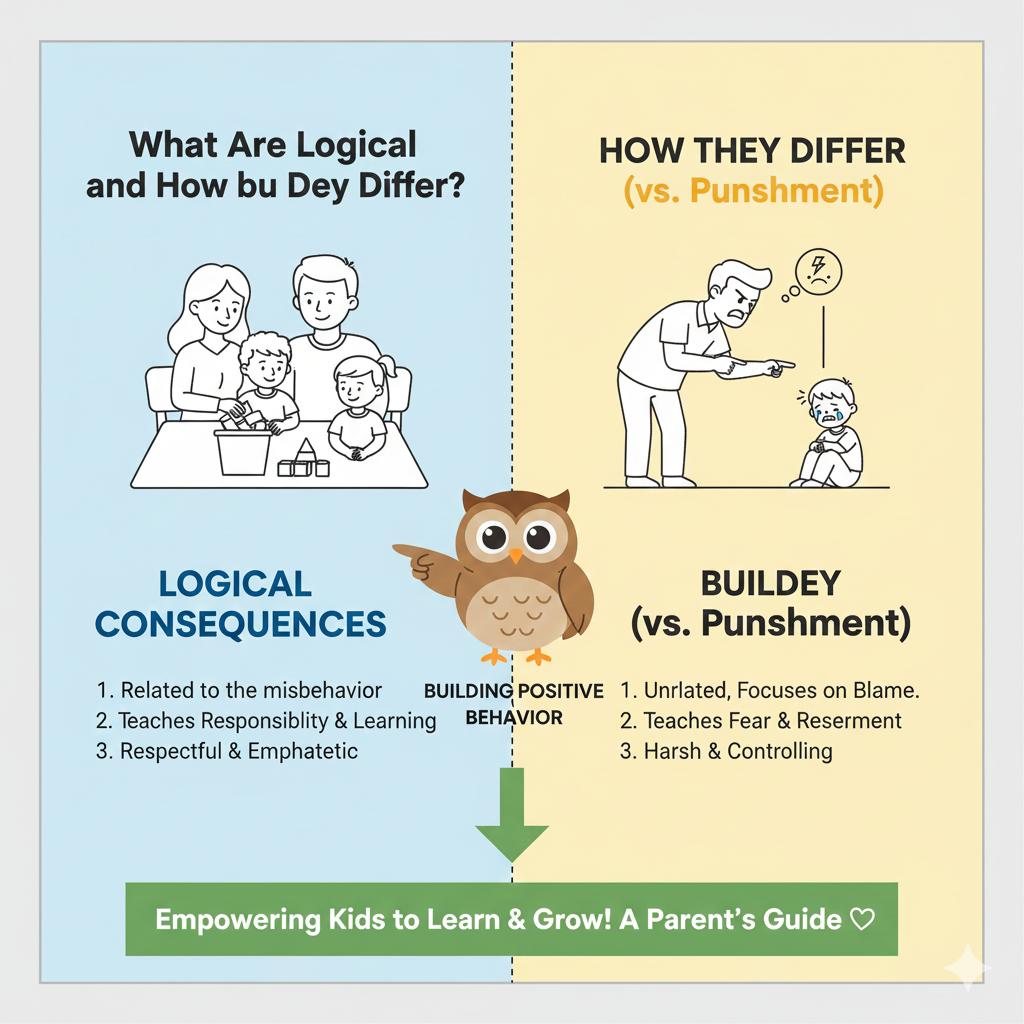
Logical consequences are structured responses imposed by adults that relate directly to the misbehavior. Unlike natural consequences that happen automatically, logical consequences require parental action. However, they maintain a clear, rational connection between the behavior and the outcome.
If a child misuses their bike, they temporarily lose bike privileges. If they damage property, they help repair or replace it. If they refuse to pick up toys, those toys become unavailable for a period. The consequence makes sense—it’s not arbitrary punishment but a logical response to the specific behavior.
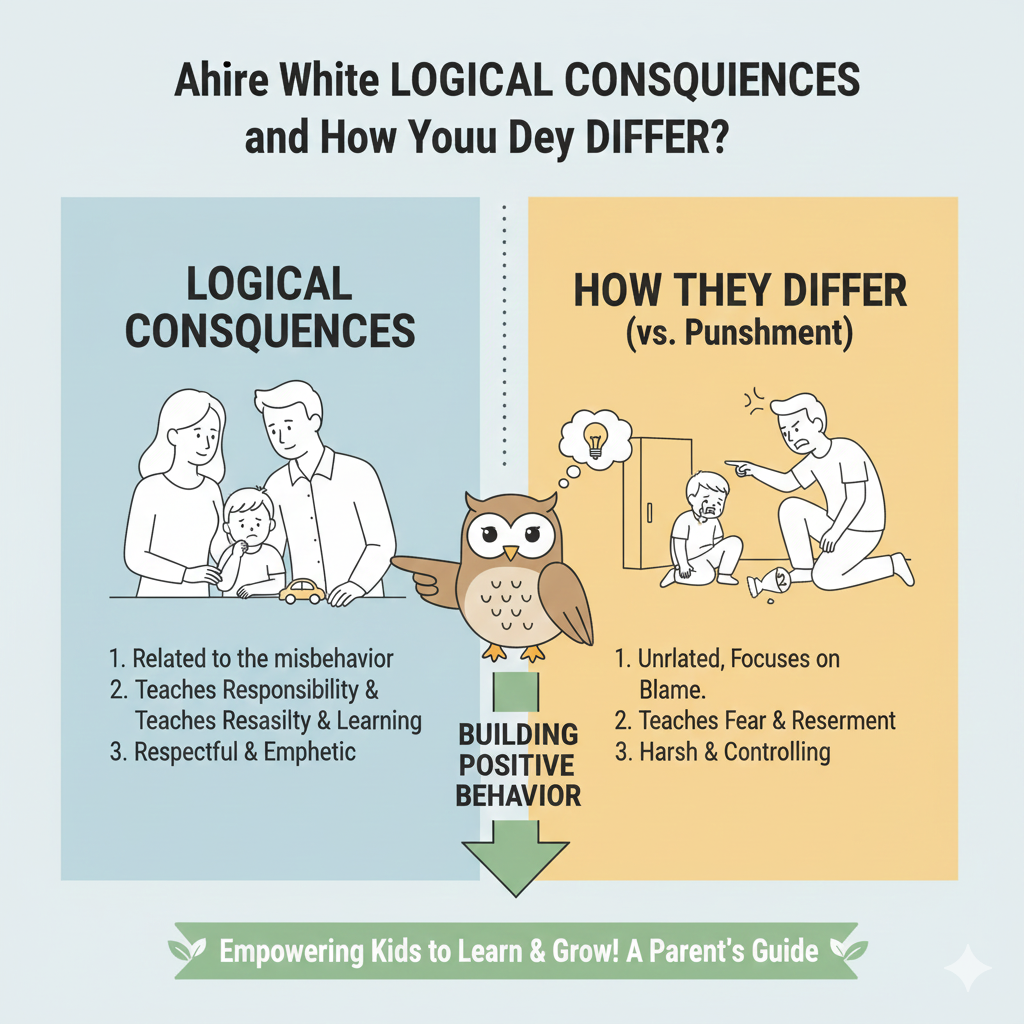
The key distinction is relevance. Logical consequences relate directly to what happened, teaching children about the specific impact of their choices. Punishment, by contrast, often has no connection to the misbehavior. Taking away screen time because a child lied doesn’t teach truth-telling—it only teaches to avoid getting caught.
Logical consequences require more planning and creativity than punishment but produce far better long-term outcomes. They preserve dignity, maintain relationships, and teach problem-solving rather than compliance through fear.
The Psychology Behind Consequence-Based Parenting
Consequence-based parenting aligns with how humans naturally learn. From infancy, we learn through trial and error, experiencing the results of our actions and adjusting behavior accordingly. This experiential learning creates deeper understanding than verbal instruction alone.
When children experience consequences rather than punishment, several psychological processes occur. First, they maintain agency—they made a choice that led to an outcome, rather than having something arbitrary done to them. This sense of control is crucial for developing intrinsic motivation and personal responsibility.
Second, consequences engage cognitive processes that punishment bypasses. Children must think about cause and effect, consider alternative choices, and problem-solve for the future. Punishment often just triggers fear and avoidance without deeper processing.
Third, consequence-based approaches preserve self-esteem. The message is “you made a poor choice” rather than “you are bad.” This distinction is fundamental for healthy identity development. Children learn to separate their worth from their behavior, understanding that mistakes are opportunities for growth.
Brain research supports this approach. When children learn through consequences rather than punishment, the hippocampus and prefrontal cortex remain engaged, supporting memory formation and executive function. Harsh punishment activates the amygdala, the brain’s fear center, which actually impairs learning and decision-making.
When to Use Natural Consequences for Child Behavior
Natural consequences work best in specific situations where safety isn’t compromised and the lesson is age-appropriate. Knowing when to step back and allow natural consequences requires judgment and confidence.
Ideal situations for natural consequences include:
Minor discomforts that teach without causing harm—forgetting a snack and feeling hungry until the next meal, refusing a jacket and feeling chilly, not practicing an instrument and performing poorly at a lesson.
Social situations where peer feedback provides the lesson—being bossy and having friends not want to play, not sharing and experiencing others’ reluctance to share in return, interrupting constantly and being ignored.
Responsibility lapses with clear, immediate results—not setting an alarm and oversleeping, leaving homework at home and facing teacher consequences, spending allowance impulsively and having no money for desired items.
Personal care choices—not bathing and feeling uncomfortable, wearing mismatched clothes and noticing others’ reactions, skipping breakfast and feeling hungry during morning activities.
The key question is: “Will this consequence teach the lesson without causing significant harm?” If yes, natural consequences are your best tool. They require the least parental energy while providing the most powerful learning.
However, never allow natural consequences when safety is at stake. A child who refuses to hold your hand in a parking lot doesn’t get to experience the natural consequence of being hit by a car. Similarly, consequences that are too delayed or too severe require parental intervention.
Implementing Logical Consequences That Teach Responsibility
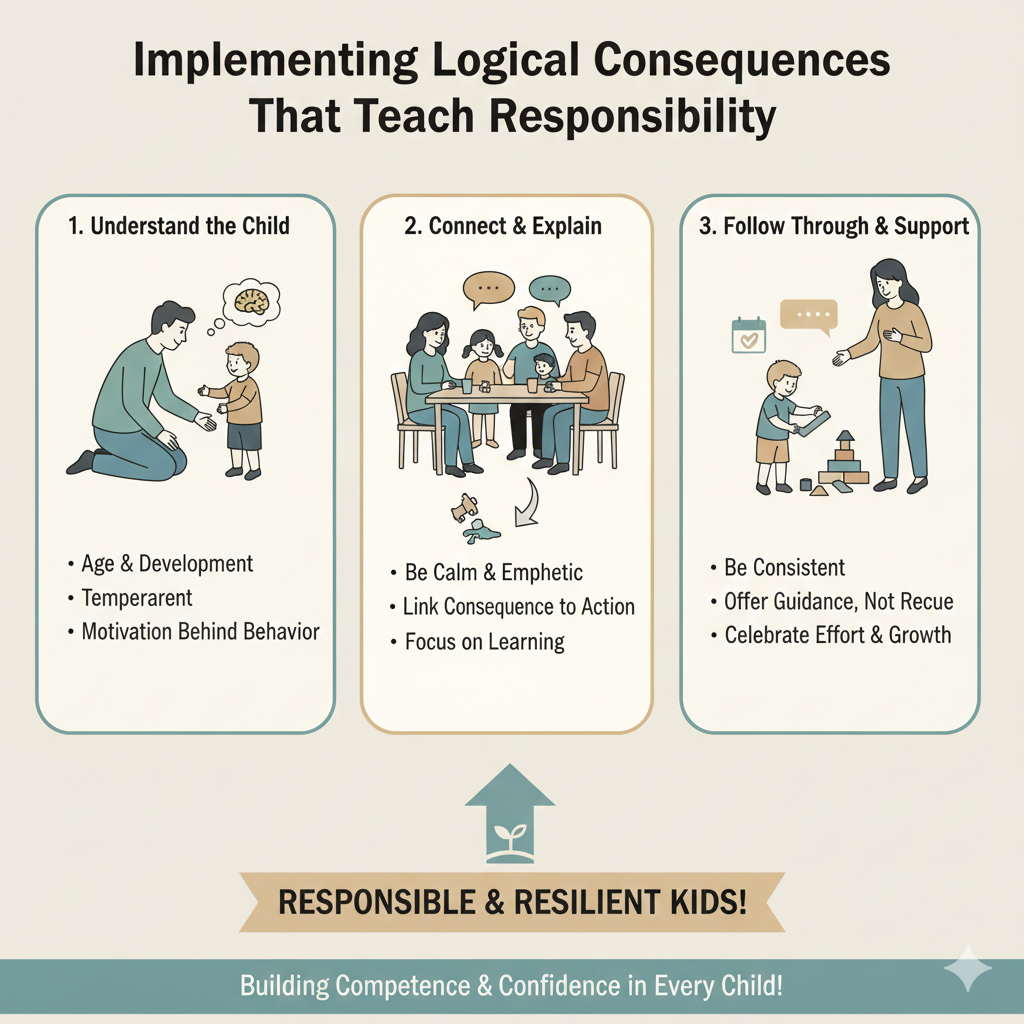
Logical consequences require more thought and creativity than natural ones, but they’re essential when natural consequences aren’t available or appropriate. Effective implementation follows specific principles.
The three Rs of logical consequences: They must be Related to the misbehavior, Respectful in delivery, and Reasonable in severity. A consequence that meets all three criteria teaches effectively while preserving the relationship.
Related: The consequence connects directly to what happened. If a child writes on walls, they clean the walls. If they miss curfew, they lose going-out privileges temporarily. The connection helps children understand cause and effect specific to their behavior.
Respectful: Deliver consequences calmly, without shaming or lecturing. “I see you drew on the wall. Here are cleaning supplies. Let me know when it’s clean” is respectful. “How could you be so stupid? You’ve ruined our house!” is not. The former teaches; the latter damages.
Reasonable: The consequence should fit the severity of the misbehavior. A child who forgets to feed the dog once doesn’t lose pet privileges for a month. Disproportionate consequences feel like punishment and breed resentment rather than learning.
Implementation steps:
First, establish clear expectations in advance. Children should know what’s expected and what will happen if expectations aren’t met. Surprises feel like punishment.
Second, follow through consistently but calmly. State the consequence matter-of-factly: “You chose not to put your toys away, so they’ll be unavailable tomorrow.” No anger, no lectures, just natural follow-through.
Third, avoid rescuing. When children experience the consequence, resist the urge to fix it for them. This is where learning happens. Empathy is appropriate; rescuing is not.
Fourth, allow repair and restoration. After the consequence, move forward. Hold no grudges. This teaches that mistakes are learning opportunities, not permanent failures.
Avoiding Punishment Disguised as Consequences
Many parents believe they’re using logical consequences when they’re actually implementing punishment with better vocabulary. Understanding the distinction prevents this common mistake.
Red flags that indicate punishment rather than consequence:
Humiliation or shaming: If the response is designed to make the child feel bad about themselves rather than learn from their choice, it’s punishment. “Everyone will see what a slob you are” versus “Your messy room means you lose the privilege of having friends over until it’s clean.”
Disproportionate severity: When the response far exceeds the seriousness of the misbehavior, it’s punitive. Missing one homework assignment doesn’t warrant losing all electronics for a month.
No logical connection: If you have to explain why the consequence makes sense, it probably doesn’t. “You lied so no dessert for a week” has no connection. “You lied about where you were, so I can’t trust you to go out alone for a while” connects directly.
Anger or vindictiveness: Consequences delivered in anger or with “I told you so” energy are punishment. The tone and delivery matter as much as the content.
Removal of love or connection: Anything that withdraws affection, ignores the child, or threatens abandonment is punishment, not consequence. “I don’t want to be around you right now” is different from “I need a few minutes to calm down.”
True consequences focus on learning and growth. They maintain dignity and connection while allowing children to experience the results of their choices. If your approach focuses on making the child suffer, it’s punishment regardless of what you call it.
Age-Appropriate Consequences for Different Developmental Stages
Effective consequences must match developmental capabilities. What works for a teenager is inappropriate for a toddler, and vice versa.
Toddlers (1-3 years): Natural consequences work best when immediate and safe. They can’t understand delayed consequences or complex logical connections. Simple redirection often works better than formal consequences. When they throw food, mealtime ends. When they hit, play stops briefly.
Preschoolers (3-5 years): They begin understanding cause and effect with simple logical consequences. Time frames must be short—hours, not days. “If you don’t pick up these blocks, they go away until tomorrow” is comprehensible. “No TV for a week” is too abstract.
Early Elementary (6-8 years): They handle more complex logical consequences and can understand delayed results. Natural consequences become powerful teachers. Social consequences (how behavior affects friendships) register strongly at this age.
Late Elementary (9-12 years): They can participate in determining appropriate consequences and learn from both natural and logical outcomes. Responsibility-based consequences work well: “You demonstrated you’re not ready for this freedom, so we’ll try again in two weeks.”
Teenagers (13-18 years): Natural consequences should dominate when safe. They need to learn from real-world results. Logical consequences should relate to lost trust or safety concerns. Collaborative problem-solving is most effective: “This choice showed poor judgment. What consequences make sense?”
The general principle: younger children need immediate, simple consequences; older children benefit from delayed, complex ones that mirror adult reality.
Building Problem-Solving Skills Through Effective Discipline
The ultimate goal of consequences isn’t punishment but skill-building. Every consequence should be an opportunity for children to develop problem-solving abilities and personal responsibility.
After a consequence has been experienced, engage in reflective conversation. “What happened? What were you trying to accomplish? What actually resulted? What might work better next time?” These questions activate critical thinking and help children internalize lessons.
Encourage children to generate solutions. Instead of telling them what to do differently, ask “What could you do instead next time?” This develops agency and creative problem-solving. Even young children can participate: “What’s another way to tell your sister you’re angry besides hitting?”
Frame mistakes as data. “This didn’t work out the way you hoped. What did you learn?” This approach destigmatizes failure and positions it as a natural part of learning. Children who see mistakes as information rather than evidence of inadequacy become more resilient.
Teach the decision-making process explicitly. Before choices that typically lead to consequences, walk through the thinking: “What are your options? What might happen with each choice? Which outcome do you prefer?” This builds the internal dialogue children need for good decision-making.
Connect today’s consequences to future competence. “Learning to manage your money now helps you be successful when you’re an adult.” This long-term perspective helps children understand that boundaries and consequences serve their development, not parental convenience.
How to Explain Consequences Without Lecturing
Parents often undermine effective consequences by over-explaining, lecturing, or showing anger. Learning to communicate consequences effectively is crucial for their success.
Keep it brief. The most powerful statements about consequences are short. “You chose not to clean your room. No friends over this weekend.” Then stop talking. Lengthy explanations dilute the message and invite argument.
Use neutral tone. State consequences as facts, not judgments. “The natural result of not eating lunch is feeling hungry” not “You never listen! Now you’ll suffer!” Emotion shifts focus from the lesson to the relationship conflict.
Avoid “I told you so.” This phrase and its equivalents add nothing educational and create resentment. The consequence itself is the lesson; rubbing it in is counterproductive.
Show empathy without rescuing. “I know you’re disappointed you can’t play with your toys today” acknowledges feelings. “But I suppose I could let you have them back early” rescues them from the lesson. Empathy plus follow-through is the sweet spot.
Connect behavior to consequence clearly but briefly. “When you [behavior], the result is [consequence]” is sufficient. “When you chose to keep playing video games instead of doing homework, you lost tomorrow’s game time.”
Don’t require apologies in the moment. Forcing apologies during consequence delivery creates resistance. Allow children to process the experience first. Genuine apologies often come later, after reflection.
Resist re-explaining repeatedly. If a child asks “Why?” after you’ve explained once, respond simply: “I’ve explained this. The decision is final.” Don’t engage in endless negotiations.
Natural Consequences That Keep Children Safe
Safety always trumps learning through experience. However, many parents intervene too quickly, preventing safe natural consequences that would teach important lessons.
The safety evaluation: Before allowing a natural consequence, ask: “Could this result in serious injury, death, or irreversible harm?” If yes, intervene. If no, consider allowing it.
Safe natural consequences include:
Minor physical discomfort—feeling cold, tired, hungry (when not medically concerning), or uncomfortable in ill-fitting clothes.
Social difficulties—losing friendships due to unkind behavior, peer rejection for being bossy, social awkwardness from poor hygiene.
Academic struggles—lower grades from poor study habits, missing recess for incomplete work, embarrassment from forgetting assignments.
Minor property loss—toys breaking from rough play, money gone from impulsive spending, belongings lost from carelessness.
Temporary inconvenience—missing activities due to lateness, boredom from breaking electronics, disappointment from poor planning.
Unsafe consequences requiring intervention:
Physical danger—running into traffic, touching hot stoves, playing with dangerous objects, risky behavior with potential for serious injury.
Legal consequences—anything that could result in criminal charges or permanent records.
Permanent damage—missing crucial medical care, situations affecting long-term health or development, choices with lifelong implications.
Severe psychological harm—bullying situations, abusive relationships, situations that could traumatize.
The key is distinguishing between discomfort that teaches and danger that harms. Children need to experience the former to develop good judgment for avoiding the latter.
Logical Consequences for Technology and Screen Time Issues
Screen time battles represent one of modern parenting’s most challenging areas. Logical consequences provide a framework for managing technology use without constant conflict.
Establish clear expectations first. “Screen time is one hour on school days, available after homework and chores are complete.” Clarity prevents disagreements about what the rule actually is.
Related consequences for technology misuse:
Exceeding time limits: Device becomes unavailable for the same amount of time they exceeded. If they played 30 extra minutes, they lose 30 minutes tomorrow.
Using devices during restricted times: Loss of device for that time period for several days. If they sneak their phone at night, phones get turned in at bedtime for the next week.
Accessing inappropriate content: Increased monitoring or loss of privacy settings until trust is rebuilt. The logical connection is “you demonstrated you need more supervision.”
Ignoring requests to disengage: Immediate loss of device for the rest of the day. The consequence relates directly to the inability to self-regulate.
Damaging devices through carelessness: They contribute financially to repair or work to earn money for replacement. They experience the cost of carelessness.
Using technology to hurt others: Device loss until they demonstrate understanding of digital citizenship and make appropriate amends.
Natural consequences for technology:
Sleep deprivation from late-night screen use leads to exhaustion and poor performance. Allow them to experience this (within reason) rather than constantly enforcing bedtime.
Missing social opportunities because they’re always on devices. When they complain of boredom or loneliness, point out the natural connection.
Poor grades resulting from choosing games over study. The academic consequences teach more powerfully than parental nagging.
The goal is teaching self-regulation, not just rule-following. “I want you to develop the ability to manage your own screen time. These limits and consequences are helping you build that skill.”
Teaching Accountability Through Consequence-Based Discipline
Accountability—taking ownership of choices and their results—is a cornerstone of character. Consequence-based discipline naturally develops this crucial trait.
Distinguish between reasons and excuses. Children need to understand that reasons explain behavior but don’t eliminate accountability. “I understand you hit your brother because you were angry. You’re still accountable for your choice to hit. What needs to happen now?”
Focus on repair, not just restriction. Effective consequences often include making amends. “You broke your sister’s toy in anger. What can you do to make this right?” This teaches that accountability includes restoration.
Avoid rescuing from consequences. When parents consistently save children from experiencing results of poor choices, they prevent accountability from developing. The child who forgets lunch repeatedly learns nothing if parents always deliver forgotten items.
Connect privileges to responsibility. “The privilege of staying up later depends on you getting up on time in the morning. If you can’t wake up, the later bedtime isn’t working.” This teaches that freedom requires responsible use.
Allow age-appropriate failure. Middle and high schoolers especially need to experience academic and social consequences of their choices. A failed test or lost friendship, while painful, teaches accountability more effectively than parental intervention.
Discuss the concept explicitly. “In our family, we take responsibility for our choices. When we make mistakes, we make them right. That’s what being accountable means.” Name the value you’re teaching.
Model accountability. When you make mistakes, acknowledge them and make amends. “I spoke harshly to you earlier. That was wrong. I apologize.” Children learn more from what you do than what you say.
Common Mistakes Parents Make With Consequences
Even well-intentioned parents frequently make errors that undermine the effectiveness of consequence-based discipline. Avoiding these pitfalls increases success.
Warning repeatedly without following through: Each warning teaches children to ignore your words. State the expectation once, remind once if age-appropriate, then implement the consequence. “If you choose to continue, here’s what happens” followed by action.
Implementing consequences in anger: When emotional, parents often choose disproportionate consequences they later regret or can’t maintain. Pause, calm down, then decide on an appropriate response.
Negotiating after the fact: Once you’ve stated a consequence, don’t bargain or reduce it because of pleading. This teaches that persistence pays off and undermines all future boundaries.
Making consequences too distant: Young children especially need immediate connections between behavior and consequence. “No TV next week” is too far away for a five-year-old to connect with today’s behavior.
Turning consequences into punishment through tone: The words might be logical consequence, but if delivered with contempt, sarcasm, or “I told you so” energy, it becomes punishment.
Failing to distinguish between accident and choice: Spilling milk accidentally doesn’t require consequence beyond cleaning it up. Throwing milk in anger does. Respond to intention, not just outcome.
Rescuing too quickly: Seeing children struggle is uncomfortable, but swooping in to prevent natural consequences robs them of learning opportunities.
Piling on consequences: One consequence per incident. Multiple punishments for the same behavior feels overwhelming and vindictive rather than educational.
When Consequences Aren’t Working: Troubleshooting Guide
Sometimes despite best efforts, consequences don’t produce the desired behavior change. When this happens, systematic troubleshooting helps identify the problem.
Is the consequence truly related to the behavior? If you can’t clearly explain the logical connection, the child likely can’t see it either. Strengthen the relevance.
Is it proportionate? Overly harsh consequences breed resentment; too lenient consequences teach that misbehavior has minimal costs. Adjust to find the right balance.
Are you following through consistently? Intermittent enforcement is worse than no consequences at all. It creates the strongest resistance to change. Increase consistency before assuming the consequence itself isn’t working.
Is the behavior serving a hidden need? Sometimes misbehavior meets an underlying need—attention, power, belonging, or skill deficiency. Address the need rather than just responding to behavior.
Is the consequence delayed too long? The shorter the time between behavior and consequence, the stronger the learning. Make consequences more immediate if possible.
Is the child developmentally capable of connecting action and outcome? Very young children or those with certain developmental differences may not yet have the cognitive capacity for some consequences to work. Adjust expectations.
Are you providing enough positive attention for good behavior? If children only get attention when they misbehave, consequences won’t reduce misbehavior because it’s meeting their need for connection.
Is there a power struggle? Sometimes the issue isn’t the consequence but the relationship dynamic. If everything becomes a battle, work on connection before focusing on correction.
Do you need professional support? Persistent behavioral challenges despite consistent, appropriate consequences may indicate deeper issues requiring professional assessment.
Combining Natural and Logical Consequences for Maximum Learning
The most effective discipline systems use both natural and logical consequences strategically. Understanding when to use each creates a comprehensive approach.
Default to natural consequences when available. They require the least parental energy and provide the most powerful learning. Only intervene when safety, timing, or severity requires it.
Use logical consequences when natural ones aren’t available, appropriate, or sufficient. Some situations simply don’t have natural consequences that work. A child who steals won’t naturally experience legal consequences in the moment, so logical ones fill the gap.
Layer them when both are possible. Sometimes natural and logical consequences work together. A teen who damages a car through reckless driving experiences both the natural consequence of car unavailability during repair and the logical consequence of losing driving privileges.
Adjust based on whether the behavior is new or repeated. First-time mistakes might only need natural consequences and discussion. Repeated patterns require more structured logical consequences.
Consider the child’s age and development. Younger children rely more on immediate natural consequences. Older children can handle complex logical consequences that teach long-term thinking.
Match consequence type to the lesson needed. Want to teach practical cause-and-effect? Natural consequences excel. Need to teach about social rules and expectations? Logical consequences often work better.
Example sequence: A child forgets their lunch. Natural consequence: They’re hungry until snack time (if this won’t cause harm). Logical consequence: They pack their own lunch the next day with supervision, learning the process. If it continues: They lose the privilege of buying school lunch and must pack at home, connecting responsibility to privilege.
The Role of Empathy in Consequence-Based Parenting
Consequences work best when delivered with empathy. This combination teaches accountability while preserving emotional connection and dignity.
Empathy means acknowledging feelings without rescuing. “I know you’re really disappointed you can’t go to the party” validates emotion. Adding “but you chose to break curfew” maintains the boundary. Following with “What can you learn from this for next time?” moves toward growth.
The empathy statement formula: “I understand you feel [emotion] about [consequence]. And the consequence remains because [brief reason].”
Why empathy matters: Children who feel understood are more likely to learn from consequences. When they feel shamed or attacked, they focus on defending themselves rather than reflecting on their choices.
Empathy prevents power struggles. When you acknowledge a child’s perspective, even while maintaining boundaries, you reduce the emotional charge that fuels defiance. “I get that you think this rule is unfair” doesn’t mean changing the rule, but recognition reduces the battle.
Empathy models emotional intelligence. When parents show empathy during difficult moments, children learn to recognize and process their own emotions and show empathy to others.
Timing matters. Sometimes children need to calm down before they can hear empathy. “I can see you’re very upset. I’m here when you’re ready to talk” gives space while maintaining connection.
Empathy includes acknowledging your own feelings appropriately. “I feel worried when you lie to me because I need to know I can trust you” helps children understand the impact of their choices on relationships without shame.
Empathy and consequences aren’t opposites—they’re partners. Together they create the optimal conditions for learning, growth, and maintaining strong relationships through challenging moments.
Conclusion: Creating a Comprehensive Consequence-Based Discipline Strategy
Natural and logical consequences provide powerful alternatives to punishment that teach responsibility, build problem-solving skills, and preserve parent-child relationships. Understanding when and how to use each type creates a discipline approach that promotes genuine learning rather than mere compliance.
The key principles to remember: consequences should be related to the behavior, delivered respectfully, and proportionate to the situation. They should teach rather than punish, connect directly to the misbehavior, and occur as naturally and immediately as possible.
Start by defaulting to natural consequences when safe and appropriate. Add logical consequences when needed, ensuring they meet the three Rs: related, respectful, and reasonable. Avoid disguising punishment as consequences by checking your intention—is the goal learning or suffering?
Adjust your approach based on your child’s age and developmental stage. Combine consequences with empathy to maintain connection while enforcing boundaries. Use mistakes as teaching opportunities, engaging children in problem-solving and reflection.
Most importantly, remember that the goal isn’t perfect behavior but character development. Consequences are tools for teaching, not weapons for controlling. When children learn through experiencing the results of their choices, they develop the internal guidance system that serves them throughout life.
By choosing natural and logical consequences over punishment, you invest in your child’s long-term development, teaching them to think critically, take responsibility, and make better choices—not because they fear punishment, but because they understand cause and effect and want to make good decisions. That’s the foundation of genuine character and lifelong success.