
Sibling rivalry is one of parenting’s most exhausting challenges, yet it’s nearly universal. The constant fighting, tattling, and competition can leave parents feeling frustrated and helpless. However, understanding the root causes of sibling conflict and implementing proven conflict resolution strategies can transform relationships and create lasting peace in your home. This comprehensive guide provides evidence-based approaches to reduce sibling rivalry and teach children essential skills for peaceful coexistence.
Understanding the Root Causes of Sibling Rivalry
Sibling rivalry isn’t simply about children being difficult—it stems from legitimate developmental needs and family dynamics. Understanding these underlying causes is the first step toward effective intervention.
Competition for parental attention drives much sibling conflict. Children possess a biological imperative to secure parental resources and attention for survival. When siblings perceive that attention is limited or unequally distributed, rivalry intensifies. This isn’t manipulation—it’s a deeply wired survival instinct.
Developmental stages and capabilities create natural friction. A toddler doesn’t understand why they can’t play with their older sibling’s delicate models. A teenager resents supervising younger siblings. These developmental mismatches generate frustration on both sides.
Individual temperaments and personalities clash in any relationship, and siblings are no exception. An introverted child who values solitude may struggle with an extroverted sibling who craves constant interaction. A methodical, cautious child may conflict with an impulsive, adventurous one.
Fairness concerns dominate children’s thinking. They’re hypervigilant about equal treatment, often keeping mental scorecards of perceived injustices. This focus on fairness, while developmentally normal, fuels rivalry when children believe parents favor a sibling.
Limited resources including physical space, toys, parental time, and attention create zero-sum thinking. When children believe they must compete for finite resources, rivalry becomes strategic rather than merely emotional.
Research in family systems theory shows that sibling relationships don’t exist in isolation—they’re influenced by parent-child relationships, marital dynamics, external stressors, and family culture. Addressing rivalry requires examining the entire family ecosystem.
The Psychology Behind Brother and Sister Fighting
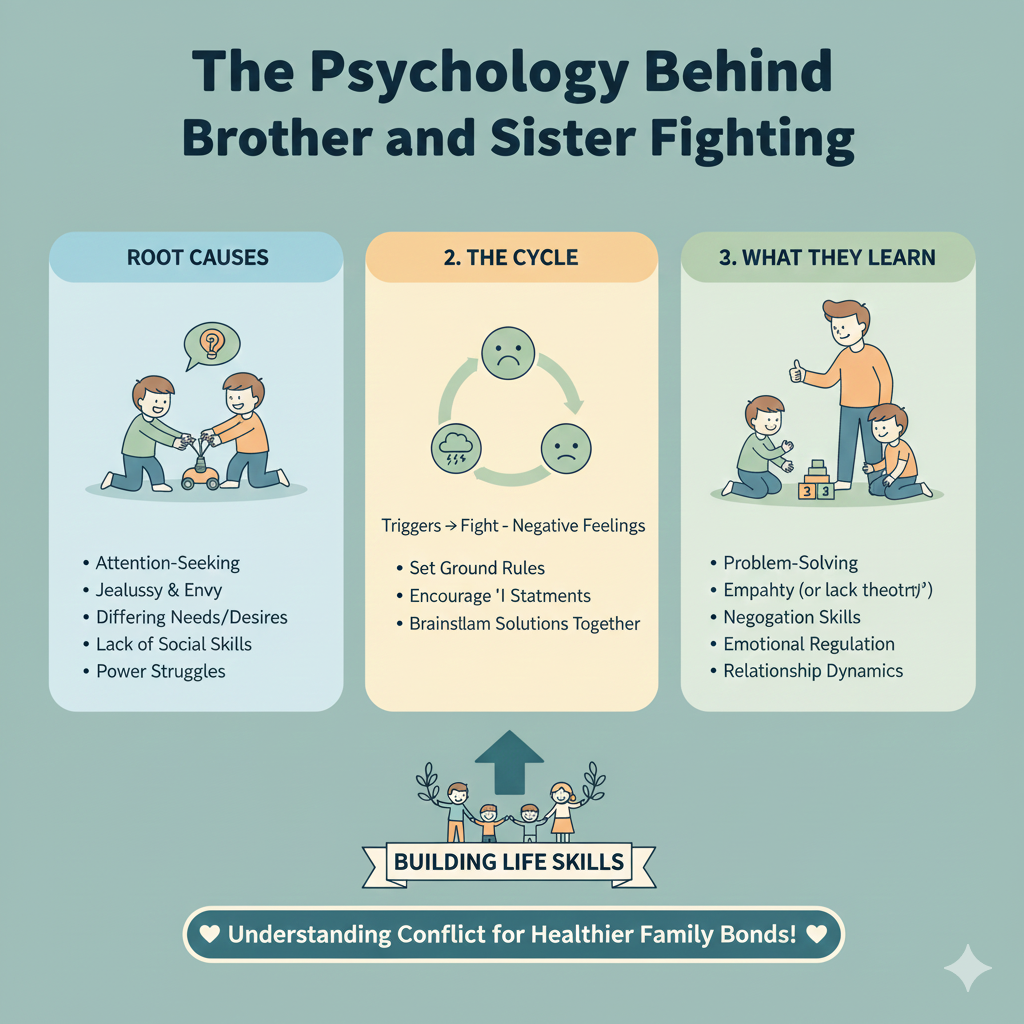
Understanding why siblings fight helps parents respond effectively rather than reactively. Conflict serves multiple psychological functions in children’s development.
Power and control dynamics play out through sibling interactions. Children who feel powerless in other areas of life may seek control through conflicts with siblings. The child who struggles academically might dominate physically. The younger sibling uses crying to wield emotional power.
Identity formation and differentiation require siblings to establish themselves as unique individuals. Fighting can be a way of declaring “I’m different from you.” This explains why siblings often choose opposite interests, styles, or friend groups—differentiation reduces direct competition.
Emotional regulation practice happens through sibling conflict. Brothers and sisters provide a relatively safe environment to experience anger, jealousy, frustration, and reconciliation. These conflicts, while difficult, teach emotional management skills.
Social skills laboratory describes the sibling relationship. Children learn negotiation, compromise, perspective-taking, and conflict resolution through interactions with siblings. Research shows that children with siblings often develop superior social cognition compared to only children.
Displacement of other frustrations means siblings sometimes fight about surface issues when they’re actually upset about something else—school stress, friendship problems, or parental conflict. The sibling becomes a safe target for unexpressed emotions.
Neuroscience research reveals that sibling conflict activates the same brain regions involved in threat detection and emotional processing as other interpersonal conflicts. However, the prefrontal cortex—responsible for impulse control and rational thinking—is still developing throughout childhood and adolescence, explaining why conflicts escalate quickly.
How Birth Order Affects Sibling Relationships
Birth order significantly influences sibling dynamics, though it’s not destiny. Understanding these patterns helps parents address rivalry more effectively.
Firstborn children often feel dethroned when siblings arrive. They experienced exclusive parental attention and may perceive siblings as threats. Firstborns typically receive more pressure to achieve and behave maturely, creating resentment toward siblings who seem to “get away with everything.” However, they also enjoy privileges of age and often develop leadership qualities.
Middle children frequently report feeling overlooked—lacking both the firstborn’s privileges and the youngest’s indulgence. This perceived invisibility can fuel rivalry as middle children compete for recognition. They often become skilled negotiators and peacemakers, learning to navigate between siblings.
Youngest children may face fewer expectations and more lenient treatment, which older siblings resent. However, they also struggle with never being the biggest, fastest, or most capable, potentially driving intense competition to prove themselves. Birth order research, while sometimes overgeneralized, identifies consistent patterns.
Gender combinations matter too. Same-gender siblings often compete more intensely, particularly during certain developmental stages, as they occupy similar family niches. Different-gender siblings may differentiate more easily but can struggle with understanding each other’s experiences.
Age spacing dramatically impacts rivalry. Siblings close in age (under three years apart) often experience more competition but may become closer friends long-term. Wider spacing reduces competition but can limit shared interests and connection.
Understanding your children’s birth order dynamics helps you avoid inadvertently reinforcing unhelpful patterns while leveraging the strengths each position brings.
Common Parenting Mistakes That Fuel Sibling Conflict
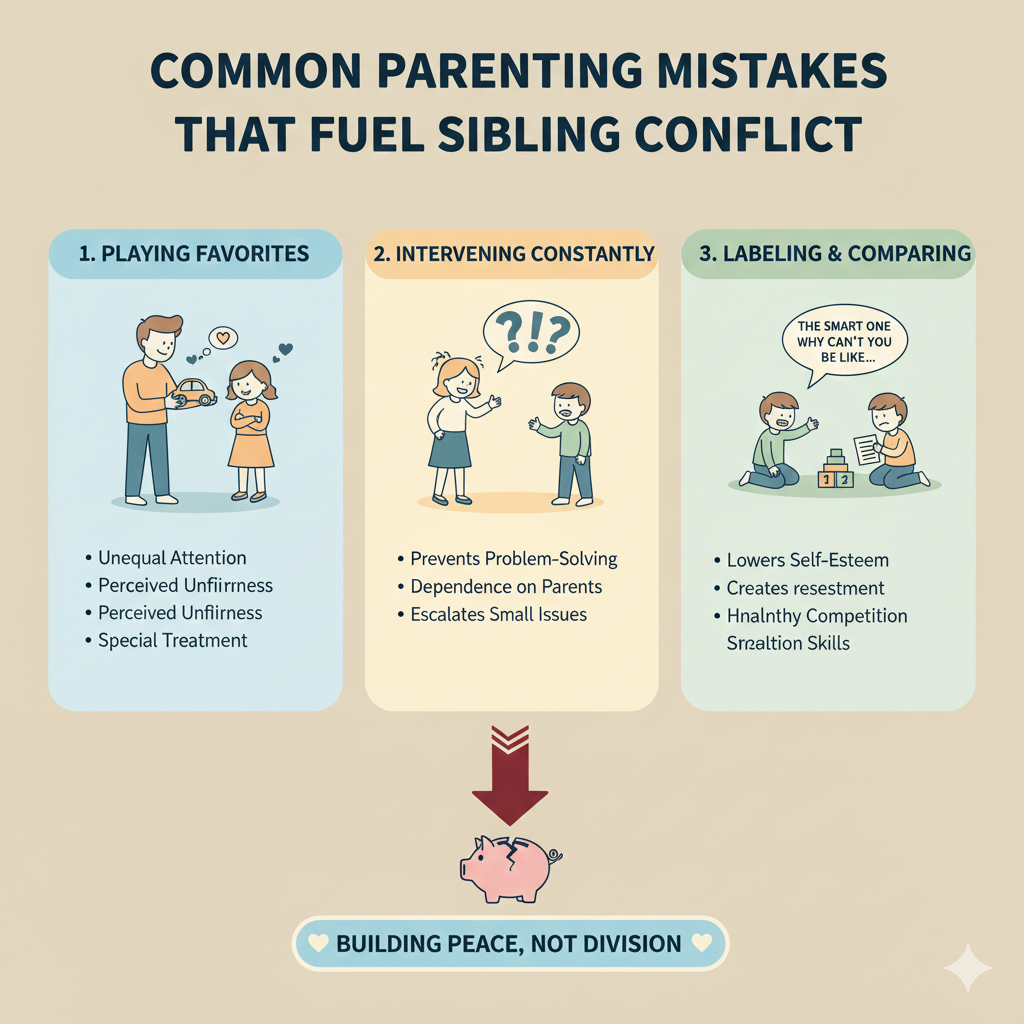
Well-intentioned parents often unknowingly intensify sibling rivalry through common mistakes. Recognizing these patterns is crucial for change.
Comparing siblings is perhaps the most damaging error. “Why can’t you be more like your brother?” creates toxic competition and resentment. Even positive comparisons (“You’re so much better at math than your sister”) establish hierarchy and judgment.
Forcing equal treatment backfires because children have different needs. Fairness doesn’t mean identical treatment—it means each child receives what they need. Insisting everything be exactly equal teaches children to focus on scorekeeping rather than appreciating individual treatment.
Taking sides consistently in conflicts creates perceived favorites. Even if one child is truly at fault more often, always blaming the same child breeds resentment in both siblings—the blamed child feels victimized; the defended child learns manipulation.
Expecting older siblings to constantly accommodate younger ones breeds resentment. “You’re older, so you should know better” places unfair burden on firstborns, who are also children with developing self-regulation.
Ignoring positive interactions while only intervening during fights teaches children that conflict gets attention. When siblings play nicely and parents don’t notice, but fighting immediately summons parental involvement, conflict becomes an attention-seeking strategy.
Creating win-lose scenarios where one child’s gain is another’s loss intensifies rivalry. “Only one of you can come with me” or “Whoever finishes first gets a treat” structures competition into family life.
Dismissing feelings with statements like “You love your brother” when a child expresses anger invalidates genuine emotions and prevents children from learning to process difficult feelings.
Not protecting personal property or space communicates that boundaries don’t matter. When younger siblings destroy older children’s belongings without consequences, resentment accumulates.
Teaching Conflict Resolution Skills to Children
Conflict resolution is a learned skill, not an innate ability. Systematically teaching these skills transforms sibling relationships and provides lifelong tools.
The STOP Method for Heated Moments:
S – Stop the action: Teach children to pause when emotions escalate. This might mean taking deep breaths, stepping away, or using a calm-down strategy. Model this yourself during conflicts.
T – Tell how you feel: Use “I feel” statements rather than accusations. “I feel angry when you take my things without asking” differs from “You’re always stealing my stuff.” Practice this language regularly.
O – Offer solutions: Brainstorm possible solutions together. Even young children can generate ideas. The goal isn’t perfect solutions but practice in creative problem-solving.
P – Pick a solution together: Agree on an approach that respects both perspectives. This teaches compromise and mutual respect.
Active listening skills must be explicitly taught. Demonstrate: “So you’re upset because you felt your sister excluded you on purpose. Do I understand correctly?” Then have children practice reflecting each other’s feelings before responding.
Negotiation basics including stating needs clearly, understanding the other person’s perspective, finding common ground, and compromising when necessary. Role-play scenarios: “You both want to choose the movie. How can you solve this?”
Emotional vocabulary allows children to express feelings beyond “mad” or “sad.” Teach words like frustrated, disappointed, excluded, jealous, overwhelmed. Richer vocabulary enables more precise communication.
Perspective-taking exercises build empathy. “How do you think your brother felt when that happened?” Initially children struggle with this, but consistent practice develops this crucial skill.
Problem-solving framework: (1) Identify the problem clearly, (2) Generate multiple solutions, (3) Evaluate each option’s consequences, (4) Choose and implement a solution, (5) Evaluate results. Use this for sibling conflicts and other family decisions.
Practice these skills during calm moments, not just during conflicts. Family meetings, dinnertime discussions, and planned activities provide low-stakes opportunities to build conflict resolution muscles.
The Fair vs. Equal Parenting Approach
One of parents’ biggest challenges is navigating fairness concerns without treating children identically. Understanding this distinction reduces rivalry.
Equal treatment means everyone gets the same thing—same bedtime, same allowance, same screen time. This appeals to children’s desire for sameness but ignores individual needs and developmental stages.
Fair treatment means each child receives what they need, even when that looks different. A teenager needs a later bedtime than a first-grader. A child struggling academically needs more homework help. A shy child needs encouragement to socialize while an extroverted child needs help with boundaries.
Explaining fairness to children: “Fair doesn’t mean everyone gets the exact same thing. Fair means everyone gets what they need. Your brother needs a booster seat in the car because he’s smaller. You need more time for homework because your work is harder. Both are fair because they’re what each of you needs.”
Individual time and attention matter more than identical treatment. Fifteen minutes of focused, individual attention with each child holds more value than equal but divided attention. Quality trumps quantity in meeting children’s need to feel special.
Celebrating differences rather than enforcing sameness reduces comparison. “In our family, we appreciate what makes each person unique” establishes a culture where different isn’t threatening.
Age-appropriate privileges tied to developmental readiness teach children that growing up brings benefits. “When you reach middle school, you’ll also get a later bedtime” gives younger children something to anticipate rather than resent.
Transparent decision-making helps children understand differential treatment. Explaining why you made a decision—”Your sister gets to go to the party because she’s older and has earned that privilege through responsible behavior”—reduces perceptions of favoritism.
When children complain about unequal treatment, resist the urge to defend or justify extensively. Simple acknowledgment works: “I hear that you wish you had the same bedtime as your brother. When you’re his age, we’ll reconsider your bedtime too.”
Creating Individual Parent-Child Bonding Time
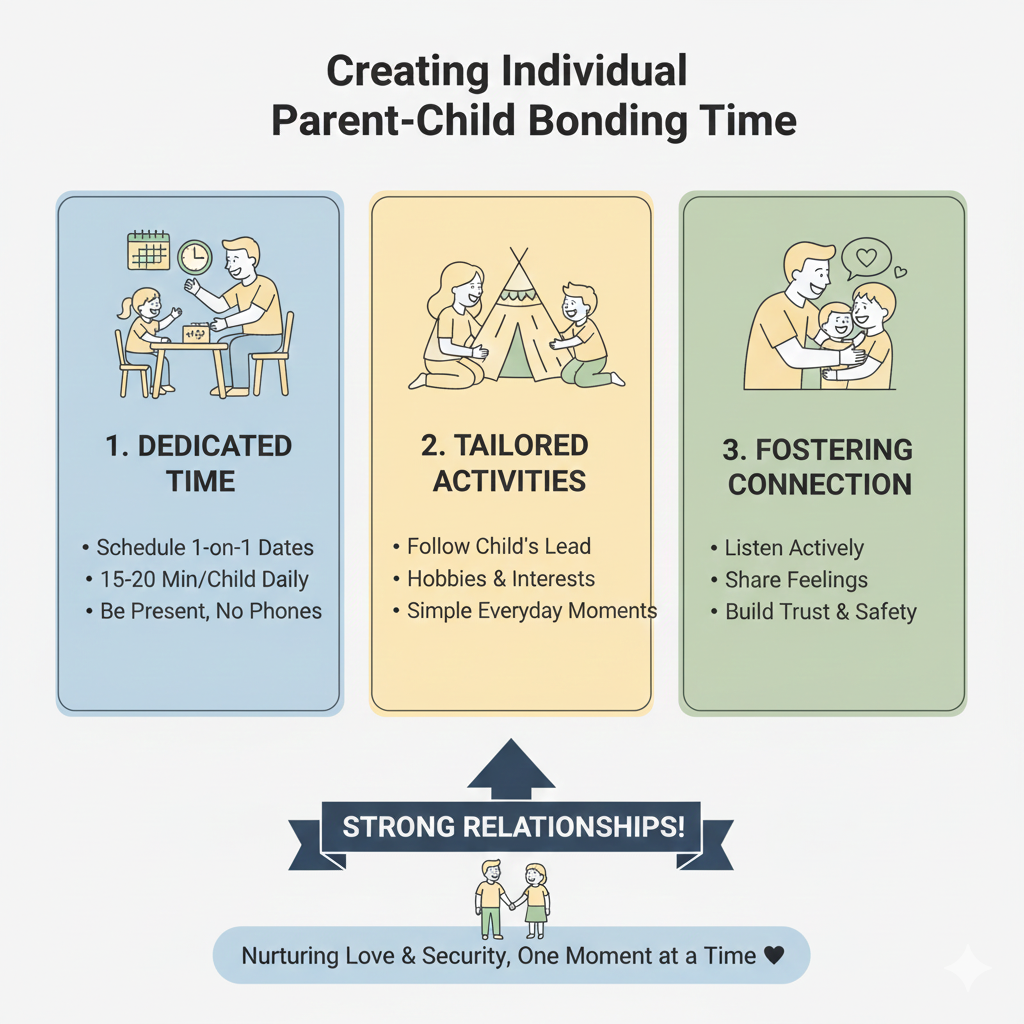
Individual attention is perhaps the most powerful tool for reducing sibling rivalry. When children feel securely connected to parents, competition for attention decreases dramatically.
The magic of one-on-one time: Research consistently shows that regular individual time with each parent reduces behavioral problems, including sibling conflict. Even 15-30 minutes of focused, uninterrupted time weekly makes measurable differences.
Quality markers for individual time:
Phone away, distractions minimized—children notice when you’re physically present but mentally elsewhere. True presence communicates value.
Child-directed activity—let them choose what you do together. The activity matters less than the focused attention and the message “you’re worth my time.”
Positive interaction—this isn’t time for correction or instruction. It’s time for connection, play, and enjoyment. Save teaching moments for other times.
Implementing regular dates: Schedule recurring individual time just like any important appointment. “Every Tuesday evening is my time with you” provides security and something to anticipate. Consistency matters more than duration.
Involving both parents: When possible, each parent should have individual time with each child. This prevents one parent becoming “the fun one” while the other handles all discipline, and ensures all relationships develop.
Acknowledging all children’s needs: During individual time with one child, siblings may interrupt or demand attention. Have a plan: “This is your brother’s special time with me. Your time is tomorrow.” Then protect that boundary consistently.
Special traditions: Create unique activities or traditions with each child that become “your thing” together. This might be Saturday morning pancakes with one child, evening walks with another, or a monthly outing to a specific place with the third.
Spontaneous moments count too: While scheduled time is important, capitalizing on unexpected opportunities—a car ride alone, helping with a project, or talking at bedtime—builds connection throughout daily life.
When children know they’ll receive individual attention regularly, they fight less urgently for it in the moment. Security reduces desperation.
Setting Up Your Home to Reduce Sibling Fighting
Environmental factors significantly impact sibling conflict. Strategic home organization and rules minimize friction points.
Personal space and property protection:
Designate private spaces where children can retreat from siblings. Even in shared rooms, each child needs a space that’s exclusively theirs—a drawer, shelf, or corner where siblings can’t intrude without permission.
Establish clear property rules: “Things in your private space belong to you. Shared spaces hold shared items. Always ask before using someone else’s belongings.” Enforce these boundaries consistently.
Use locks, dividers, or storage solutions to physically protect important possessions. An older child’s collectibles shouldn’t be accessible to a toddler sibling.
Physical environment adjustments:
Create multiple activity zones so children aren’t forced into constant proximity. A play area, quiet reading space, and outdoor area provide choices when someone needs distance.
Duplicate frequently fought-over items when practical. Two tablets, two controllers, or two of a popular toy eliminates many conflicts, though teaching sharing remains important.
Establish retreat spaces where children can cool down during conflicts—a cozy corner, bedroom, or outdoor space where they can process emotions before attempting resolution.
Structured systems that prevent conflict:
Timer-based sharing for toys or devices eliminates arguing about “whose turn” it is. When the timer sounds, turns switch. No negotiation, no parental mediation needed.
Sign-up systems for shared resources like computers or TV time allow children to schedule usage, preventing last-minute conflicts.
Chore rotations using visual charts remove arguments about unfair distribution of household work.
Rules about physical space:
“Hands to yourself” as a non-negotiable rule. Physical aggression is never acceptable, even when provoked.
“Closed door means privacy” teaches respect for personal boundaries. Knocking becomes mandatory.
“Ask before entering someone’s space” when they’re using it, even in shared rooms.
Environmental changes won’t eliminate all conflict, but they remove many unnecessary friction points, allowing you to focus energy on teaching relationship skills rather than constantly mediating preventable disputes.
Intervening in Sibling Fights: When and How
Knowing when to intervene versus when to let siblings work it out themselves is one of parenting’s trickiest judgment calls. Both approaches have their place.
When immediate intervention is necessary:
Physical aggression occurs or seems imminent—hitting, kicking, pushing, or threatening violence requires immediate stopping. Safety always comes first.
Severe verbal abuse happens—name-calling, cruelty, or attacks on identity need intervention. Not all arguing requires intervention, but psychological harm does.
The conflict is extremely one-sided—when one child is clearly victimizing another who can’t defend themselves, adult protection is necessary.
Property destruction is occurring—before expensive or meaningful items get damaged, step in.
When to let siblings handle it:
Minor disagreements that seem manageable—if voices aren’t raised significantly and no one seems distressed, wait and observe.
Both children are engaging relatively equally—when neither is obviously overpowered, they may work through it.
They’re using words, not physical force—verbal negotiation, even if loud, is practice in conflict resolution.
This is a recurring issue they need to learn to handle—constantly mediating the same problem prevents skill development.
Effective intervention strategies:
Separate first, talk later: When emotions are high, separation allows cooling down. “You both need five minutes apart. Then we’ll talk about what happened.”
Listen to both perspectives without judgment: “Tell me what happened from your point of view” to each child, without interrupting or correcting. Feeling heard defuses intensity.
Identify the underlying issue: “It sounds like you both want to play with the same toy” rather than “Why are you fighting again?” Focus on problem-solving, not blame.
Guide toward solutions without imposing them: “What are some ways you could solve this?” rather than “Here’s what you’re going to do.” Ownership of solutions increases follow-through.
Establish consequences for unacceptable behavior: If hitting occurred, there’s a consequence. But distinguish between the conflict (which may be normal) and unacceptable responses to conflict.
Coach emotional regulation: “I can see you’re really angry. What’s a safe way to show that anger?” teaches alternatives to aggression.
Avoid playing detective: Unless you witnessed the entire incident, determining “who started it” is usually impossible and unnecessary. Focus on teaching both children better responses.
The goal is gradually shifting from parental management to sibling self-management. Early intervention teaches skills; eventually children internalize these lessons and handle more independently.
Teaching Empathy and Emotional Intelligence Between Siblings
Empathy—understanding and sharing another’s feelings—is the foundation of positive sibling relationships. It can be deliberately cultivated.
Labeling emotions in real-time: When you observe siblings interacting, narrate feelings: “I notice your sister looks sad after you said that” or “Your brother seems excited to show you his drawing.” This builds emotion recognition.
Perspective-taking questions: After conflicts, ask “How do you think your brother felt when that happened?” Initially children struggle, but consistent practice develops this muscle.
Sharing your own emotions appropriately: “I feel frustrated when I have to ask multiple times” models emotional awareness and expression. Children learn that all humans experience and communicate feelings.
Reading books and discussing characters’ feelings: Stories provide safe distance for exploring emotions and relationships. “Why do you think she acted that way? How was her brother feeling?”
Validating all emotions while limiting behaviors: “It’s okay to feel angry at your sister. It’s not okay to hit her” teaches that emotions are acceptable but actions have limits.
Celebrating empathetic moments: When you catch a child showing empathy—comforting a sibling, noticing someone’s feelings, or making a kind gesture—acknowledge it specifically: “You noticed your brother was upset and brought him his favorite toy. That was very empathetic.”
Teaching emotion regulation strategies:
Deep breathing exercises that children can use when upset. Make it playful: “Smell the flower, blow out the candle.”
Physical outlets for intense emotions—jumping jacks, running, or squeezing a stress ball provide safe release.
Words for big feelings—teaching children to say “I’m feeling overwhelmed” instead of lashing out gives them tools for self-advocacy.
Sibling appreciation exercises: During family time, have siblings share one thing they appreciate about each other. This seems simple but systematically builds positive regard.
Collaborative challenges: Activities requiring siblings to work together toward a shared goal—building a fort, completing a puzzle, preparing a meal—develop cooperation and mutual appreciation.
Empathy isn’t automatic, especially in young children whose brain development limits perspective-taking. Consistent teaching gradually builds this crucial capacity.
Handling Jealousy and Favoritism Concerns
Perceived favoritism destroys sibling relationships faster than almost anything else. While perfect equity is impossible, addressing jealousy thoughtfully is essential.
Recognizing the reality: Every parent has moments of finding one child easier than another. Temperament matches, shared interests, and developmental stages create natural affinity. This is human. The key is not letting temporary feelings become permanent patterns.
Children’s jealousy serves a purpose: It signals their need for reassurance about their place in the family. Rather than dismissing (“Don’t be silly, I love you both the same”), acknowledge the feeling: “You’re worried that I love your brother more. Let me be clear—I love you completely, just as you are.”
Avoid comparative statements entirely: Never say “She’s the smart one” or “He’s my athlete” even if you perceive these as positive. Children hear hierarchy and limitation.
Celebrate individual qualities without comparison: “You have such creativity” differs from “You’re more creative than your brother.” One affirms, the other compares.
Different children, different needs, same love: Explain that love isn’t finite or comparative. “I love you and your sister completely. Sometimes we need different things from each other, and that’s okay.”
Notice your own patterns: Honestly assess whether you gravitate toward one child. If so, deliberately increase positive interactions with the other. Seek to understand the less-compatible child rather than judging them.
Include children in understanding neurodiversity and temperament: Age-appropriately explain that brains and personalities differ. “Your brother’s brain works differently, so he needs different support. That doesn’t mean I love him more—it means I’m helping him with what he needs.”
When actual favoritism has occurred: If you realize you’ve consistently favored one child, address it. With older children, you might even acknowledge: “I’ve realized I haven’t been as patient with you as I should be. I’m working on that, and I want you to know it’s not because of anything wrong with you.”
Special circumstances that breed jealousy:
New baby arrivals require special attention to older siblings’ needs. Maintain older children’s routines, involve them positively in baby care, and protect their individual time with you.
Children with special needs may receive disproportionate attention. Acknowledge this reality to typically-developing siblings while ensuring they still receive dedicated focus.
Exceptionally talented or troubled children command attention. Intentionally spotlight the “middle” or “easy” child to prevent their invisibility.
Jealousy is normal. The goal isn’t eliminating it but ensuring it doesn’t poison relationships or self-worth.
Positive Reinforcement Strategies for Peaceful Behavior
While addressing conflict is necessary, systematically reinforcing positive sibling interactions is equally important. What gets attention grows.
Catch them cooperating: When siblings play nicely, solve a problem together, or show kindness, notice it: “I saw you share your toy without being asked. That was generous” or “You two worked together to clean up. Great teamwork.”
Specific praise over generic: “You used kind words when you were frustrated with your brother” teaches more than “Good job.” Specificity helps children understand exactly what behavior to repeat.
Behavior-specific rewards: For families working to improve sibling relationships, consider a reward system. Each time siblings resolve a conflict peacefully, play cooperatively for a sustained period, or show kindness, they earn points toward a shared reward. This creates cooperation rather than competition.
Family reward systems emphasize collective success: “When we have three peaceful days, we’ll plan a special family activity.” This motivates siblings to support each other’s good behavior rather than benefiting from a sibling’s mistakes.
Sibling compliment rituals: At dinner or bedtime, each person shares something positive about a sibling. Initially children resist, but it becomes habit and gradually shifts perspective.
Photograph or record positive moments: Show children pictures of themselves playing happily together. “Look how much fun you have when you cooperate” reinforces positive identity as siblings who enjoy each other.
Privileges tied to cooperative behavior: “When you’ve shown you can play together peacefully, you’ve earned time at the park together.” Freedom becomes reinforcement.
Acknowledge effort and progress, not just success: “I noticed you started to yell at your sister but then took a breath and used a calm voice instead. That took real effort.” Recognizing growth encourages continued improvement.
Natural positive consequences: Help children notice how good behavior benefits them directly. “You shared with your brother, and now he wants to share his game with you. Kindness often comes back.”
Parent modeling: When you cooperate with a partner or other adults, narrate it: “Dad and I disagreed about dinner plans. We talked about it and found a solution that works for both of us.” Modeling is the most powerful teaching tool.
Balance is essential. If children only receive attention during conflicts, they’ll create conflicts for connection. Systematic positive reinforcement shifts the pattern.
Age-Specific Strategies for Different Developmental Stages
Sibling rivalry looks different across developmental stages. Tailoring your approach to ages and stages increases effectiveness.
Toddlers and Preschoolers (2-5 years):
Developmental reality: They’re egocentric, have limited impulse control, and struggle with sharing and perspective-taking. Conflict is inevitable and developmentally normal.
Strategies: Supervise closely, redirect before escalation, use simple language (“Gentle hands”), teach basic emotion words (“You feel angry”), allow natural consequences when safe, keep expectations realistic, have duplicates of favorite toys.
Focus on: Teaching basic social skills like taking turns, using words instead of hitting, and simple problem-solving.
Early Elementary (6-9 years):
Developmental reality: They understand fairness (sometimes obsessively), can use language more effectively, developing empathy, but still impulsive. Tattling peaks during this stage.
Strategies: Teach conflict resolution steps explicitly, use humor to defuse tension, establish clear rules and consequences, teach “I feel” statements, distinguish between tattling and reporting safety concerns.
Focus on: Building negotiation skills, emotional vocabulary, and beginning perspective-taking.
Late Elementary/Tweens (10-12 years):
Developmental reality: Peer relationships become central, identity formation accelerates, emotional volatility increases, can think more abstractly about relationships.
Strategies: Hold family meetings for problem-solving, give them tools and step back from constant mediation, acknowledge relationship complexity, teach conflict resolution without constant intervention.
Focus on: Sophisticated problem-solving, managing jealousy, respecting differences, handling conflicts increasingly independently.
Teenagers (13-18 years):
Developmental reality: Independence-seeking can create friction, especially with younger siblings they’re expected to supervise. Different maturity levels in shared spaces create tension.
Strategies: Respect need for privacy and autonomy, avoid forcing togetherness, facilitate conversations about expectations and boundaries, acknowledge legitimacy of needing space from siblings.
Focus on: Respecting boundaries, managing responsibilities toward younger siblings without resentment, maintaining connection despite different developmental stages.
Age gaps considerations:
Large gaps (5+ years) reduce competition but may limit connection. Encourage respect from older siblings without expecting constant entertainment or supervision of younger ones.
Small gaps (under 3 years) intensify competition but often result in closer friendships long-term. Expect more conflict in early years while building skills for eventual closeness.
Different developmental stages in the same house require juggling. The teenager needs independence; the toddler needs supervision; the middle schooler needs attention. This is where individual time with each child becomes crucial.
Managing Tattling vs. Reporting Safety Issues
Tattling—a common sibling behavior that drives parents crazy—requires a thoughtful response that balances teaching self-advocacy with maintaining appropriate reporting.
Understanding the tattling impulse:
Young children tattle because they’re learning social rules and need adult validation that they understand correctly. “Johnny took my toy” means “I know the rule is no taking. Right?”
Attention-seeking motivates some tattling. If conflict consistently summons parental attention, children learn to report minor infractions.
Genuine concern sometimes underlies tattling. Children may not distinguish between minor rule-breaking and actual safety concerns.
Power dynamics drive tattling when children feel powerless. Getting a sibling “in trouble” provides a sense of control.
Teaching the distinction between tattling and reporting:
Tattling: Trying to get someone in trouble for minor issues. The goal is punishment for the other person.
Reporting: Sharing information about potential danger or harm. The goal is safety or help.
The key question: “Are you trying to get your sibling in trouble, or are you trying to get help for a problem?” This teaches children to examine their motivation.
Example responses to tattling:
“Can you solve this problem yourself, or do you need my help?” This empowers children to handle minor issues independently.
“I’m not interested in hearing about what your brother is doing unless someone is in danger or something is being damaged.” This sets boundaries about trivial reports.
“That sounds frustrating. What have you tried to solve this?” This puts problem-solving back on the child.
When children report legitimate concerns:
Thank them: “I’m glad you told me about that. It’s important to let adults know when someone might get hurt.”
Respond appropriately: Take safety reports seriously even if they sometimes turn out to be exaggerated. Better safe than dismissive.
Teach discernment: “When someone is bleeding, upset, or in danger—always tell an adult. When someone isn’t sharing a toy—try to work it out first.”
Reducing tattling:
Increase positive attention so children don’t need to tattle for connection.
Teach conflict resolution skills so minor disputes don’t require adult intervention.
Set boundaries about tattling: “Unless someone is hurt or something is broken, I expect you to handle it yourselves.”
Notice and praise when children resolve issues independently: “I heard you two disagree about the game, and you worked it out without my help. That’s impressive problem-solving.”
Age considerations:
Younger children (under 6) need more guidance distinguishing tattling from reporting. Their judgment is still developing.
Older children who tattle excessively may need help with other issues—feeling powerless, attention-seeking, or difficulty with peer relationships.
The goal is gradually teaching children to advocate for themselves, seek help when truly needed, and manage minor interpersonal friction independently.
Creating Family Meetings for Conflict Prevention
Regular family meetings provide structured time for addressing issues, making decisions collaboratively, and building family cohesion—all of which reduce sibling rivalry.
Structure of effective family meetings:
Consistent timing: Same time weekly (Sunday evening, Saturday morning) builds routine and predictability.
Everyone participates: Age-appropriate involvement for all family members, including young children who can share simple thoughts.
Rotating leadership: Taking turns running meetings teaches leadership and ensures all voices matter.
Agenda setting: Anyone can add items throughout the week to a shared list, ensuring concerns are heard.
Basic format:
- Appreciation sharing (5-10 minutes): Each person shares something positive about another family member. This starts on a connection-building note.
- Follow-up from previous meeting (5 minutes): Check in on solutions implemented last time. Are they working?
- Problem-solving (15-20 minutes): Address agenda items using collaborative problem-solving. Focus on solutions, not blame.
- Planning (5-10 minutes): Discuss the upcoming week’s schedule, activities, or special events.
- Fun activity (10-15 minutes): End with something enjoyable—a game, dessert, or family activity.
Ground rules for meetings:
One person talks at a time. Use a talking object (stuffed animal, special stone) that must be held to speak.
No interrupting. Even if you disagree, wait for your turn.
Focus on solutions, not blame. “How can we solve this?” not “Who’s at fault?”
All ideas are welcome. Brainstorm without judgment, then evaluate options.
Decisions are collaborative when possible. Majority vote or consensus, not parental decree, for appropriate issues.
Topics appropriate for family meetings:
Recurring sibling conflicts that need new approaches
Distribution of chores
Planning family activities or outings
House rules that affect everyone
Schedule conflicts or coordination issues
Celebrating family successes or members’ achievements
Benefits of family meetings for sibling relationships:
Creates forum where all voices have equal weight, reducing feelings of powerlessness that fuel rivalry.
Teaches collaborative problem-solving and negotiation skills transferable to sibling interactions.
Builds family identity and cohesion—us working together rather than individual competition.
Addresses issues proactively before they escalate into major conflicts.
Demonstrates that disagreements can be handled respectfully and productively.
Maintaining effectiveness:
Keep it positive. If meetings become complaint sessions, engagement drops. Balance problem-solving with appreciation and fun.
Follow through on decisions. If the family agrees to something, implement it. Empty agreements teach that meetings don’t matter.
Age-appropriate adaptations. With very young children, keep it short and simple. With teenagers, respect their need for genuine voice in decisions.
Don’t force participation. If a teenager refuses to attend, state the expectation but don’t battle. Maintain the meeting for others. Often reluctant participants return when they realize decisions affecting them happen with or without their input.
Family meetings won’t solve all sibling rivalry, but they provide tools, structures, and family culture that significantly reduce conflict.
Long-Term Benefits of Positive Sibling Relationships
While addressing sibling rivalry can feel exhausting, the investment pays lifelong dividends. Understanding these long-term benefits motivates sustained effort during challenging periods.
Research on adult sibling relationships reveals:
Longest-lasting relationship: Siblings often know each other longer than anyone else—longer than parents, spouses, or friends. This relationship spans the entire lifespan.
Mental health benefits: Adults with positive sibling relationships report lower rates of depression and anxiety. Supportive siblings provide emotional resources throughout life’s challenges.
Social skill foundation: The negotiation, conflict resolution, empathy, and cooperation learned through sibling relationships transfer to all other relationships. Children with siblings often demonstrate superior social competence.
Support network in adulthood: Siblings become increasingly important as parents age and die. They share family history, provide practical help, and offer unique understanding of each other’s upbringing and experiences.
Resilience factor: Individuals with positive sibling relationships show greater resilience during stress. Having a sibling who “gets it” provides powerful buffering against life’s difficulties.
Career benefits: Collaboration, negotiation, and conflict management skills honed with siblings prove valuable in professional settings. Many successful leaders credit sibling relationships with teaching these crucial competencies.
Parenting the next generation: Adults who successfully navigated sibling relationships often implement healthier parenting with their own children, breaking cycles of destructive family patterns.
Health outcomes: Research suggests positive family relationships, including sibling bonds, correlate with better physical health outcomes and longevity.
The investment perspective:
The hours spent teaching conflict resolution to fighting children aren’t wasted—they’re investing in:
Decades of mutual support between your children
Your children’s future social and professional success
Emotional resources they’ll access throughout life
Family cohesion that continues when you’re gone
Skills they’ll use in all relationships, including with their own children
When exhausted by constant sibling conflict, remember: you’re not just managing today’s fight over a toy. You’re teaching skills and building relationships that will serve your children for the next 70+ years. That perspective makes the effort worthwhile.
Conclusion: Building a Foundation for Lifelong Sibling Connection
Sibling rivalry is normal, common, and even developmentally necessary to some extent. However, chronic, intense conflict isn’t inevitable. The strategies outlined in this guide—teaching conflict resolution, ensuring individual attention, creating fair but not equal treatment, intervening appropriately, building empathy, and establishing family systems—transform sibling relationships.
The journey from rivalry to friendship doesn’t happen overnight. It requires consistent effort, patience with setbacks, and willingness to examine your own patterns and biases. Some days will feel like progress; others will feel like regression. This is normal.
Start with one or two strategies that resonate most with your family’s needs. Master those before adding others. Consistency with a few approaches works better than inconsistent implementation of many.
Remember that each developmental stage brings new challenges and new opportunities. The strategies that work with toddlers differ from those effective with teenagers. Adapt your approach as your children grow.
Most importantly, maintain perspective. The investment you make now in teaching your children to resolve conflicts, understand each other’s perspectives, and build genuine connection creates a foundation that will serve them throughout their lives. Adult siblings who enjoy close, supportive relationships almost always have parents who intentionally cultivated those bonds during childhood.
Your children’s relationship with each other is one of the greatest gifts you can influence as a parent. While you can’t force sibling friendship, you can create the conditions where it becomes possible and even likely. That’s the real goal—not perfect peace, but siblings who possess the skills, empathy, and positive history to build meaningful, supportive relationships that last a lifetime.