
Discipline & Behavior • Parenting Psychology
Positive Reinforcement vs. Bribery: What’s the Difference in Parenting?
By Prasad Fernando • Updated April 2026 • 14 min read
“If you stop screaming in the store, I’ll buy you a toy.”
Every parent has been there. Your child is mid-meltdown in aisle seven, people are staring, and you’d agree to almost anything for two minutes of peace. But as the words leave your mouth, a nagging voice in the back of your head whispers: Am I bribing my kid?
The line between positive reinforcement parenting and bribery is one of the most confusing distinctions in modern parenting. Parenting books tell you to “reinforce good behavior,” but isn’t that just paying your child to behave? Experts recommend reward charts and praise, but aren’t you teaching your child to only do the right thing when there’s something in it for them?
Here’s the truth: reward vs bribery is not about what you give — it’s about when you give it, why you give it, and what message it sends about who holds the power. Understanding this distinction transforms how you approach motivating kids behavior, and it’s backed by decades of behavioral psychology research that shows one approach builds intrinsic motivation while the other slowly erodes it.
This guide breaks down the real difference between reinforcement and bribery, explains the psychology behind each approach, provides clear examples you can apply today, and addresses the nuances that most parenting resources gloss over.
📑 In This Article
- The Core Difference: Timing Changes Everything
- What Is Positive Reinforcement? (The Psychology)
- What Is Bribery? (And Why It Backfires)
- Side-by-Side: 10 Real-Life Scenarios
- 5 Types of Positive Reinforcement That Work
- 7 Mistakes That Turn Reinforcement Into Bribery
- Building Intrinsic Motivation (Beyond Rewards)
- Age-by-Age Reinforcement Strategies
- Frequently Asked Questions
The Core Difference: Timing Changes Everything
The single most important distinction between positive reinforcement parenting and bribery comes down to one word: timing.
✅ POSITIVE REINFORCEMENT:
“You got dressed all by yourself this morning! That was so responsible. Let’s pick a special breakfast to celebrate.”
Happens AFTER the desired behavior. The child did the right thing first. The reward acknowledges and reinforces the behavior that already occurred.
❌ BRIBERY:
“If you get dressed right now, I’ll let you have pancakes for breakfast.”
Happens BEFORE or DURING the undesired behavior. The child is acting out or refusing, and the parent offers a reward to stop the behavior or gain compliance in the moment.
See the difference? In reinforcement, the parent is in control. The child has already demonstrated the behavior, and the parent chooses to acknowledge it. In bribery, the child is in control. They’re refusing or misbehaving, and the parent is negotiating from a position of desperation.
This distinction may seem subtle, but its psychological impact is enormous. Reinforcement teaches: “When I make good choices, good things follow.” Bribery teaches: “When I refuse or act out, I can negotiate for something I want.”
What Is Positive Reinforcement? (The Psychology)
Positive reinforcement is a foundational principle of behavioral psychology, first systematically studied by psychologist B.F. Skinner. In simple terms, positive reinforcement means adding something desirable after a behavior to increase the likelihood that the behavior will occur again. It’s how all living creatures learn: behaviors that produce pleasant outcomes get repeated; behaviors that don’t, diminish.
In positive reinforcement parenting, this principle is applied deliberately: when your child displays a behavior you want to encourage — sharing, following instructions, completing chores, managing frustration calmly — you follow it with something positive. This “something positive” can be verbal praise, physical affection, a small privilege, quality time, or occasionally a tangible reward.
The critical elements that make positive reinforcement effective are:
- It follows the behavior: The reward comes after the child has already done the desired action, not as a promise to get them to start.
- It’s specific: “I noticed you shared your crayons with your sister without me asking — that was really generous” is far more effective than “good job.”
- It’s proportionate: The acknowledgment matches the effort. Sharing crayons doesn’t warrant a trip to the toy store.
- It’s genuine: Children can detect hollow praise instantly. Real enthusiasm for real effort builds confidence; empty praise builds suspicion.
- It fades over time: The goal is for the behavior to become internalized, so external reinforcement gradually decreases as the behavior becomes habit.
Why Positive Reinforcement Works
Neurologically, positive reinforcement activates the brain’s reward pathways, releasing dopamine and creating a positive association with the behavior. Over time, the child’s brain begins to anticipate the reward when considering the behavior, making the desired choice more automatic and eventually intrinsically motivated.
Research consistently demonstrates that positive reinforcement is more effective at changing behavior than punishment. A landmark review of behavioral research found that reinforcement produces faster learning, more durable behavior change, fewer negative side effects, and a stronger parent-child relationship compared to punishment-based approaches.
What Is Bribery? (And Why It Backfires)
Bribery in parenting occurs when a parent offers a reward to stop unwanted behavior or to gain compliance during a moment of conflict. The reward is offered reactively, in the heat of the moment, usually when the parent feels desperate, embarrassed, or overwhelmed.
Key characteristics that distinguish bribery from reinforcement:
- It’s offered during or before misbehavior: The child is already refusing, tantruming, or acting out when the offer is made.
- It’s reactive: The parent didn’t plan it — they’re responding to the child’s behavior in the moment.
- The child holds the power: The parent is essentially negotiating with the child, which shifts the power dynamic.
- It escalates over time: Once a child learns that misbehavior leads to offers, they need bigger and bigger incentives to comply.
- It rewards the wrong behavior: The sequence is misbehavior → offer → compliance → reward. The child learns that the path to rewards starts with misbehavior.
Why Bribery Backfires: The 4 Hidden Costs
1. It creates an escalation cycle. If a lollipop stops the tantrum today, next week the child needs two lollipops. Next month, they need a toy. The price of compliance keeps rising because the child learns they can negotiate upward.
2. It teaches transactional morality. The child learns that good behavior only happens when there’s a payoff. “What do I get?” replaces “What’s the right thing to do?” This undermines the development of intrinsic motivation and moral reasoning.
3. It rewards the tantrum, not the compliance. Even though the parent thinks they’re rewarding the child for stopping the meltdown, the child’s brain codes the entire sequence: throw fit → receive offer → comply → get reward. The tantrum is the necessary first step in the cycle.
4. It erodes parental authority. When you negotiate with a screaming child, you communicate that their misbehavior has bargaining power. Over time, this shifts the family dynamic so that the child’s emotional outbursts become tools for getting what they want.

Side-by-Side: 10 Real-Life Scenarios
The distinction between reward vs bribery becomes clearest through specific examples. Here are ten everyday situations showing both approaches:
🎯 Situation: Getting dressed in the morning
❌ Bribery: “If you get dressed without a fight, you can have screen time.” (Offered during the refusal)
✅ Reinforcement: “You got dressed all by yourself today without me asking! Since we have extra time now, you can have 10 minutes of screen time before we leave.” (Given after the behavior)
🎯 Situation: Grocery store behavior
❌ Bribery: “Stop screaming and I’ll buy you a candy bar.” (Negotiating mid-tantrum)
✅ Reinforcement: “You were so patient and helpful at the store today. Let’s pick out a treat together as a thank-you.” (Acknowledged after the trip)
🎯 Situation: Homework completion
❌ Bribery: “Finish your homework and I’ll give you $5.” (Transactional payment)
✅ Reinforcement: “I noticed you sat down and finished your homework without being reminded. That shows real responsibility. Would you like to pick what we have for dinner tonight?” (Recognized after completion)
🎯 Situation: Sharing with siblings
❌ Bribery: “If you share with your brother, I’ll give you extra dessert.” (Paying for a social behavior)
✅ Reinforcement: “I saw you offer your brother a turn with your toy. That was really kind of you.” (Verbal reinforcement after the behavior)
🎯 Situation: Bedtime cooperation
❌ Bribery: “Get into bed now and I’ll read you three books instead of one.” (Offered during resistance)
✅ Reinforcement: “You brushed your teeth, put on pajamas, and got into bed without me reminding you tonight! Since we have extra time, I’d love to read an extra book.” (Natural reward for cooperation)
🎯 Situation: Doctor’s office behavior
❌ Bribery: “I’ll buy you ice cream if you don’t cry at the doctor.” (Pre-emptive bribe tied to emotional suppression)
✅ Reinforcement: “You were really brave at the doctor today, even though it was scary. Let’s celebrate that bravery with a stop at the ice cream shop.” (Celebrating courage after the fact)
🎯 Situation: Cleaning up toys
❌ Bribery: “Clean up now or no TV. But if you do it fast, you can have extra TV.” (Threat + bribe combo)
✅ Reinforcement: “Wow, you cleaned up all your toys without being asked! The playroom looks amazing. Thank you for taking care of your things.” (Genuine acknowledgment)
🎯 Situation: Restaurant manners
❌ Bribery: “If you sit still, you can play on my phone.” (Offered to prevent disruption)
✅ Reinforcement: “You used such great manners at dinner tonight — you stayed in your seat, used your indoor voice, and said please and thank you. I’m really proud of you.” (Specific praise afterward)
💡 Notice the pattern: In every bribery example, the parent is reacting to the child’s current or anticipated misbehavior. In every reinforcement example, the parent is responding to behavior that has already happened. The reward is the same (screen time, treats, praise) — it’s the timing and power dynamic that makes the critical difference.
5 Types of Positive Reinforcement That Work
Effective positive reinforcement parenting goes far beyond sticker charts and candy. The most powerful reinforcers are often the simplest and most natural:
1. Specific Verbal Praise (The Most Powerful Tool)
Specific, descriptive praise is the most effective and sustainable form of positive reinforcement. Research by Dr. Carol Dweck on growth mindset shows that how you praise matters enormously. Praise effort, strategy, and character over innate ability:
- Instead of: “Good job!” (vague, evaluative)
- Try: “You kept trying even when that puzzle was really hard. That persistence is exactly how people get better at things.” (specific, process-focused)
Specific praise tells the child exactly what they did right, why it matters, and that you noticed. This is far more motivating than generic compliments.
2. Quality Time and Attention
For most children, undivided parental attention is the most powerful reward there is. “You handled that frustration so well — let’s spend some extra time playing your favorite game together.” Quality time as reinforcement strengthens the parent-child bond while encouraging desired behavior. It’s free, unlimited, and never creates entitlement.
3. Natural Consequences and Privileges
The best reinforcement often comes from natural outcomes. When a child gets ready efficiently, the natural reward is extra play time before school. When they complete chores without reminders, the natural result is more free time. These logical connections help children see the real-world benefits of positive behavior rather than viewing rewards as arbitrary payoffs from parents.
4. Tangible Rewards (Used Strategically)
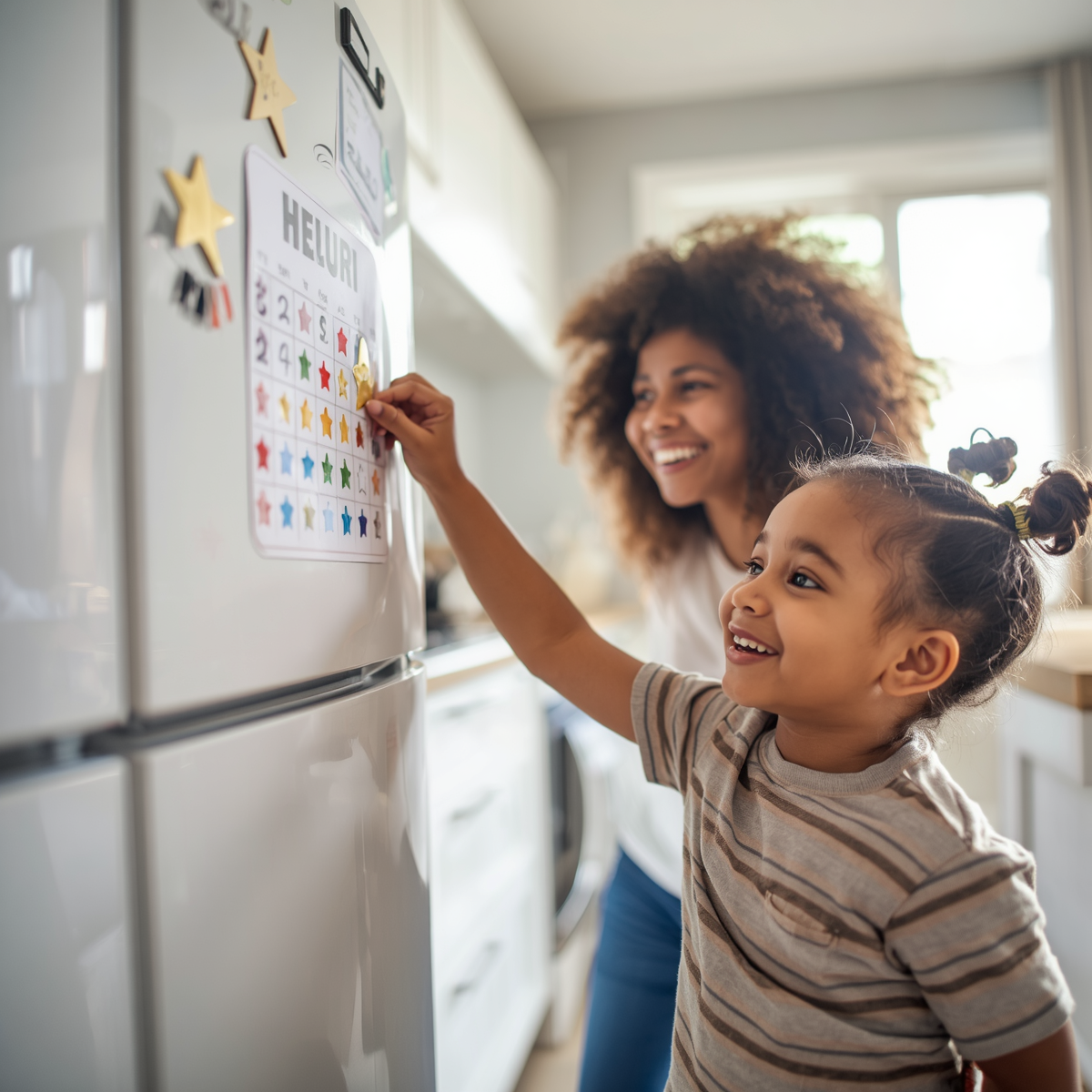
Sticker charts, small treats, and tangible rewards have their place when used correctly. They’re most effective for building new habits that don’t have their own natural rewards yet: toilet training, learning to brush teeth independently, establishing a morning routine. The key is to phase them out once the habit is established, transitioning to verbal praise and natural consequences.
5. Physical Affection and Nonverbal Acknowledgment
A hug, high-five, thumbs-up, or knowing smile across the room can be incredibly reinforcing. Nonverbal reinforcement is especially effective because it can happen in public without embarrassing an older child, and it communicates connection without interrupting the child’s flow. A quiet hand on the shoulder that says “I noticed” can be more powerful than any verbal praise.

7 Mistakes That Turn Reinforcement Into Bribery
Even parents who understand the theory can accidentally slip from reinforcement into bribery. Watch for these common pitfalls:
Mistake 1: Offering Rewards During Misbehavior
The moment you offer a reward while your child is tantruming, whining, or refusing, you’ve crossed into bribery territory. The fix: wait until the storm passes, address the misbehavior, and then later (in a calm moment) reinforce any positive behavior that did occur. If nothing positive happened, there’s nothing to reinforce — and that’s okay.
Mistake 2: Making Every Behavior Transactional
If your child starts asking “What do I get?” before complying with basic expectations, you’ve created a transactional dynamic. Not everything deserves a reward. Basic responsibilities — getting dressed, being polite, following safety rules — are expectations, not achievements. Reserve reinforcement for behaviors that require genuine effort, improvement, or character.
Mistake 3: Rewarding Too Frequently
Constant rewards lose their impact and create dependency. Research on reinforcement schedules shows that intermittent, unpredictable reinforcement actually produces stronger and more lasting behavior change than continuous reinforcement. Once a behavior is established, shift to occasional acknowledgment rather than every-time rewards.
Mistake 4: Using Only Tangible Rewards
If every reinforcement involves a physical object (toy, treat, sticker), you’re building external dependency. Children need to develop intrinsic satisfaction from doing the right thing. Use tangible rewards sparingly and as a bridge to intrinsic motivation, not as the primary motivator.
Mistake 5: Praising the Child Instead of the Behavior
“You’re such a good girl!” seems positive, but it ties the child’s identity to performance. When they inevitably make a mistake, they think: “I’m not a good girl anymore.” Instead, praise the specific behavior: “Sharing your snack was a really kind thing to do.” This separates the child’s worth from their actions, building resilience.
Mistake 6: Setting Up “If-Then” Deals in Advance
“If you behave at Grandma’s, we’ll go to the playground after” walks a fine line. It’s pre-emptive and conditional, which can feel like bribery. A better approach: set clear behavior expectations before the visit (“At Grandma’s, we use inside voices and gentle hands”), then reinforce after the fact if they met those expectations (“You were so respectful at Grandma’s! We have time for the playground — let’s go!”).
Mistake 7: Forgetting to Fade the Rewards
Reward systems like sticker charts are meant to be temporary scaffolding, not permanent fixtures. If your child has been earning stickers for brushing teeth for six months, the system has outlived its purpose. Gradually phase out external rewards as the behavior becomes habitual, transitioning to occasional verbal acknowledgment.
Building Intrinsic Motivation (Beyond Rewards)
The ultimate goal of positive reinforcement parenting isn’t to create a child who behaves well for rewards — it’s to develop a child who behaves well because they’ve internalized the values behind the behavior. This is the shift from extrinsic motivation (doing something for an external reward) to intrinsic motivation (doing something because it feels right, interesting, or satisfying). Here’s how to build intrinsic motivation:
Connect Behavior to Values, Not Rewards
Instead of “You’ll get a sticker for sharing,” try “When you share, you make your friend feel included and happy. That’s what being a good friend looks like.” This connects the behavior to a meaningful value (friendship, kindness) rather than a transactional payoff. Over time, the child develops an internal motivation to share because they value friendship, not because they want a sticker.
Emphasize the Feeling, Not the Reward
Help children notice how good behavior feels internally: “How did it feel when you helped your sister?” “You look really proud of yourself for finishing that project.” “Did you notice how happy your friend looked when you invited her to play?” These questions direct attention to the intrinsic emotional rewards of positive behavior, which are far more durable than any external incentive.
Offer Choices and Autonomy
Research by psychologists Edward Deci and Richard Ryan (Self-Determination Theory) consistently shows that autonomy is one of the most powerful drivers of intrinsic motivation. When children feel they have choice and control, they’re more motivated to participate willingly. “Would you like to do your homework before or after snack?” gives the child agency within your boundary, reducing the need for external motivating kids behavior strategies.
Let Natural Consequences Teach
Whenever safe and appropriate, allow natural consequences to reinforce behavior. The child who rushes through getting dressed has more play time before school — that’s a natural reward. The child who dawdles misses the fun part of the morning — that’s a natural consequence. These real-world outcomes are the most powerful teachers because they come from life itself, not from a parent doling out or withholding rewards.
Model Intrinsic Motivation
Let your children see you doing difficult things because they’re right, not because of external rewards: “I’m going to exercise even though I’m tired, because I know I’ll feel better afterward.” “I’m going to tell the cashier she gave me too much change because honesty is important to me.” Children internalize values they see practiced, not values they hear preached.

Age-by-Age Reinforcement Strategies
Effective approaches to motivating kids behavior change as children develop. Here’s what works best at each age:
Toddlers (1–3 Years)
Best reinforcement type: Immediate, enthusiastic verbal praise and physical affection (clapping, hugs, high-fives). Toddlers need reinforcement within seconds of the behavior because their sense of time is extremely limited.
What works: Specific, animated reactions: “You put the block in the box! Amazing!” Celebrate small steps generously. At this age, effort matters more than outcome.
What to avoid: Delayed rewards, complex sticker charts (too abstract), or expecting sustained good behavior in exchange for a later payoff.
Preschoolers (3–5 Years)
Best reinforcement type: Simple visual tracking systems (sticker charts, marble jars), specific praise, and natural privileges. Preschoolers can begin to understand “when you do X, you earn Y” connections.
What works: Keep reward systems very simple (5-7 stickers = one small reward). Make the connection between behavior and reinforcement explicit. Use role-play and pretend to practice desired behaviors.
What to avoid: Overcomplicated point systems, rewards that are too far in the future, or withdrawing earned rewards as punishment (this destroys trust in the system).
Early School Age (6–8 Years)
Best reinforcement type: A balance of verbal acknowledgment, increased privileges and autonomy, and occasional tangible rewards. Children this age increasingly value peer recognition and competence.
What works: Emphasize natural consequences and privileges (“Because you finished your chores without reminders, you’ve earned extra free time”). Connect behavior to character: “That took real integrity.” Begin shifting toward intrinsic motivation conversations.
What to avoid: Paying cash for basic expectations, overly public praise that embarrasses (some children become self-conscious), or maintaining reward systems that should have been phased out.
Tweens (9–12 Years)
Best reinforcement type: Increased autonomy and trust, private acknowledgment, shared experiences, and respect for their growing independence. Tweens often find tangible rewards patronizing.
What works: “I trust you to handle this” is often the most motivating thing you can say to a tween. Use increased privileges as natural reinforcement: later bedtime, more independence, choosing family activities. Acknowledge effort privately rather than publicly.
What to avoid: Treating them like younger children (sticker charts become insulting), excessive monitoring that communicates distrust, or withdrawing autonomy as punishment for unrelated behaviors.
Frequently Asked Questions
Are sticker charts bribery?
Not inherently. A sticker chart is a tool — whether it’s reinforcement or bribery depends on how you use it. If the chart was set up proactively to build a specific habit (using the potty, completing morning routines) and stickers are earned after the behavior, it’s reinforcement. If you’re waving the sticker chart at a screaming child saying “You’ll get a sticker if you stop!” it’s bribery. The key: set up the system during a calm moment, not in the heat of conflict. And plan to phase it out once the habit is established.
Is it okay to use food as a reward?
Occasional treats as celebration are fine and normal (“Let’s celebrate your great report card with ice cream!”). However, routinely using food as a behavioral reward (“Eat your vegetables and you can have cookies”) can create unhealthy emotional associations with food. Research in pediatric nutrition suggests that using dessert as a reward actually increases children’s preference for sweets and decreases their willingness to eat the non-reward foods. Use non-food reinforcers as your primary tools.
What if positive reinforcement doesn’t seem to work?
If reinforcement isn’t producing results, check these common issues: (1) Are you being specific enough? Generic “good job” doesn’t teach anything. (2) Is the reinforcement immediate enough? Young children especially need immediate feedback. (3) Are you reinforcing the right behavior? Sometimes we miss the small steps. (4) Is the child capable of the expected behavior? Unrealistic expectations can’t be reinforced into existence. (5) Is the reinforcement meaningful to the child? A sticker means nothing to a child who doesn’t value stickers. Match the reinforcer to the individual child.
My child now expects a reward for everything. What do I do?
This is a sign that rewards have been overused or applied too broadly. To reset: (1) Stop rewarding basic expectations (getting dressed, eating meals, basic hygiene). These are simply part of life. (2) Have a conversation: “Some things we do because they’re part of being in our family, not because we get a reward.” (3) Shift heavily toward verbal praise and natural consequences rather than tangible rewards. (4) Reserve tangible rewards for genuinely challenging new behaviors. The transition may involve some pushback, but it’s essential for developing intrinsic motivation.
How is positive reinforcement different from permissive parenting?
Positive reinforcement parenting is not the same as permissive parenting. Permissive parents avoid setting boundaries and consequences. Positive reinforcement parents set clear boundaries AND acknowledge when children meet or exceed expectations. It’s perfectly compatible with firm limits: “Hitting is not okay, and there will be a consequence for that. But I also noticed that you apologized to your brother afterward, and that took real maturity.” Strong boundaries and positive reinforcement work best together.
Does praise make children dependent on external validation?
This is a valid concern raised by some parenting researchers. The answer depends on the type of praise. Evaluative praise (“You’re so smart!” “Good boy!”) can create validation dependency and a fixed mindset. Descriptive praise (“You spent 20 minutes on that drawing — I can see how much detail you put into it”) and process praise (“You tried three different strategies before you found one that worked”) build intrinsic motivation and resilience. The research is clear: it’s not whether you praise, but how you praise.
Final Thoughts: It’s Not About Being Perfect
If you’ve read through this guide and realized that you’ve been bribing your child sometimes — welcome to the club. Every parent has offered a desperate cookie to stop a public meltdown. Every parent has negotiated with a screaming toddler at least once. That doesn’t make you a bad parent. It makes you a human parent.
The distinction between reward vs bribery isn’t about achieving perfection. It’s about understanding the pattern so you can shift the overall direction. You don’t need to eliminate every bribe overnight. You need to increase the ratio of reinforcement to bribery over time, so the dominant pattern in your household teaches: good choices lead to good outcomes, effort is recognized, and doing the right thing is its own reward.
Your child doesn’t need a parent who never makes mistakes. They need a parent who understands the difference between building motivation and buying compliance — and who keeps trying to get it right, one interaction at a time.
That’s not just positive reinforcement parenting. That’s good parenting, period.

About the Author
Prasad Fernando is a parenting writer and father of two children. He created ParentalRing to share evidence-based parenting strategies that help families build cooperation, character, and connection. His writing draws from behavioral psychology research, positive parenting frameworks, and the everyday realities of raising young children.
Disclaimer: This article is for general informational and educational purposes only. It does not constitute professional psychological or medical advice. Every child and family is different, and the strategies described here may not be appropriate for every situation. If you have persistent concerns about your child’s behavior, please consult your child’s pediatrician or a licensed child psychologist for individualized guidance.
Sources and Further Reading
This article draws from established behavioral psychology research, including B.F. Skinner’s principles of operant conditioning, Dr. Carol Dweck’s research on growth mindset and praise, Edward Deci and Richard Ryan’s Self-Determination Theory of intrinsic motivation, and positive parenting frameworks informed by the American Academy of Pediatrics. Parents seeking further information are encouraged to consult HealthyChildren.org (AAP), the Child Mind Institute, and their child’s pediatrician or a family therapist.
You Might Also Like
Discipline vs. Punishment: Why One Builds Character and the Other Doesn’t
Natural vs. Logical Consequences: Choosing the Best Tool for Misbehavior
Why Kids Push Boundaries (and Why It’s Actually a Good Thing)