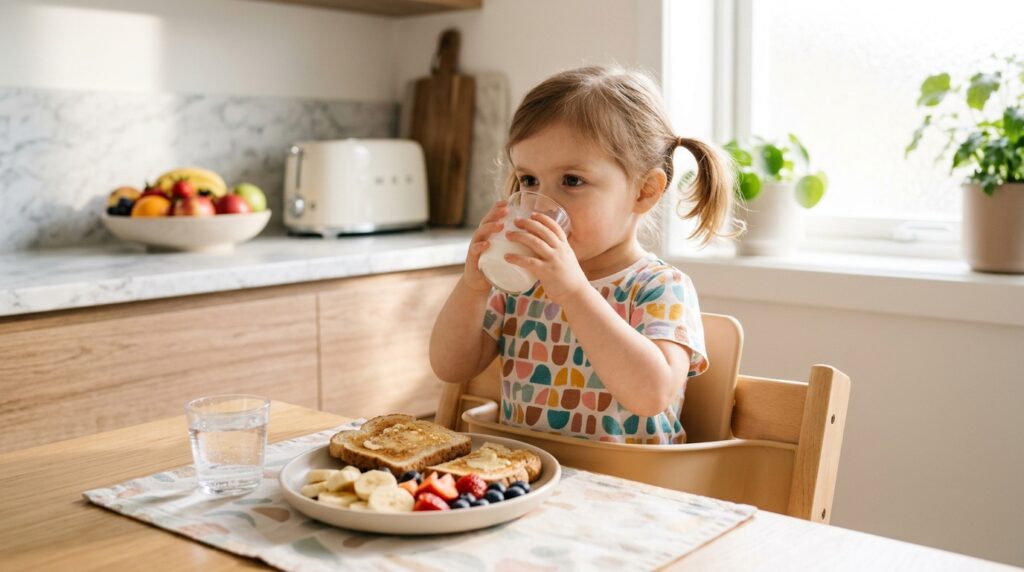
After the first birthday, the bottle and formula start to fade out and a new set of questions appears. How much cow’s milk should my toddler drink? Is juice okay? What about plant milks or the “toddler milks” sold next to the formula? Drinks can quietly make a big difference to a toddler’s appetite, teeth and nutrition, so it is worth getting the basics right.
This guide is based on the recommended drinks guidance from the American Academy of Pediatrics and its partner organizations. It covers how much milk, water and juice toddlers and preschoolers need, which drinks to skip, and what to do if your child drinks too much milk.
Quick Guide: Recommended Drinks by Age
| Age | Milk | Water | 100% fruit juice |
|---|---|---|---|
| 12 to 24 months | About 16 oz (2 cups) a day of plain whole milk | About 8 to 32 oz (1 to 4 cups) a day | Not needed; if offered, keep it small |
| 2 to 3 years | 16 to 24 oz (2 to 3 cups) a day of plain skim or low-fat (1%) milk | About 8 to 40 oz (1 to 5 cups) a day | No more than 4 oz a day |
| 4 to 5 years | 16 to 24 oz (2 to 3 cups) a day of plain skim or low-fat (1%) milk | About 8 to 40 oz (1 to 5 cups) a day | No more than 4 to 6 oz a day |
Water needs vary with activity, weather and how much water children get from food, which is why the ranges are wide. Whole fruit is always preferred over juice.
Milk: How Much Is Enough?
Milk provides calcium, vitamin D and protein that support growing bones. For children aged 12 to 24 months, the guidance recommends about 2 cups a day of plain whole milk. From age 2, most children can switch to plain skim or low-fat (1%) milk, about 2 to 3 cups a day. Your pediatrician may suggest something different based on your child’s growth or family history.
More is not better. Toddlers have small stomachs, and large amounts of milk can fill them up so they eat less food. Too much milk is also linked with iron deficiency, because milk is low in iron and can make it harder for the body to absorb iron from other foods.
Signs your toddler may be drinking too much milk
- They drink milk throughout the day and eat very little at meals.
- They regularly drink well over 3 cups a day.
- They still go to sleep with a bottle of milk.
- They are often constipated.
If this sounds familiar, try offering milk only with meals in an open cup, offering water between meals, and talking to your pediatrician, who may check your child’s iron levels.
Water: The Best Everyday Drink
Plain water is the best drink between meals. It quenches thirst without adding sugar and is good for teeth. Tap water in most areas also contains fluoride, which helps prevent tooth decay. Keep a water cup or bottle available, especially during active play and in hot weather.
If your toddler is not used to plain water, try serving it cold, in a fun cup, or with slices of fruit or cucumber for a hint of flavor.
Juice: Small Amounts Only
Juice is not needed in a toddler’s diet. Even 100% fruit juice is high in natural sugar and lacks the fiber of whole fruit. The guidance recommends no juice for babies under 1, no more than 4 oz a day for ages 2 to 3, and 4 to 6 oz a day for ages 4 to 5. If you offer juice:
- Choose 100% fruit juice, not “fruit drinks” or “juice cocktails.”
- Serve it in an open cup with a meal, not in a bottle or sippy cup to carry around.
- Consider diluting it with water.
Drinks to Skip
The recommended drinks guidance advises avoiding these for young children:
- Sugary drinks: soda, fruit drinks, sports drinks, lemonade and sweetened waters.
- Flavored milks such as chocolate or strawberry milk, because of added sugar.
- “Toddler milks” or “transition formulas”, which are marketed for children over 1 but are considered unnecessary and often contain added sugars.
- Most plant-based milks as a replacement for cow’s milk. Many are lower in protein and other nutrients. Fortified soy milk is considered the closest alternative.
- Drinks with low-calorie or artificial sweeteners, including stevia.
- Caffeinated drinks of any kind.
If your child has a milk allergy or your family does not use dairy, talk to your pediatrician or a registered dietitian about the best alternative.
From Bottles to Cups
The AAP encourages moving from bottles to cups around the first birthday. Long-term bottle use, especially carrying a bottle around or falling asleep with one, is linked to tooth decay and drinking too much milk. Try these steps:
- Offer milk in an open cup or straw cup at meals.
- Drop the midday bottle first, then the morning one, and the bedtime bottle last.
- Move the bedtime milk earlier in the routine, before teeth brushing, so your child does not fall asleep drinking.
- Keep bottles out of sight once you have made the switch.
Drinks and Picky Eating
If your toddler regularly refuses meals, look at what they drink before you look at what they eat. Many “picky eaters” are simply full of milk or juice. Offering water between meals and keeping milk to mealtimes is one of the simplest fixes. For more strategies, see our guide on what to do when your toddler refuses dinner.
Frequently Asked Questions
Can my 1-year-old have low-fat milk?
For most children aged 12 to 24 months, the guidance recommends whole milk. Your pediatrician may recommend lower-fat milk earlier in some situations, such as a family history of heart disease or concerns about weight.
Is oat or almond milk okay for toddlers?
Most plant-based milks are not nutritionally equivalent to cow’s milk and are not recommended as the main milk for young children. Fortified soy milk is the closest substitute. Ask your pediatrician if your child cannot have dairy.
Does my toddler need to drink water if they drink milk?
Yes. Milk is a food as well as a drink. Water is the best choice for thirst between meals and during play.
The Bottom Line
For most toddlers, the best drinks are simple: plain milk with meals and plain water the rest of the time. Aim for about 2 cups of whole milk a day from 12 to 24 months, and 2 to 3 cups of skim or low-fat milk from age 2. Keep juice small or skip it, avoid sugary and flavored drinks, and move from bottles to cups around the first birthday. For easy breakfast ideas that pair well with a cup of milk, see our freezer-friendly breakfasts for kids.
Sources
- American Academy of Pediatrics. Recommended Drinks for Young Children Ages 0–5. HealthyChildren.org.
- Healthy Eating Research. (2019). Consensus Statement: Healthy Beverage Consumption in Early Childhood: Recommendations from Key National Health and Nutrition Organizations.
This article is for general information only and is not a substitute for advice from your pediatrician or a registered dietitian.