

Time-outs have been a cornerstone of modern parenting for decades, promoted as a gentler alternative to physical punishment. However, many parents discover that time-outs simply don’t work for their child—or worse, they escalate conflicts and damage the parent-child relationship. If you’re struggling with ineffective time-outs, you’re not alone. This comprehensive guide explores why time-outs fail, what the research reveals about their limitations, and evidence-based discipline alternatives that build cooperation, self-regulation, and genuine behavior change.
Understanding Why Traditional Time-Outs Don’t Work
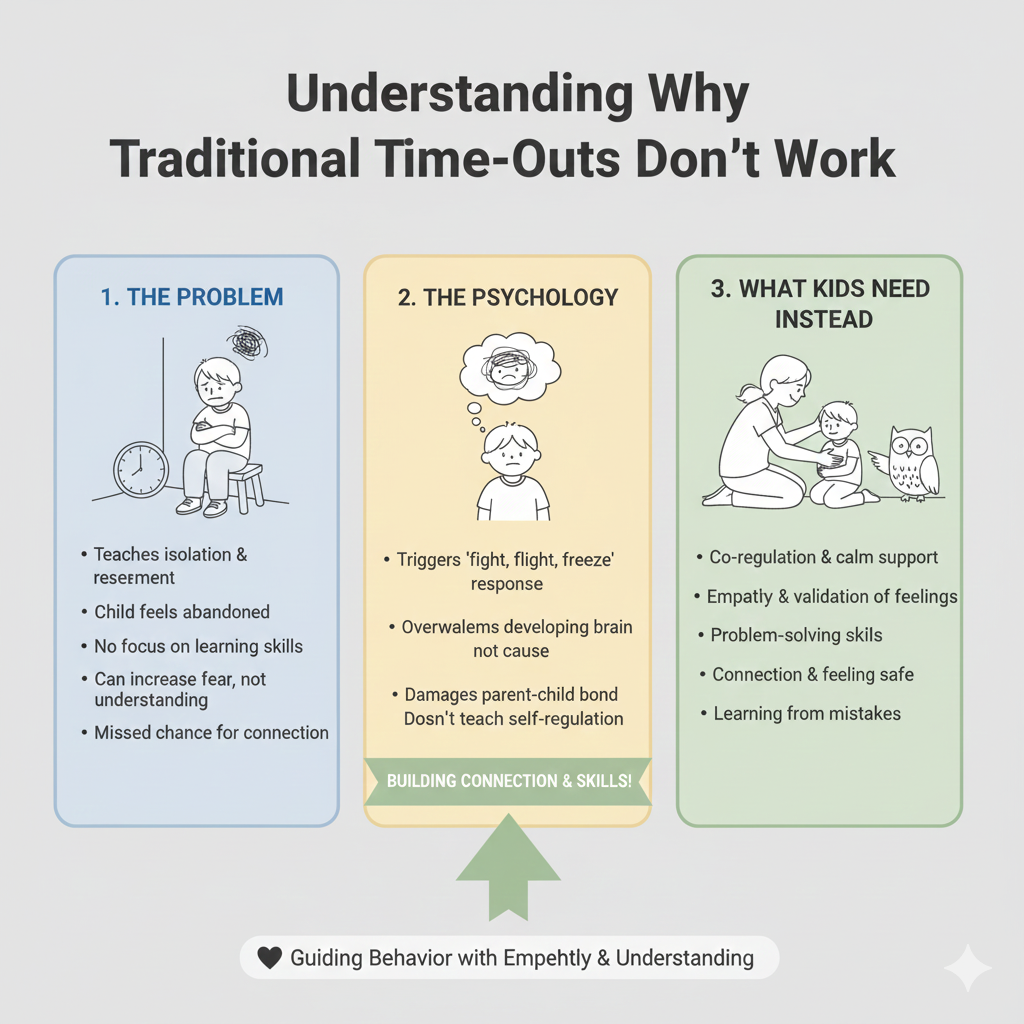
Time-outs fail for numerous reasons, many rooted in misunderstanding their purpose and misapplying the technique. The original concept—allowing a child to calm down and reset—has morphed into something quite different in practice.
The isolation paradox: When children are already dysregulated emotionally, isolation often intensifies distress rather than promoting calm. A child experiencing big emotions needs co-regulation from a caring adult, not solitary confinement. The developing brain lacks the capacity for self-soothing that time-outs assume.
Shame and disconnection: Many children experience time-outs as rejection. The implicit message—”Your behavior is so unacceptable that I don’t want to be near you”—triggers shame rather than learning. Shame activates the brain’s threat response system, preventing the reflective thinking necessary for behavioral change.
Power struggles emerge: Strong-willed children often refuse to go to time-out or won’t stay there, transforming discipline into exhausting battles. Parents escalate consequences (“Now it’s ten minutes!”), children escalate resistance, and the original misbehavior gets lost in the struggle.
Developmental inappropriateness: Time-outs require cognitive abilities many children haven’t developed yet. Young children lack the capacity to sit alone and reflect on their behavior. Even older children often spend time-out feeling angry at parents rather than contemplating better choices.
Missing skill-building: Time-outs remove children from the situation without teaching what to do instead. A child who hits during frustration hasn’t learned alternative responses—they’ve simply been removed and punished.
Attachment disruption: For children with insecure attachment or trauma histories, isolation feels threatening and reactivates past experiences of abandonment. These children need more connection during difficult moments, not less.
Research in developmental neuroscience reveals that the prefrontal cortex—responsible for self-regulation, impulse control, and reflection—doesn’t fully mature until the mid-twenties. Expecting young children to engage these capacities while emotionally flooded and isolated is neurologically unrealistic.
The Neuroscience Behind Child Behavior and Self-Regulation
Understanding brain development transforms how we approach discipline. When we align strategies with how children’s brains actually work, we achieve better outcomes with less frustration.
The triune brain model helps explain children’s behavior. The reptilian brain (brainstem) controls survival functions and activates during perceived threats. The limbic system (emotional brain) processes feelings and memories. The neocortex (thinking brain) handles reasoning, planning, and self-control.
When children misbehave, they’re often in “downstairs brain” mode—the reptilian and limbic systems have taken over. The “upstairs brain” (prefrontal cortex) responsible for good decisions is essentially offline. Sending a child to time-out while in this state is like asking someone drowning to practice their swimming technique.
Emotional flooding describes what happens when the amygdala detects threat or intense emotion. It hijacks higher brain functions, triggering fight, flight, or freeze responses. A child in this state literally cannot access the reasoning abilities time-outs require. They must calm down before any learning can occur.
Co-regulation precedes self-regulation. Babies can’t calm themselves; they need caregivers to soothe them. Through thousands of repetitions of this co-regulation, children gradually internalize the capacity to self-regulate. Expecting young children to self-regulate in isolation skips essential developmental steps.
Mirror neurons help explain why calm parental presence helps children regulate. When an adult maintains composure during a child’s emotional storm, the child’s nervous system begins mirroring that calm. Conversely, parental anger activates more distress.
The stress response system (hypothalamic-pituitary-adrenal axis) floods the body with cortisol during perceived threats. Chronic activation from repeated stressful discipline encounters can alter brain development and stress responsivity long-term. Discipline approaches that minimize activation of this system while still teaching are preferable.
Executive function development occurs gradually throughout childhood and adolescence. These skills—impulse control, working memory, flexible thinking, emotional regulation—are precisely what misbehaving children are struggling with. Punishment for executive function failures doesn’t build these capacities; practice and coaching do.
Understanding neuroscience doesn’t mean abandoning boundaries. It means working with the brain’s natural development rather than against it.
Common Time-Out Mistakes That Escalate Misbehavior
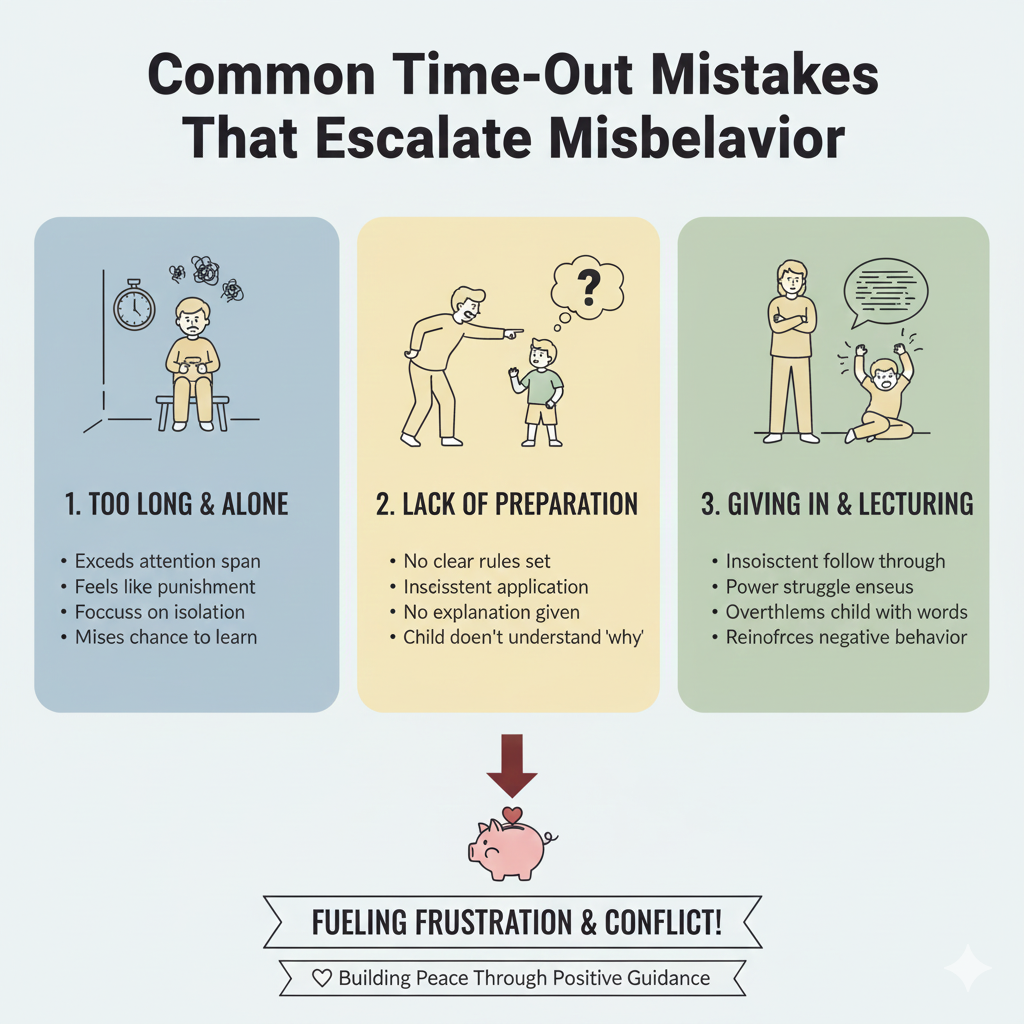
Even when time-outs might work in theory, implementation mistakes undermine their effectiveness and create additional problems.
Using time-outs in anger: When parents assign time-outs while visibly angry or frustrated, the message becomes about parental displeasure rather than behavioral learning. Children focus on the parent’s anger rather than their own behavior.
Inconsistent application: Using time-outs sometimes but not others for the same behavior creates confusion. Children can’t learn from unpredictable consequences.
Making time-outs too long: The guideline “one minute per year of age” exists for a reason. Excessive time-outs become punishment without added learning. A child stops thinking about their behavior and starts thinking about how unfair their parent is.
Lecturing during time-out: Talking at a child during time-out defeats the purpose of quiet calming. It also often escalates emotions rather than reducing them.
Giving attention to resistance: When children refuse time-out and parents engage in lengthy negotiations or physical struggles, the attention rewards resistance. The child learns that refusing creates more parental interaction than compliance.
No follow-up conversation: Sending a child to time-out and then moving on without discussion misses the teaching opportunity. Children need help processing what happened and identifying better choices.
Using time-out for every infraction: When time-out becomes the default response to all misbehavior, it loses meaning and effectiveness. Different situations require different approaches.
Implementing without relationship foundation: Time-outs might work in the context of a strong, secure relationship. Without that foundation, they feel purely punitive.
Forcing emotional suppression: Requiring children to be “completely calm” or “ready to apologize” before exiting time-out can extend isolation indefinitely for children who struggle with emotional regulation.
Isolation in frightening spaces: Sending children to dark, isolated, or scary places transforms time-out from calming space to punishment chamber.
Recognizing these mistakes helps parents troubleshoot why their time-outs aren’t working before abandoning the approach entirely.
Introducing Time-In: Connection-Based Discipline Approach
Time-in represents a fundamental shift from isolation to connection during behavioral challenges. Rather than sending children away, parents stay with them through the emotional storm.
What is time-in? Time-in means staying physically and emotionally present with a child who’s struggling behaviorally or emotionally. Instead of “Go to your room until you can behave,” it’s “Let’s sit together until you feel calmer.”
The philosophy behind time-in: Children do better when they feel better. Misbehavior often signals unmet needs, skill deficits, or emotional overwhelm. Connection helps meet those needs while teaching regulation skills.
How time-in works:
When misbehavior occurs, move to a quiet, comfortable space together. This might be a cozy corner, the couch, or even the floor.
Stay calm and present. Your regulated nervous system helps regulate theirs. You might sit quietly together, offer a hug if they’re receptive, or simply be near without talking.
Allow the emotion to move through. Don’t try to stop crying or immediate shut down anger. Emotions need expression before regulation is possible.
Once calm, discuss what happened. “You were really frustrated when your tower fell. What could you do instead of throwing blocks?”
Problem-solve together. “Next time you feel that frustrated, what might help? Should we take deep breaths? Would you like to ask for help?”
Benefits of time-in:
Maintains connection during difficult moments, reinforcing that love isn’t conditional on good behavior.
Teaches emotional regulation through co-regulation rather than expecting it to happen spontaneously.
Preserves the relationship, preventing the resentment that isolation can breed.
Allows real-time teaching about emotions and coping strategies.
Works better for children with attachment difficulties, anxiety, or trauma histories.
Time-in challenges:
Requires more parental time and emotional energy than sending a child away.
Demands that parents manage their own emotions effectively—difficult when you’re frustrated.
May feel like “giving in” or rewarding bad behavior, though research shows it doesn’t.
Requires retraining your own instincts if you were raised with punishment-based discipline.
When time-in is most effective:
For young children (under 6) who lack self-regulation skills.
For emotionally sensitive children who respond strongly to perceived rejection.
For children with trauma or attachment challenges.
When the behavior stems from emotional overwhelm rather than willful defiance.
When building emotional intelligence and regulation skills is the priority.
Time-in doesn’t mean no boundaries or consequences. It means enforcing boundaries while maintaining connection.
Positive Discipline Techniques That Actually Work
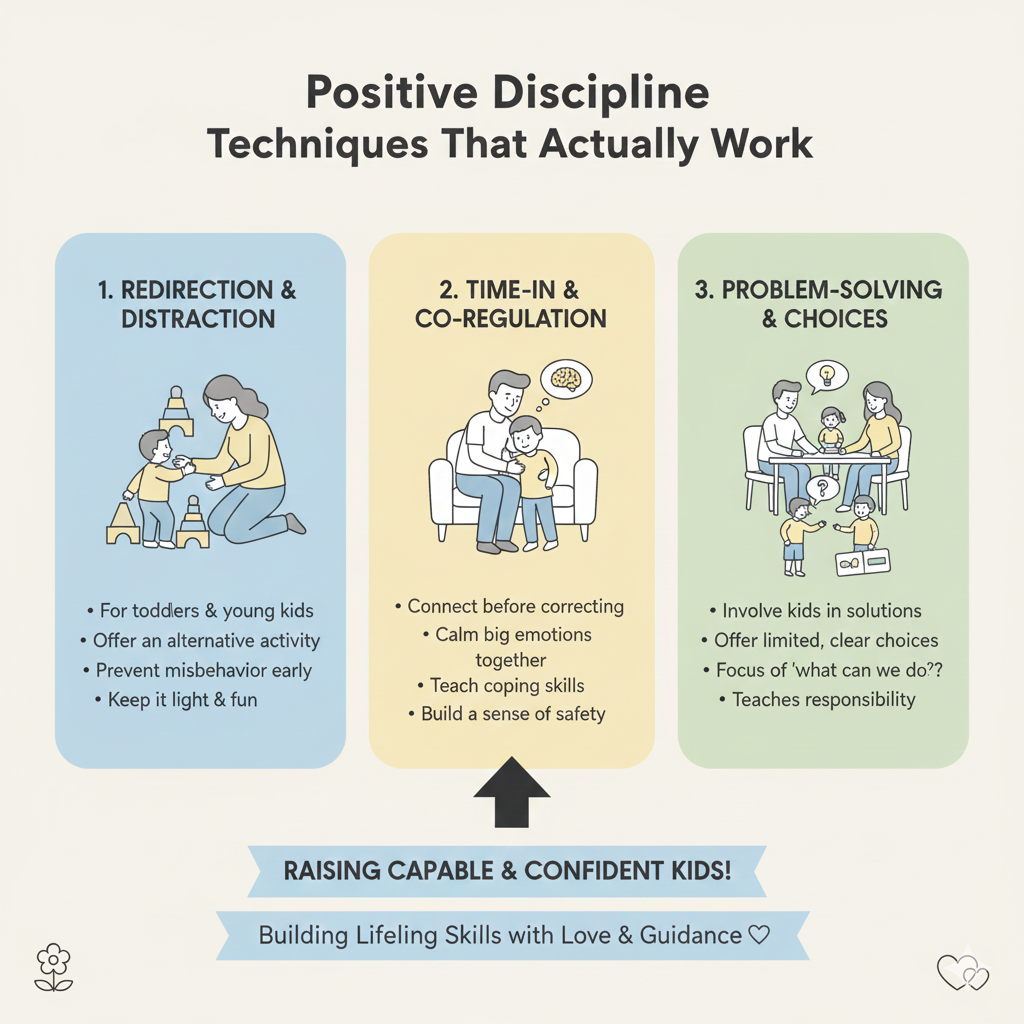
Beyond time-in, numerous evidence-based strategies effectively address misbehavior while teaching skills and preserving relationships.
Natural and logical consequences: Allow children to experience the results of their choices. Forgot lunch? Experience hunger until snack time (natural consequence). Broke a toy through rough play? That toy is no longer available (natural consequence). Refused to put toys away? Toys become unavailable tomorrow (logical consequence).
Collaborative problem-solving: When issues arise, involve children in finding solutions. “You’re having trouble getting ready for school on time. What ideas do you have for making mornings easier?” This builds executive function and personal responsibility.
Emotion coaching: Label and validate feelings while guiding behavior. “You’re really angry your brother took your toy. Anger is okay. Hitting is not. What’s a safe way to show your anger?” This teaches emotional literacy and regulation.
Offering choices: Providing limited choices gives children autonomy within boundaries. “It’s bedtime. Would you like to brush teeth first or put on pajamas first?” Reduces power struggles while maintaining limits.
When-then statements: Clear cause-effect statements remove parental arbitrariness. “When you’ve finished homework, then you can have screen time.” The child controls the timeline through their choices.
Positive attention for good behavior: Catch children behaving well and acknowledge it specifically. “You shared your toy without being asked. That was generous.” What gets attention increases.
Family meetings: Regular meetings where everyone discusses issues and collaboratively solves problems build cooperation and reduce conflicts.
Redirection: For young children especially, redirecting attention to appropriate activities often prevents problems without confrontation.
Do-overs: When children handle something poorly, allow them to try again. “That wasn’t respectful. Let’s try that again.” This teaches without shaming.
Teaching replacement behaviors: Instead of just stopping unwanted behavior, teach what to do instead. “Use gentle hands” is more instructive than “Stop hitting.”
Connection before correction: When children are struggling, increase rather than decrease connection. Often misbehavior signals need for attention or reassurance.
These strategies share common elements: they’re respectful, they teach skills, they involve children actively, and they maintain dignity and connection.
Understanding Emotional Regulation in Children
Misbehavior often stems from poor emotional regulation. Teaching regulation skills addresses root causes rather than just symptoms.
What is emotional regulation? The ability to recognize, understand, and manage emotional responses appropriately. This includes:
- Identifying what you’re feeling
- Understanding why you feel that way
- Modulating intensity of emotion
- Choosing appropriate responses
- Recovering after emotional upset
Developmental timeline: Babies have zero capacity for self-regulation. Toddlers begin developing it but still rely heavily on adults. Preschoolers can sometimes regulate with support. School-age children have emerging but inconsistent skills. Teenagers’ abilities are sophisticated but still developing. Full maturity doesn’t arrive until the mid-twenties.
Teaching regulation through co-regulation:
Name the emotion: “You seem really frustrated right now.” Labeling helps children understand their internal experience.
Validate without fixing: “It’s really disappointing when plans change.” Acknowledging feelings doesn’t mean changing the situation.
Stay calm: Your regulated nervous system cues theirs. Deep breaths, calm voice, and relaxed body language are contagious.
Offer physical comfort if welcome: Hugs, sitting close, or gentle touch activate calming neurochemicals.
Teach calming strategies: Deep breathing, counting, physical movement, or sensory tools give children options for self-soothing.
Wait for calm before problem-solving: Emotional flooding prevents rational thought. Wait until the prefrontal cortex is back online.
Reflect afterward: “You got really upset when you couldn’t have candy. You calmed down by taking deep breaths. That’s a helpful strategy.”
Building emotional vocabulary: Rich language for emotions helps children identify and communicate feelings. Move beyond “mad,” “sad,” “happy,” and “scared” to include frustrated, disappointed, overwhelmed, excited, anxious, content, and proud.
Regulation challenges vary: Some children naturally regulate easily; others struggle significantly. Temperament, sensory processing differences, trauma history, developmental disabilities, and other factors influence regulation capacity.
The window of tolerance: Each child has a zone where they can function well. Below this (hypo-arousal), they shut down—listless, withdrawn, or numb. Above it (hyper-arousal), they escalate—aggressive, impulsive, or chaotic. Helping children stay within their window, and expanding it gradually, is key.
Self-regulation toolkit: Help children develop personal strategies:
- Physical: running, jumping, squeezing stress ball
- Sensory: listening to music, using fidget toys, taking a shower
- Social: talking to someone, asking for a hug
- Cognitive: positive self-talk, problem-solving, distraction
When children have regulation skills, much misbehavior disappears. They’re not choosing to act out—they’re overwhelmed. Teaching regulation addresses the real issue.
Behavior Charts and Reward Systems: Do They Work?
Behavior charts and reward systems are popular discipline tools, but they’re controversial. Understanding their appropriate use and limitations matters.
How they work: Visual tracking of behavior with rewards for meeting goals. Stars, stickers, points, or checkmarks accumulate toward a prize or privilege.
Potential benefits:
Makes expectations concrete and visible, especially helpful for children who struggle with abstract concepts.
Provides immediate positive feedback for good behavior, which reinforces it.
Creates structure and predictability that some children find reassuring.
Can motivate behavior change when intrinsic motivation hasn’t developed yet.
Teaches goal-setting and delayed gratification when used appropriately.
Significant limitations:
Undermines intrinsic motivation: Research shows external rewards can reduce internal desire to do the right thing. Children who receive rewards for tasks they previously enjoyed often lose interest when rewards stop.
Creates score-keeping mentality: Children focus on earning points rather than understanding why behaviors matter.
Doesn’t teach underlying skills: A child earns rewards for not hitting but hasn’t learned to manage frustration. Without skill-building, behavior change doesn’t last.
Privileged children benefit most: Reward systems work better for children who already have good self-regulation and just need extra motivation. Struggling children often fail, leading to discouragement.
Can damage relationships: When everything becomes transactional (“I’ll behave if you give me something”), relationships suffer.
Effectiveness diminishes over time: Children habituate to rewards, requiring increasingly valuable prizes to maintain motivation.
When behavior charts might work:
For specific, short-term behavior changes (toilet training, establishing new routines).
For children with developmental disabilities where concrete visual systems help.
When paired with skill-teaching, not as the sole intervention.
When rewards are reasonable, natural, and related to the behavior.
When transitioning away from rewards is part of the plan from the beginning.
Alternatives to traditional reward systems:
Acknowledgment over rewards: “I noticed you used kind words when you were frustrated. That took real effort.” Recognition without tangible rewards.
Natural rewards: “Because you finished homework early, you have extra time to play.” The reward relates directly to the behavior.
Collaborative goal-setting: “What goal would you like to work on this week? How will we know if you’re making progress?” Child ownership increases motivation.
Progress celebration: Notice and celebrate growth rather than perfection. “Last week sharing was really hard for you. This week I’ve seen you share three times. You’re really working on that.”
The verdict: Behavior charts can be useful tools in specific contexts but shouldn’t be the foundation of your discipline approach. Teaching skills, building connection, and fostering intrinsic motivation create more lasting change.
Discipline Strategies for Strong-Willed Children
Strong-willed children—those with intense determination, resistance to authority, and fierce independence—require adapted approaches. Strategies that work for compliant children often backfire with spirited ones.
Understanding strong-willed temperament: These children aren’t being difficult—they’re being themselves. Temperament is innate, not a parenting failure. Strong-willed traits include:
- Intense emotional responses
- Persistence bordering on stubbornness
- Need for autonomy and control
- Questioning of rules and authority
- High sensitivity to fairness
- Difficulty with transitions
- Strong preferences and opinions
What doesn’t work:
Power struggles: These children will escalate indefinitely rather than submit. You cannot force compliance without damaging the relationship and creating resentment.
Harsh punishment: Increases defiance rather than cooperation. These children dig in harder when treated harshly.
Arbitrary rules: “Because I said so” triggers resistance. Strong-willed children need logical explanations.
Public humiliation: Shaming intensifies defiance and destroys trust.
Constant correction: If all they hear is criticism, they stop listening entirely.
What works:
Offer choices within boundaries: “It’s bedtime. Would you like to brush teeth now or after we read a book?” They get control while you maintain the limit.
Explain reasoning: “We hold hands in parking lots because cars might not see small children. I need to know you’re safe.” Logic reduces resistance.
Pick battles carefully: Not everything is worth fighting over. Prioritize safety and respect; let go of preferences that don’t matter.
Acknowledge their perspective: “I understand you want to keep playing. And it’s time for bed.” Validation doesn’t mean changing rules.
Channel strong will positively: These children become leaders, entrepreneurs, and change-makers. Frame their persistence as strength, not defect.
Give advance notice: “We’re leaving in ten minutes. Start thinking about wrapping up your game.” Transitions are easier with preparation.
Make it their idea: “I need help figuring out how to get everyone ready on time. Any suggestions?” Ownership increases cooperation.
Natural consequences: Allow them to experience results of choices when safe. Strong-willed children learn best from experience, not lectures.
Collaborate on solutions: “You’re having trouble getting homework done. Let’s brainstorm ideas together.” Partnership beats dictation.
Spend positive time together: When the relationship is strong, cooperation increases. These children need to know you enjoy them, not just manage them.
Parent perspective shift: Strong-willed children require more patience and creativity, but their traits become assets in adulthood. Survival mode parenting focuses on immediate compliance; growth-minded parenting nurtures their strengths while teaching regulation. The latter is more challenging but yields better long-term outcomes.
Age-Appropriate Alternatives to Time-Out
Effective discipline matches developmental capabilities. What works for a three-year-old differs dramatically from what works for a thirteen-year-old.
Toddlers (1-3 years):
Redirection: “Blocks aren’t for throwing. Let’s build a tower instead.” Simple and immediate.
Environmental control: Toddler-proof spaces eliminate many conflicts. Remove temptations rather than constantly saying no.
Physical guidance: Gently redirecting hands teaches “gentle touch” more effectively than lectures.
Simple cause-effect: “When you throw food, mealtime ends.” Immediate, clear consequences.
Comfort and connection: When overwhelmed, toddlers need co-regulation. Sit with them through meltdowns.
Preschoolers (3-5 years):
Emotion coaching: “You’re really angry. Let’s take some deep breaths together.” Teach regulation skills.
Limited choices: “Would you like to clean up toys or help set the table?” Autonomy within limits.
Do-overs: “That wasn’t kind. Let’s try that again using respectful words.”
Natural consequences: Experience results when safe. Forgot jacket? Feel chilly.
Calm-down corner: Unlike punitive time-out, this is a cozy space with calming tools they choose to use.
Early Elementary (6-9 years):
Problem-solving conversations: “You and your sister are fighting over the tablet. What are some solutions?”
Logical consequences: “You didn’t feed the dog, so you’ll do it before and after school tomorrow.”
Reflection questions: “What happened? What were you trying to accomplish? What could you do differently next time?”
Repair and restoration: “You hurt your friend’s feelings. How can you make this right?”
Collaborative rule-setting: Involve them in creating family guidelines increases compliance.
Tweens (10-12 years):
Natural consequences: Let them experience real-world results (within reason). Failed test from not studying teaches more than lectures.
Loss of privileges related to behavior: “You broke phone rules, so the phone goes away for two days.”
Increased autonomy for demonstrated responsibility: “You’ve been managing homework independently, so you’ve earned later bedtime.”
Private conversations: Avoid correcting in front of peers, which breeds resentment.
Appeal to values: “In our family we value honesty. How does lying fit with that?”
Teenagers (13-18 years):
Natural consequences dominate: They need to experience real-world results to learn.
Collaborative problem-solving: “You’re struggling with time management. Let’s figure out a system together.”
Respect autonomy while maintaining safety boundaries: “I trust you, and curfew is still 11 PM.”
Connection over control: The relationship matters more than winning compliance battles.
Logical consequences tied to demonstrated judgment: “That choice showed poor judgment. Let’s discuss appropriate consequences.”
Avoid power struggles: With teens especially, battles breed resentment. State your limit once, explain your reasoning, and follow through without debate.
The common thread: As children develop, discipline shifts from external control to internal guidance, from parental management to collaborative problem-solving.
Addressing Underlying Issues: When Behavior Problems Signal More
Sometimes persistent misbehavior despite consistent, appropriate discipline signals underlying issues requiring additional support.
Developmental disabilities:
ADHD makes impulse control and sustained attention extraordinarily difficult. Standard discipline often fails because the child literally can’t regulate attention and behavior without additional support.
Autism spectrum conditions create challenges with social understanding, flexibility, and sensory processing. Misbehavior may stem from overwhelm or misunderstanding rather than defiance.
Learning disabilities cause frustration that emerges as behavioral problems, especially in school settings.
Mental health concerns:
Anxiety manifests as control-seeking, irritability, or oppositional behavior in children who can’t articulate their worry.
Depression in children often presents as irritability, defiance, or aggression rather than obvious sadness.
Trauma responses include hypervigilance, aggression, dissociation, or extreme oppositional behavior as survival strategies.
Medical issues:
Sleep deprivation dramatically affects behavior and emotion regulation. Chronic sleep debt looks like ADHD or oppositional behavior.
Nutritional deficiencies, food sensitivities, or blood sugar instability impact mood and behavior.
Chronic pain or discomfort (ear infections, dental issues, constipation) cause irritability in children who can’t articulate the problem.
Environmental stressors:
Parental conflict or divorce creates insecurity that emerges as behavioral problems.
School difficulties—academic struggles, bullying, or teacher conflicts—spill over into home behavior.
Major life changes (moves, new siblings, parent job loss) create stress that manifests behaviorally.
When to seek professional help:
Behavior problems persist despite consistent, appropriate discipline for several months.
Misbehavior is severe—extreme aggression, property destruction, or risk-taking that endangers the child or others.
The child seems genuinely distressed about their own behavior but can’t control it.
Family stress is overwhelming or the parent-child relationship is significantly damaged.
Development seems delayed or atypical in concerning ways.
Professional resources:
Pediatrician: Rule out medical causes, discuss developmental concerns, refer to specialists.
Child psychologist: Assessment and therapy for behavioral, emotional, or developmental issues.
Family therapist: Address relationship dynamics and communication patterns.
Developmental pediatrician: Evaluation for ADHD, autism, or other developmental conditions.
School support: IEPs, 504 plans, or behavioral intervention plans for school-related issues.
Parent training programs: Evidence-based programs like Parent-Child Interaction Therapy or Triple P.
Parent self-care: Dealing with chronic behavior challenges is exhausting. Parents need support too—therapy, support groups, respite care, or simply reliable help from friends and family.
Sometimes the most effective discipline strategy is addressing what’s driving the behavior rather than focusing solely on the behavior itself.
Creating a Personalized Discipline Plan for Your Family
No single discipline approach works for every family or every child. Creating a personalized plan based on your values, children’s needs, and family circumstances increases effectiveness.
Step 1: Clarify your values
What matters most to your family? Respect? Responsibility? Kindness? Honesty? Your discipline should reflect and teach these values.
What kind of adults do you want to raise? Independent thinkers? Compassionate individuals? Confident decision-makers? Your daily discipline shapes these outcomes.
Step 2: Assess what’s not working
List current behavior challenges. Be specific: “Morning routines are chaotic” rather than “Kids won’t listen.”
Identify your typical responses. How do you currently handle these situations?
Evaluate effectiveness honestly. Is it working? If not, trying harder at ineffective strategies won’t help—you need different strategies.
Step 3: Consider your children’s unique needs
Temperament: Strong-willed, sensitive, spirited, cautious? Different temperaments require different approaches.
Developmental stage: What’s reasonable to expect given their age and maturity?
Special needs: Any diagnoses, suspected issues, or areas of significant struggle?
Learning style: Some children respond to words, others to actions, others to logical consequences.
Step 4: Choose primary strategies
Select 3-5 core approaches that align with your values and your children’s needs. Too many strategies create inconsistency.
Examples:
- Natural consequences + emotion coaching + collaborative problem-solving
- Time-in + positive reinforcement + logical consequences
- Connection before correction + family meetings + choice-offering
Step 5: Create specific action plans
For each common problem, outline your response. Example:
Problem: Child refuses to do homework
Step 1: Connect—”I notice homework is really frustrating lately. Tell me about it.”
Step 2: Problem-solve—”What would make homework easier? Different timing? Help from me? Breaking it into chunks?”
Step 3: Natural consequence if refusal continues—”If you choose not to do homework, you’ll face consequences at school. I’ll support you, but this is your responsibility.”
Step 6: Get family buy-in
Share the plan with age-appropriate children. “We’re making some changes to how we handle problems in our family.”
Explain reasoning: “We want everyone to feel respected and learn to solve problems.”
Invite input: “What ideas do you have?” (for older children)
Step 7: Implement consistently
Start date: Begin your new approach on a specific day, ideally when stress is lower (not during holidays or major transitions).
Consistency: Commit to at least 3-4 weeks of consistent implementation before evaluating. New patterns take time.
Step 8: Evaluate and adjust
After a month, assess: What’s better? What’s still challenging? What needs tweaking?
Make adjustments based on results, not emotions. If something isn’t working, modify the approach, not the consistency.
Step 9: Communicate with other caregivers
Share your plan with anyone who cares for your children. Consistency across settings increases effectiveness.
Provide written guidelines if helpful, especially for occasional caregivers.
Step 10: Practice self-compassion
You won’t implement perfectly. Stress, exhaustion, and old habits will occasionally resurface.
Repair when you mess up: “I yelled earlier. That wasn’t respectful. I’m sorry.”
Progress, not perfection. Focus on overall trajectory, not daily perfection.
A personalized plan provides direction when emotions run high, ensuring that discipline aligns with your deepest parenting intentions rather than reactive impulses.
Conclusion: Moving Beyond Time-Outs to Effective Discipline
When time-outs fail, it’s not a parenting failure—it’s an opportunity to find approaches better suited to your child and your family. The goal of discipline isn’t compliance through punishment but teaching self-regulation, problem-solving, and ethical decision-making.
Effective discipline maintains connection while enforcing boundaries, teaches skills rather than just punishing mistakes, works with child development rather than against it, and builds long-term capacity rather than demanding immediate perfection.
The strategies outlined here—time-in, emotion coaching, natural consequences, collaborative problem-solving, and others—share common principles: respect for the child as a whole person, teaching as the primary goal, maintaining relationships through difficulties, and developing intrinsic motivation rather than external compliance.
Start by choosing one or two new approaches that resonate with your family’s needs. Master those before adding others. Consistency with a few strategies beats inconsistent implementation of many.
Remember that behavior change takes time. Children need repeated practice with new skills. Parents need repeated practice with new responses. Allow weeks, not days, to see meaningful shifts.
Be patient with yourself and your children. Breaking old patterns is hard. Creating new ones takes sustained effort. But the investment pays lifelong dividends in your relationship, your child’s development, and your family’s overall wellbeing.
When time-outs fail, it’s not the end—it’s the beginning of discovering discipline approaches that truly work for your unique child and family. That discovery process, while sometimes challenging, leads to more peaceful homes and more emotionally healthy children. That’s worth the effort.