

Every parent experiences it: the moment your child deliberately does exactly what you just told them not to do, testing limits with seemingly endless persistence. Boundary pushing frustrates parents and exhausts caregivers, yet this behavior serves crucial developmental purposes. Understanding why children test limits—and recognizing it as a sign of healthy development rather than defiance—transforms frustrating moments into opportunities for growth. This comprehensive guide explores the psychology, neuroscience, and developmental benefits of boundary testing while providing strategies for responding effectively.
Understanding the Psychology of Boundary Testing in Children
Boundary testing isn’t random misbehavior—it’s purposeful exploration driven by fundamental psychological needs. Children push limits to understand their world, themselves, and their relationships.
The need for predictability and security: Young children live in a world they don’t fully understand or control. Boundaries provide structure within chaos. When children test limits repeatedly, they’re asking: “Is this rule still here? Can I count on it?” Consistent boundaries create a predictable environment where children feel secure.
Research in developmental psychology demonstrates that children with clear, consistent boundaries exhibit lower anxiety and greater emotional security than those with either no boundaries or unpredictable ones. The paradox is that limits create freedom—within known boundaries, children can explore confidently.
Identity formation and autonomy: Testing boundaries is how children define themselves as separate individuals. Toddlers say “no” constantly as they discover they can have different wants than their parents. Teenagers challenge family values as they form independent identities. Both are essential developmental tasks.
Erik Erikson’s stages of psychosocial development highlight autonomy versus shame (toddlers) and identity versus role confusion (adolescents) as critical periods where boundary testing intensifies. This isn’t rebellion—it’s necessary identity work.
Cognitive development and cause-effect learning: Children learn through experimentation. “What happens if I do this?” isn’t defiance—it’s scientific inquiry. Each boundary test provides data about how the world works, what responses follow actions, and how systems function.
Jean Piaget’s theory of cognitive development explains that children construct understanding through active experience, not passive instruction. Boundary testing is experiential learning in action.
Power and control in a powerless world: Children control almost nothing in their lives—when to wake, what to eat, where to go, what to wear. Pushing boundaries represents attempts to exert agency. While frustrating for parents, this drive for autonomy is healthy and necessary for developing self-efficacy.
Attachment security testing: Securely attached children periodically test whether caregivers remain reliable. “If I misbehave, will you still love me?” Consistent, loving responses to boundary testing reinforce attachment security. Children need to know love is unconditional, not performance-based.
The Neuroscience Behind Child Development and Risk-Taking
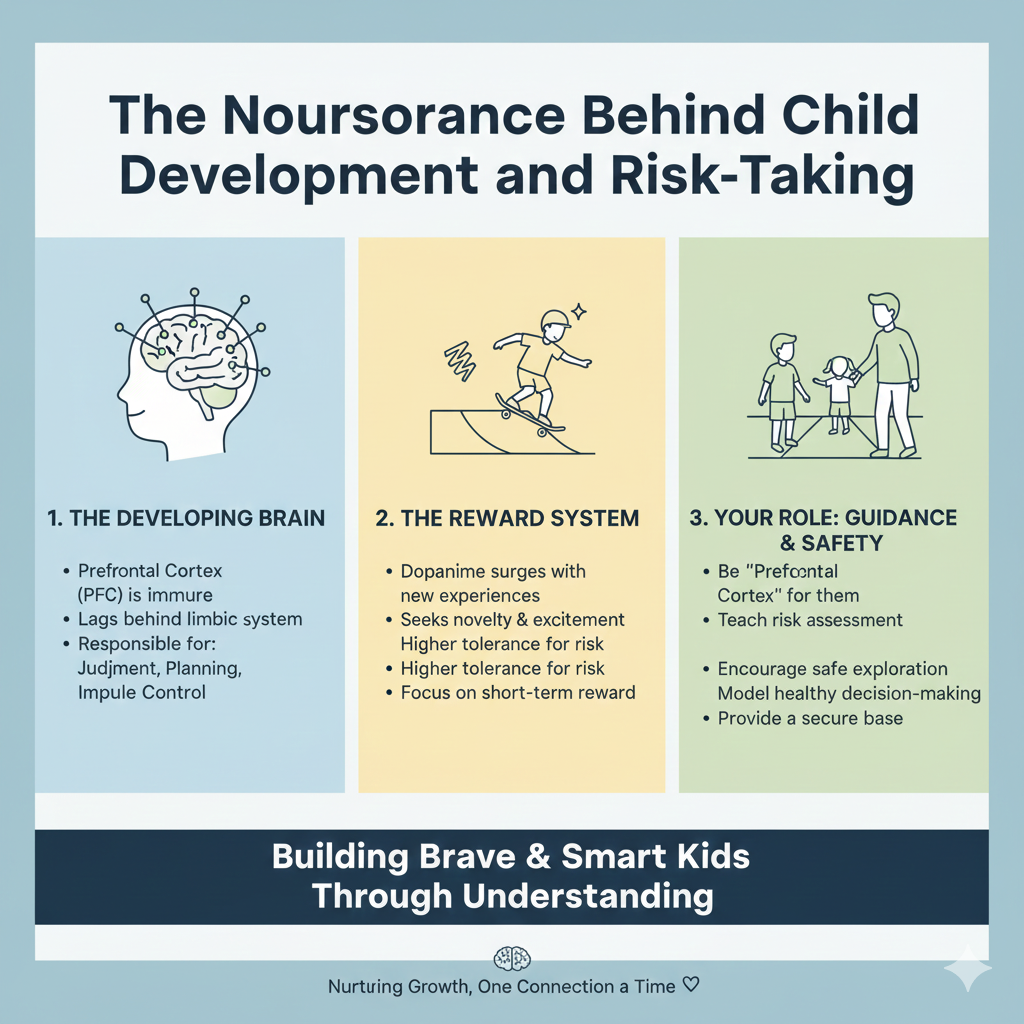
Brain development explains much boundary-pushing behavior. Understanding the neuroscience creates empathy and informs effective responses.
Prefrontal cortex immaturity: The prefrontal cortex—responsible for impulse control, planning, considering consequences, and regulating behavior—doesn’t fully mature until the mid-twenties. Children and teenagers literally lack the neurological equipment for consistent self-control.
When children push boundaries, they’re not choosing poor behavior from a fully developed decision-making center. They’re operating with under-construction brain architecture. Expecting adult-level self-regulation from developing brains is neurologically unrealistic.
Dopamine and reward systems: The adolescent brain is particularly reward-sensitive. Dopamine responses to novel, exciting, or risky experiences are heightened during adolescence, explaining why teenagers take risks that adults find baffling. This neurological reality drives boundary pushing, especially in social contexts.
Research shows that adolescent risk-taking isn’t due to inability to recognize danger—teens understand risks as well as adults. Rather, the reward center overwhelms the still-developing regulatory systems, especially in peer presence.
Executive function development: Executive functions—working memory, cognitive flexibility, inhibitory control—develop gradually throughout childhood and adolescence. These skills are precisely what boundary testing challenges. Children aren’t refusing to use executive functions; they’re developing them through practice.
Mirror neurons and social learning: Children’s brains are wired to learn through observation and imitation. When they see others (siblings, peers, characters) pushing boundaries, their mirror neurons activate, making them more likely to test similar limits. This isn’t peer pressure weakness—it’s how human brains learn.
The teenage brain’s unique wiring: During adolescence, the brain undergoes massive reorganization. Neural pruning eliminates unused connections while strengthening frequently used pathways. Risk-taking and boundary testing during this period actually shape brain development, determining which neural pathways persist into adulthood.
Stress response and learning: Moderate stress (like appropriately enforced boundaries) enhances learning by activating attention and memory systems. Children need to experience mild discomfort from limit-testing to develop emotional regulation. Preventing all stress interferes with resilience development.
Understanding neuroscience doesn’t excuse poor behavior, but it contextualizes it. We wouldn’t expect a child learning to walk to never fall; similarly, we shouldn’t expect developing brains to demonstrate mature self-regulation consistently.
How Boundary Pushing Builds Independence and Self-Confidence
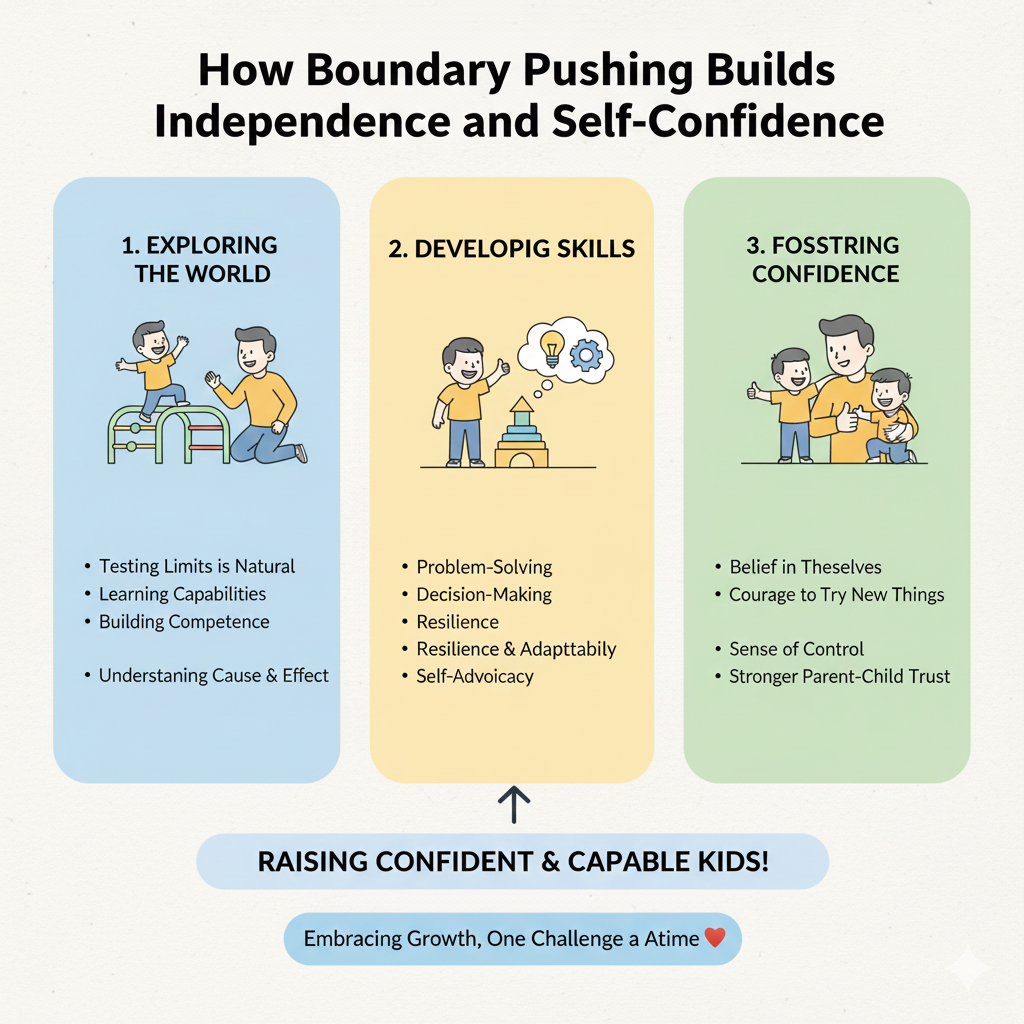
While frustrating in the moment, boundary testing develops crucial life skills and psychological strengths that serve children throughout life.
Self-efficacy through agency: When children push boundaries and experience consequences—both when boundaries hold and when they earn increased freedoms—they develop self-efficacy. They learn their actions matter and they can influence outcomes. This belief in personal effectiveness is fundamental to achievement and wellbeing.
Albert Bandura’s research on self-efficacy shows it predicts academic success, career achievement, resilience during adversity, and mental health. Boundary testing is practice ground for developing this crucial trait.
Decision-making skills development: Each boundary test is a decision with consequences. Through repeated cycles of choice-outcome-reflection, children build decision-making capacity. They learn to evaluate options, predict consequences, weigh risks against benefits, and learn from mistakes.
Overprotected children who never test boundaries don’t develop these skills. They reach adulthood without the practice necessary for sound judgment.
Emotional resilience and frustration tolerance: When boundaries hold despite testing, children experience disappointment. While uncomfortable, this builds resilience—the capacity to encounter setbacks and recover. Adults who crumble at minor frustrations often missed these childhood opportunities to develop frustration tolerance.
Problem-solving and creativity: Boundary pushing requires creativity. Children finding loopholes, negotiating skillfully, or developing elaborate arguments are exercising cognitive skills that translate to innovation and problem-solving in other domains.
The child who argues persuasively about why bedtime should be later is developing rhetorical skills valuable for future advocacy, leadership, and career success.
Understanding consequences and accountability: Natural and logical consequences following boundary tests teach accountability. Children learn their choices have results, developing the connection between action and outcome essential for responsible adulthood.
Differentiation and identity clarity: Through testing boundaries, children discover what matters to them versus what matters to parents. “I’ll push back on this but comply with that” reveals their emerging values and preferences. This differentiation is necessary for authentic identity formation.
Healthy skepticism and critical thinking: Children who never question rules become adults who blindly follow authority. Appropriate boundary testing develops the healthy skepticism necessary for critical thinking, ethical reasoning, and resisting manipulation or peer pressure.
The goal isn’t producing compliant children who never question—it’s raising thoughtful adults who can evaluate situations and make principled decisions, even when those decisions differ from others’ expectations.
Different Types of Boundary Testing Behavior
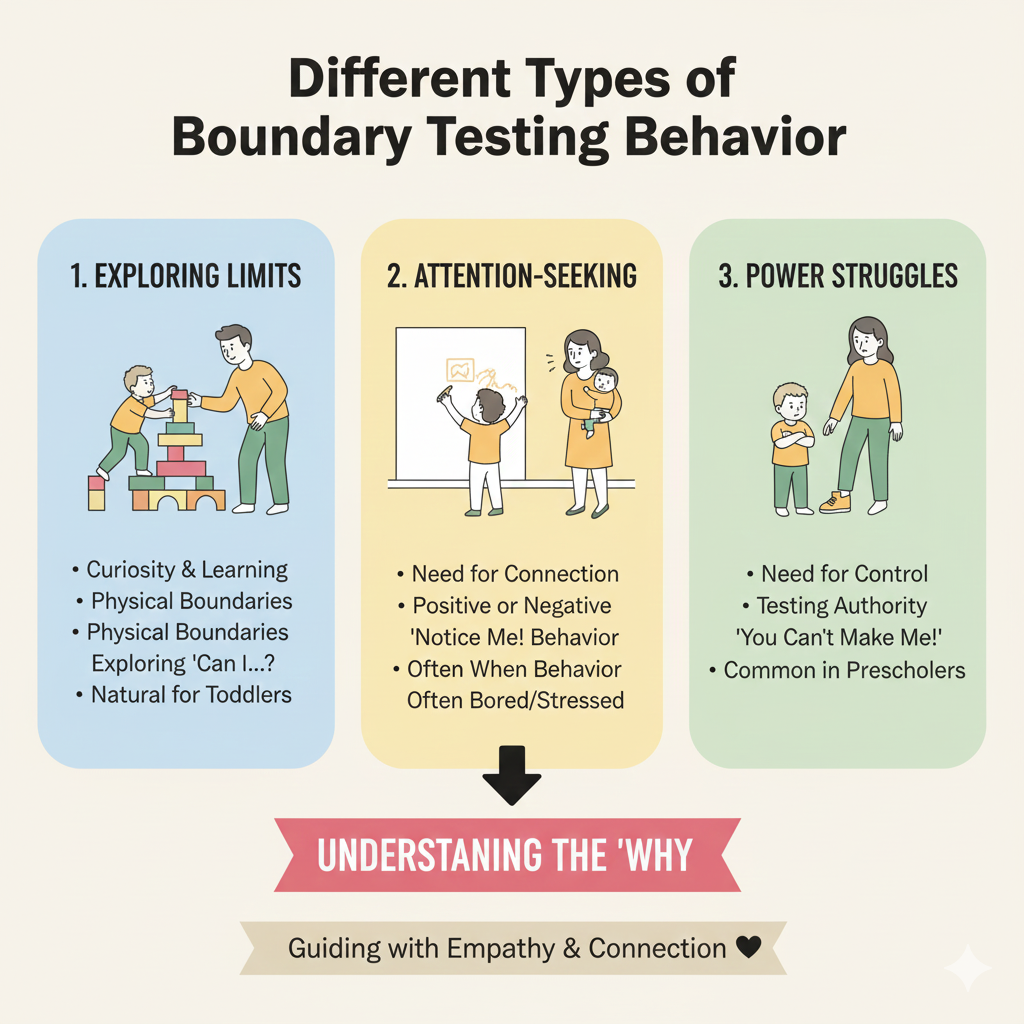
Not all boundary pushing looks the same. Recognizing different types helps parents respond appropriately rather than treating all testing as identical defiance.
Exploratory testing: Young children especially engage in boundary testing simply to understand rules. “What happens if…?” drives this behavior. A toddler touching something forbidden after being told “no” is gathering information, not being willfully disobedient.
Response: Clear, calm consistency. “I said no touching. That’s not safe.” Then redirect attention.
Developmental testing: As children reach new stages, they test boundaries to see if rules adjust with their growth. A newly verbal toddler might refuse naps, testing whether talking ability changes requirements. A new teenager might challenge curfew, testing whether puberty brings new freedoms.
Response: Acknowledge growth while maintaining age-appropriate boundaries. “You are getting older, and bedtime is still 8:00. When you’re ten, we’ll discuss a later time.”
Attention-seeking testing: When children feel disconnected or invisible, negative attention becomes preferable to no attention. Boundary pushing reliably summons parental involvement, making it an effective (if maladaptive) strategy for connection.
Response: Increase positive attention proactively. “I notice you’ve been testing rules more lately. Let’s spend some time together.” Address the underlying need rather than just the behavior.
Power and control testing: Children feeling powerless in most areas exert control through boundary pushing. This intensifies during periods of major change (new sibling, divorce, move) when children feel especially out of control.
Response: Offer choices within boundaries. “You don’t have a choice about bath time, but you can choose bubble bath or toys.” Provide appropriate autonomy.
Values-based testing: Older children and teenagers test boundaries that conflict with their emerging values. A teen passionate about environmental issues might challenge family consumption patterns. This isn’t disrespect—it’s identity formation.
Response: Welcome the conversation. “I’m interested in your perspective. Tell me more about why this matters to you.” Distinguish between testing household rules and expressing developing values.
Peer-influenced testing: Especially during school years, children test boundaries their peers don’t have. “Everyone else gets to…” drives this behavior. They’re negotiating the intersection of family expectations and social norms.
Response: Acknowledge without changing rules. “Other families make decisions that work for them. In our family, this is our rule.” Explain reasoning when appropriate.
Limit-seeking testing: Some children push until they hit firm boundaries. These children find security in knowing where limits are. When boundaries are vague or inconsistent, they escalate behavior until they encounter clear stopping points.
Response: Provide clear, consistent boundaries. These children need to know rules are reliable, not negotiable.
Manipulation testing: Older children and teens might test boundaries strategically, seeking loopholes or exceptions. They’re developing negotiation skills—arguably a positive developmental sign, if frustrating.
Response: Appreciate the cleverness while maintaining boundaries. “Nice try. Creative thinking. And the rule still stands.”
Recognizing which type of testing is occurring informs effective responses. The child seeking attention needs connection, not stricter consequences. The child seeking limits needs consistency, not flexibility.
Age-Specific Boundary Testing: What to Expect
Boundary testing looks different across developmental stages. Realistic expectations based on age reduce parental frustration and guide appropriate responses.
Infants (0-12 months):
What it looks like: Minimal true boundary testing. Behaviors like dropping food or repeating actions are exploration, not testing.
Developmental purpose: Learning cause and effect, exploring physical capabilities.
Parent response: Redirect gently. “Food stays on the tray.” Environment management prevents most issues.
Toddlers (1-3 years):
What it looks like: The famous “no” phase. Doing the opposite of instructions. Testing the same boundary repeatedly. Physical testing (climbing, touching forbidden items).
Developmental purpose: Establishing autonomy, understanding rules are consistent, learning cause and effect.
Why it intensifies: First major individuation period. “I am separate from my parent” is a profound discovery requiring repeated confirmation.
Parent response: Clear, simple boundaries with immediate follow-through. “I said no. That’s hot.” Redirection. Pick battles—not everything is worth fighting.
Preschoolers (3-5 years):
What it looks like: Verbal negotiation begins. “Why?” becomes constant. Testing rules in different contexts. Selective hearing. Boundary pushing with peers emerges.
Developmental purpose: Understanding reasoning behind rules, testing whether rules apply everywhere, developing language and negotiation skills.
Why it intensifies: Language explosion allows verbal testing. Theory of mind (understanding others have different perspectives) begins developing.
Parent response: Brief explanations without extensive negotiation. “We hold hands in parking lots for safety. That’s not negotiable.” Offer choices within limits.
Early Elementary (6-9 years):
What it looks like: Arguing about fairness. Comparing rules to peers’ families. Testing adult consistency across settings (does school rule match home rule?). Lying or rule-bending emerges.
Developmental purpose: Understanding justice and fairness, reconciling different rule systems, testing integrity of moral codes.
Why it intensifies: Concrete operational thinking develops. Logical reasoning improves, enabling more sophisticated testing.
Parent response: Acknowledge fairness concerns without changing appropriate boundaries. “I understand you think this is unfair. In our family, this is our rule.” Discuss values underlying rules.
Tweens (10-12 years):
What it looks like: Questioning family values. Increased privacy-seeking. Testing boundaries around technology, peer activities, independence. Eye-rolling and attitude.
Developmental purpose: Beginning identity formation, increasing peer importance, testing readiness for adolescent independence.
Why it intensifies: Early puberty begins. Prefrontal cortex continues developing while reward systems become more active, creating imbalance.
Parent response: Distinguish between attitude (address disrespectful communication) and questioning (welcome thoughtful challenges). Grant increasing autonomy with demonstrated responsibility.
Teenagers (13-18 years):
What it looks like: Challenging authority more directly. Risk-taking increases. Testing curfews, privacy boundaries, rules around substances, dating, driving. Significant arguments about autonomy.
Developmental purpose: Identity consolidation, separation from family, preparing for independent adulthood, peer relationship primacy.
Why it intensifies: Major brain reorganization. Identity versus role confusion. Biological drive toward independence peaks.
Parent response: Maintain safety boundaries firmly while increasing age-appropriate freedoms. Connection over control. Natural consequences when safe. Collaborative problem-solving rather than dictates.
Young Adults (18+):
What it looks like: Testing adult relationship boundaries. Challenging parental advice. Making independent choices parents disagree with.
Developmental purpose: Establishing adult identity, building independent life, redefining parent-child relationship.
Parent response: Transition from authority to consultant. Offer perspectives without demanding compliance. Respect autonomy while maintaining your own boundaries.
Understanding developmental stages normalizes boundary testing, reducing the tendency to take it personally or respond reactively.
The Connection Between Secure Attachment and Healthy Testing
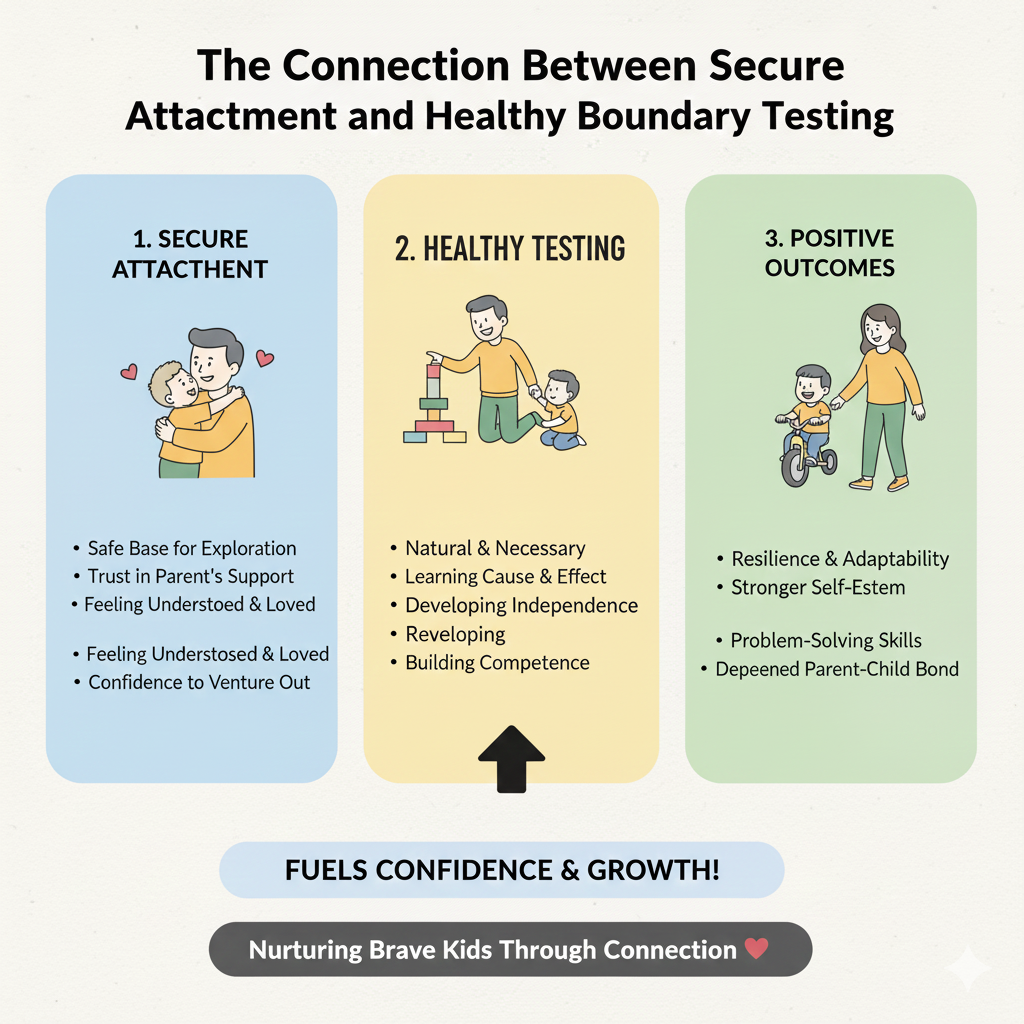
Attachment theory illuminates why secure children test boundaries more confidently—and why consistent responses to testing strengthen attachment.
Secure attachment provides foundation for exploration: John Bowlby’s attachment theory describes how secure base relationships enable exploration. Children confident in caregiver availability explore more boldly, including testing boundaries. Paradoxically, securely attached children may test more, not less, because they trust the relationship will survive the testing.
Testing as attachment assessment: Children periodically verify attachment security through behavior that asks: “Will you still love me if I’m difficult? Will you still set limits, showing you care about my wellbeing?” Boundary testing is sometimes disguised attachment checking.
Consistent responses build secure attachment: When caregivers respond to boundary testing with calm, consistent limits while maintaining emotional connection, they reinforce secure attachment. The message: “I love you always. Your behavior has consequences. These are separate things.”
Inconsistent responses create anxiety: Unpredictable responses to boundary testing activate attachment anxiety. Children don’t know what to expect, creating insecurity. They test more frantically, seeking the predictability attachment requires.
Harsh responses damage attachment: Punishment that feels like withdrawal of love (shaming, rejection, “I don’t like you when you’re like this”) threatens attachment security. Children may comply through fear but at the cost of secure connection.
The “good enough” parent concept: Donald Winnicott’s research shows perfect parenting isn’t necessary—”good enough” parenting where caregivers respond appropriately most of the time creates secure attachment. You won’t handle every boundary test perfectly. Consistent overall patterns matter more than perfect consistency.
Repair after rupture matters: When you respond poorly to boundary testing (everyone does sometimes), repair strengthens rather than damages attachment. “I yelled earlier. That wasn’t okay. I’m sorry” teaches accountability while reinforcing connection.
Attachment and autonomy aren’t opposites: Secure attachment enables healthy autonomy. Children confident in connection can separate, explore, and test boundaries because they trust they can return to secure base. Insecurely attached children may cling (unable to separate) or distance (unable to trust connection), both preventing healthy boundary testing.
Parenting style interactions: Authoritative parenting (high warmth, high structure) combined with secure attachment produces the healthiest boundary testing—confident, persistent, but responsive to limits. Authoritarian (low warmth, high control) creates fearful compliance or rebellion. Permissive (high warmth, low structure) creates anxiety from lack of boundaries.
Understanding attachment reframes boundary testing from threat to relationship opportunity. Each test answered with consistency and connection strengthens the bond that enables healthy development.
Setting Firm Boundaries While Encouraging Healthy Exploration
The parenting challenge: maintaining clear limits while supporting the developmental benefits of boundary testing. This balance is achievable with intentional strategies.
Distinguish between negotiable and non-negotiable boundaries:
Non-negotiable (safety, respect, core values): “We don’t hit. Ever. That’s not up for discussion.”
Negotiable (preferences, logistics, age-appropriate choices): “You want a later bedtime. Let’s discuss what might work.”
Children who know which boundaries are flexible and which are firm waste less energy testing non-negotiables.
Explain the “why” behind boundaries: Age-appropriate reasoning helps children understand rules aren’t arbitrary. “We hold hands in parking lots because drivers might not see small children. I need to know you’re safe.”
Understanding doesn’t mean children won’t test, but it provides cognitive framework for eventual internalization.
Offer autonomy within boundaries: “You must wear shoes outside. You choose which shoes.” Control within structure satisfies autonomy needs while maintaining limits.
Use “yes” more than “no”: When possible, redirect to acceptable alternatives rather than just prohibiting. “You can’t draw on walls. You can draw on this paper.” This respects exploration while maintaining boundaries.
Create “yes spaces” for exploration: Designated areas where rules relax allow safe boundary testing. A mud kitchen for messy play. A basement where yelling is okay. Specific times when usual rules don’t apply.
Adjust boundaries as children demonstrate readiness: “You’ve shown you can manage 30 minutes of screen time responsibly. Let’s try 45 minutes.” Earned freedom rewards maturity and motivates responsibility.
Maintain boundaries calmly: Emotional reactions escalate testing. “I see you’re testing bedtime. It’s still 8:00. Time for pajamas” delivered calmly is more effective than frustrated escalation.
Follow through consistently: Empty threats teach boundary testing works. State consequences you’ll actually enforce, then enforce them every time.
Acknowledge the testing explicitly: “You’re testing whether this rule still applies. It does.” Direct naming sometimes satisfies the need to test without lengthy battles.
Celebrate appropriate assertiveness: When children advocate for themselves respectfully, acknowledge it. “You made a good case for why you think this rule is unfair. I appreciate you expressing that respectfully.”
Model boundary-setting: Children learn from watching you set boundaries with others. “I know you’d like me to stay later, but I need to get home to my family” demonstrates healthy limit-setting.
Repair and reconnect after boundary conflicts: After enforcing limits, especially if conflict occurred, reconnect. “Earlier was hard. I love you. Want to read together?” Separates the behavior from the relationship.
The goal isn’t eliminating boundary testing—it’s channeling it productively while maintaining necessary limits.
Teaching Children to Self-Regulate Through Boundaries
External boundaries gradually become internal self-regulation. This transformation is the ultimate goal of discipline.
The internalization process: Young children need external control. With repeated experience of boundaries consistently enforced with explanation, they gradually internalize these limits. “Mom says no touching the stove” becomes “Hot things aren’t safe” becomes automatic avoidance.
This process requires hundreds or thousands of repetitions. Patient consistency is key.
Scaffolding self-regulation: Like physical scaffolding supporting a building under construction, parental boundaries support developing self-regulation. As internal capacity grows, external support reduces. Too much scaffolding prevents development; too little causes collapse.
The role of executive function: Self-regulation requires executive functions that develop slowly. By late elementary years, children can begin managing simpler self-regulation tasks (homework, morning routine). By adolescence, more complex regulation (long-term planning, emotional control) emerges.
Expecting self-regulation before neurological readiness frustrates everyone. Age-appropriate expectations prevent this.
Teaching metacognition: Help children think about their thinking. “You really wanted the candy, but you waited until after dinner like we agreed. How did you manage that?” This reflection builds awareness of self-regulation strategies.
Emotion regulation precedes behavioral regulation: Children must recognize and manage emotions before they can regulate behavior driven by those emotions. Teaching emotional literacy and coping strategies is foundational.
The “outside voice” becoming “inside voice”: Initially, parents provide the regulatory voice: “Use gentle hands.” With repetition, children mouth these words to themselves. Eventually, the external voice becomes internal dialogue. You’re literally building their self-talk.
Praising self-regulation attempts: Notice and acknowledge when children regulate successfully. “You were really angry, but you took deep breaths instead of hitting. That’s excellent self-control.” Recognition reinforces the behavior.
Allowing safe mistakes: Children need to experience consequences of poor self-regulation in low-stakes situations. A child who doesn’t save allowance and can’t afford a desired toy learns more than one whose parents always rescue them.
Gradual responsibility transfer: Demonstrate, supervise, coach, then step back. With homework: you sit with them (demonstrate), nearby (supervise), check in periodically (coach), then trust independently (step back). Each phase builds self-regulation capacity.
Connecting boundaries to future competence: “Learning to manage frustration now helps you handle challenges as an adult.” Long-term perspective motivates children to work on self-regulation.
Modeling self-regulation: Children learn from watching you manage frustration, delay gratification, and recover from mistakes. Your self-regulation is their blueprint.
Boundary testing is the training ground for self-regulation. Each test answered consistently teaches children they can trust their own internal limits, gradually reducing need for external control.
When Boundary Pushing Becomes Concerning
While most boundary testing is healthy, extreme or persistent patterns may signal underlying issues requiring professional attention.
Warning signs of concerning boundary testing:
Extreme frequency or intensity: All children test boundaries, but if it’s constant, exhausting, and unresponsive to consistent intervention, evaluation may be warranted.
Complete disregard for safety: Typical risk-taking differs from genuine inability to assess danger or compulsive dangerous behavior.
Significant impairment: When boundary testing severely impacts school performance, peer relationships, or family functioning despite appropriate parenting responses.
Emotional dysregulation: If testing always involves extreme emotional reactions—rage, aggression, complete meltdowns disproportionate to the situation.
No response to consistent intervention: After months of consistent, appropriate boundary-setting, behavior worsens or shows no improvement.
Sudden dramatic change: Abrupt escalation in boundary testing may signal trauma, peer problems, or mental health concerns.
Developmental regression: Testing that seems more characteristic of much younger children may indicate stress or developmental concerns.
Potential underlying issues:
ADHD: Impulsivity and difficulty with inhibitory control drive boundary testing. Children want to comply but neurologically struggle with self-control.
Oppositional Defiant Disorder (ODD): Pattern of angry, irritable mood; argumentative, defiant behavior; or vindictiveness lasting at least six months beyond typical boundary testing.
Anxiety: May manifest as control-seeking, rigidity, or testing to manage overwhelming internal anxiety.
Autism Spectrum Disorder: Difficulty understanding social rules, need for sameness, and sensory sensitivities may appear as boundary testing.
Trauma: Past trauma creates hypervigilance, control needs, or difficulty trusting authority, manifesting as excessive boundary testing.
Learning disabilities: Frustration from academic struggles often emerges as behavioral issues.
Family stressors: Parental conflict, divorce, financial stress, or other family dysfunction increase boundary testing.
When to seek professional help:
Your parenting strategies consistently fail despite implementing them correctly.
You feel overwhelmed, exhausted, or the parent-child relationship is severely strained.
The child seems genuinely distressed about their own behavior but can’t control it.
Concerning patterns persist for 6+ months despite intervention.
Safety concerns arise—for the child, siblings, or others.
Professional resources:
Pediatrician: Rule out medical causes, discuss development, provide referrals.
Child psychologist: Assessment and therapy for behavioral or emotional concerns.
Family therapist: Address relationship patterns and communication.
Developmental pediatrician: Evaluate ADHD, autism, other developmental conditions.
School consultation: Determine if school-based support (IEP, 504 plan) could help.
Most boundary testing is normal, healthy development. But when it crosses into concerning territory, professional support helps identify root causes and develop effective interventions.
Positive Parenting Strategies for Boundary Testing
Responding effectively to boundary testing requires specific strategies that maintain limits while supporting development and preserving relationships.
Stay calm and neutral: Your emotional regulation teaches theirs. Respond to testing with calm consistency rather than frustration or anger. “You’re testing bedtime again. It’s still 8:00.”
Acknowledge the underlying need: “You’re pushing because you want more independence. I understand that.” Validation reduces intensity even when boundary remains.
Use “I notice” statements: “I notice you’re arguing a lot about screen time lately. Let’s talk about what’s going on.” Observation without judgment opens dialogue.
Offer choices within limits: “You must wear a coat. Red or blue?” Autonomy within boundaries satisfies need for control.
Natural consequences when safe: “You chose not to bring your jacket. You’ll feel cold. Hopefully tomorrow you’ll decide differently.”
Logical consequences: “You threw your toy. It goes away for the rest of today.” Directly related consequences teach more effectively.
Time-in over time-out: Stay connected during difficult moments. “You’re having a hard time. Let’s sit together until you feel calmer.”
The broken record technique: Calmly repeat the same boundary without elaboration. “Bedtime is 8:00.” “But—” “Bedtime is 8:00.” “I want—” “Bedtime is 8:00.” Refuse to engage in debate.
Empathy plus boundaries: “I know you’re disappointed, and the answer is still no.” Both matter equally.
Appreciate the skill development: “You made a really persuasive argument. I see your negotiation skills are developing. And the rule stays the same.” Acknowledge growth while maintaining limits.
Connect before correcting: When testing increases, increase positive connection time. Often the testing decreases when the underlying need for connection is met.
Collaborative problem-solving: “You’re pushing back on homework time. Let’s figure out a better system together.” Involvement increases buy-in.
Reframe testing positively: “You have strong opinions and advocate for yourself. These are leadership qualities. We need to find respectful ways to express them.”
Pick battles strategically: Not every test requires engagement. Ignore minor provocations; respond consistently to important boundaries.
Repair after conflicts: After boundary testing creates conflict, reconnect. “That was hard earlier. I love you. Want to play a game together?”
Celebrate compliance: When children accept boundaries gracefully, notice it. “You really wanted to stay up later, but you accepted bedtime without arguing. That shows maturity.”
Model boundary-setting: Demonstrate healthy boundaries with others. Children learn from watching you.
Self-care: Responding calmly to testing requires emotional reserves. Prioritize sleep, support, and stress management.
Long-term perspective: Remember you’re teaching lifelong skills, not just managing today’s conflict. The investment pays forward.
These strategies share common elements: maintaining connection, teaching skills, respecting the child’s developing autonomy, and staying calm.
Real-Life Examples: Reframing Boundary Testing Positively
Shifting perspective from viewing boundary testing as defiance to recognizing it as development transforms parenting experiences.
Example 1: The persistent “Why?”
Old mindset: “She’s questioning every single thing I say. She’s so defiant!”
New mindset: “She’s developing critical thinking skills and wants to understand reasoning. This will serve her well in school and life.”
Response: Answer once or twice, then: “I’ve explained. The decision is final. I appreciate that you want to understand, and I need you to accept this boundary now.”
Example 2: The toddler touching the forbidden item
Old mindset: “He touched it right after I said no. He’s deliberately disobeying!”
New mindset: “His impulse control is still developing. He’s learning that words predict outcomes. This takes repetition.”
Response: Calmly redirect. “I said no touching. Let’s look at this toy instead.” Repeat consistently.
Example 3: The teenager arguing about curfew
Old mindset: “She’s so disrespectful, arguing about every rule!”
New mindset: “She’s developing autonomy and testing whether childhood rules apply as she matures. She’s also practicing advocacy skills.”
Response: “I hear you want a later curfew. Let’s discuss what you’d need to demonstrate to earn that. For now, curfew stays at 11.”
Example 4: The preschooler saying “no” constantly
Old mindset: “He says no to everything! So stubborn!”
New mindset: “He’s discovering he’s separate from me with his own preferences. This autonomy is crucial for healthy development.”
Response: Offer choices when possible. “It’s time for bath. Would you like bubbles or toys tonight?” On non-negotiables: “I hear you saying no. Bath time isn’t a choice.”
Example 5: The child finding loopholes
Old mindset: “She’s always trying to get around rules. So manipulative!”
New mindset: “She’s developing problem-solving skills and creative thinking. These will serve her well in careers and life.”
Response: “Nice creative thinking! And the spirit of the rule is clear—no screens before homework. That includes this loophole.”
Example 6: The multiple bedtime requests
Old mindset: “Just more stalling. He’s playing me!”
New mindset: “Separation at bedtime is hard. He’s seeking connection and reassurance before facing sleep alone.”
Response: “I hear you want more time together. We’ve had stories and songs. Now it’s sleep time. I love you. See you in the morning.”
Example 7: The boundary testing after stressful events
Old mindset: “Great, his grandmother just died and now he’s acting out. Add this to our grief!”
New mindset: “He’s processing overwhelming emotion. Testing boundaries verifies security during chaos.”
Response: “I notice you’ve been testing rules more since Grandma died. That’s normal during hard times. The rules stay the same. Want to talk about how you’re feeling?”
Reframing doesn’t mean accepting all behavior—boundaries still matter. But understanding purpose reduces parental frustration and informs more effective responses.
Conclusion: Embracing Boundary Testing as Part of Healthy Development
Boundary testing frustrates parents, exhausts caregivers, and creates household conflict. Yet this behavior serves essential developmental purposes: building independence, developing decision-making skills, forming identity, learning self-regulation, and testing attachment security.
When children push boundaries, they’re doing exactly what their developing brains are designed to do. They’re learning about their world, themselves, and their relationships through direct experience. The persistent “no” of toddlerhood, the constant “why” of preschool years, the testing of elementary age, and the challenges of adolescence all represent necessary developmental work.
This doesn’t mean accepting all behavior or abandoning boundaries. Clear, consistent limits remain essential for security and healthy development. But understanding why testing occurs transforms how we respond—with less frustration, more empathy, and greater effectiveness.
The goal isn’t eliminating boundary testing but channeling it productively. Maintain firm boundaries on safety and respect. Allow flexibility on preferences and age-appropriate choices. Respond with calm consistency rather than anger. Connect before correcting. Celebrate growing independence while providing necessary structure.
Remember that today’s persistent boundary tester becomes tomorrow’s critical thinker, effective advocate, and confident decision-maker. The child who never questions becomes an adult who can’t evaluate situations independently. The teenager who never challenges family values doesn’t develop their own authentic identity.
Your exhausting work maintaining boundaries while supporting exploration isn’t just managing daily conflicts—it’s building the foundation for healthy adulthood. The investment in responding thoughtfully to thousands of boundary tests creates adults who can set their own boundaries, make principled decisions, and navigate complexity with confidence.
So the next time your child pushes a boundary, take a breath and reframe: This isn’t defiance—it’s development. This isn’t a problem to solve—it’s an opportunity to teach. And this exhausting moment is actually evidence that your child is growing exactly as they should.