
Discipline & Behavior • Toddlers
Why Your Toddler Hits (and 7 Gentle Ways to Stop It)
By Prasad Fernando • Updated April 2026 • 14 min read

Your sweet, cuddly toddler just smacked you across the face. Or hit another child at the playground. Or slapped the family dog. And now you’re standing there in shock, embarrassment, or frustration wondering: Where did this come from? Did I do something wrong? Is my child going to be aggressive?
First, take a breath. Toddler hitting is one of the most common behavioral challenges parents face between ages 1 and 3, and it is almost always a normal part of development — not a sign of a violent temperament, bad parenting, or a future behavioral disorder. Research in early childhood development consistently shows that physical aggression peaks between ages 2 and 3 and then gradually declines as children develop language, emotional regulation, and social skills.
But “normal” doesn’t mean you should ignore it. How you respond to toddler aggression during these critical years shapes whether hitting remains a temporary developmental phase or becomes an entrenched pattern. The approach that works isn’t punishment, yelling, or hitting back — it’s a combination of understanding, consistency, and gentle guidance that teaches your toddler what to do instead.
This guide explains the brain science behind why toddlers hit, identifies the specific triggers you can watch for, provides 7 evidence-based gentle strategies for how to stop toddler hitting, and addresses the situations parents find most challenging — from hitting at daycare to hitting a new baby sibling.
📑 In This Article
- Why Toddlers Hit: The Brain Science
- The 8 Most Common Hitting Triggers
- What Hitting Means at Different Ages
- What NOT to Do When Your Toddler Hits
- 7 Gentle Ways to Stop Toddler Hitting
- Handling Specific Situations
- When to Be Concerned About Toddler Aggression
- Frequently Asked Questions
Why Toddlers Hit: The Brain Science
Understanding why your toddler hits completely changes how you respond. Toddler hitting is not about anger management problems, defiance, or lack of discipline — it’s about neurodevelopment. Here’s what’s happening inside your toddler’s brain:
The Prefrontal Cortex Is Under Construction
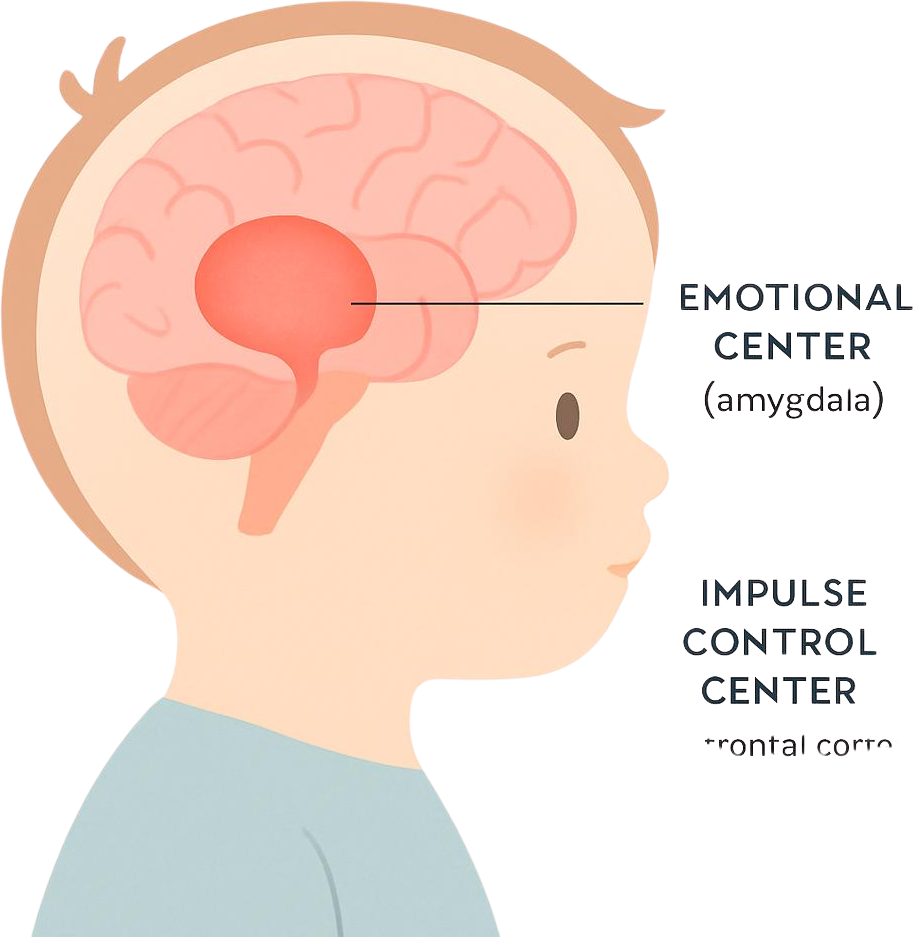
The prefrontal cortex — the brain region responsible for impulse control, reasoning, and decision-making — doesn’t begin significant development until around age 3 and won’t be fully mature until the mid-twenties. When your toddler feels an impulse to hit, they literally lack the neurological hardware to stop themselves. It’s not that they won’t control themselves — they can’t. Not yet. This is the single most important fact about toddler aggression: it reflects brain immaturity, not character.
Big Emotions, Tiny Vocabulary
Toddlers experience emotions with the same intensity as adults — frustration, anger, jealousy, overwhelm, excitement — but possess only a fraction of the words needed to express them. A 2-year-old who feels “I’m frustrated because you took my toy and I was still playing with it and I don’t know how to negotiate with you” has no way to articulate that complex feeling. So their body does the talking instead: they hit. Hitting is their most efficient form of communication when words fail.
Physical Expression Comes Before Verbal Expression
In the developmental timeline, physical action always precedes verbal communication. Babies reach before they point. Toddlers grab before they ask. Hitting before talking through conflict is simply the natural sequence of human development. Your child isn’t choosing hitting over words — they haven’t yet developed the alternative.
The Fight-or-Flight Response Is Hair-Trigger Sensitive
The amygdala (the brain’s alarm system) is fully functional in toddlers, but the prefrontal cortex (which calms the alarm) is not. This means toddlers have an extremely sensitive threat-detection system with almost no braking mechanism. When they feel threatened, frustrated, or overwhelmed, their nervous system fires into fight-or-flight mode instantly — and hitting is the “fight” response in action.
The 8 Most Common Hitting Triggers
Most toddler hitting isn’t random. It’s triggered by specific situations and states. Identifying your child’s triggers is the first step toward preventing hits before they happen:
1. Frustration
The number one trigger. When a tower falls, a toy won’t work, or they can’t do what they’re attempting, frustration overwhelms their limited coping capacity. The hit is an explosion of the frustration they can’t verbalize.
2. Overstimulation
Busy environments, loud noises, too many people, or too much activity flood a toddler’s sensory system. When their nervous system is maxed out, hitting becomes a way to discharge the excess energy and stress.
3. Fatigue and Hunger
A tired or hungry toddler has almost zero emotional resilience. Behaviors that they could manage when well-rested and well-fed become impossible. Many parents notice hitting increases dramatically in the hour before nap time or meals.
4. Wanting Something They Can’t Have
Being told “no” triggers a wave of frustration and disappointment that a toddler’s brain cannot process gradually. The emotion arrives all at once, at full intensity, and the hit is the immediate physical release.
5. Defending Territory or Possessions
Sharing is developmentally beyond most toddlers. When another child reaches for their toy, the toddler’s instinctive response is to protect what’s “theirs” — and hitting is the fastest protection strategy available.
6. Seeking Attention
Even negative attention (yelling, dramatic reactions) is attention. If hitting consistently produces a big response from parents — even an angry one — some toddlers learn that hitting is an effective way to get the focused attention they crave.
7. Imitating What They’ve Seen
Toddlers are imitation machines. If they’ve seen hitting on TV, observed another child hitting at daycare, or experienced physical discipline at home, they may reproduce the behavior because that’s how they learn — by copying.
8. Excitement and Sensory Exploration
Not all hitting is angry. Some toddlers hit when they’re happy or excited — their body is buzzing with energy and they don’t know how to express it appropriately. They may also hit to explore cause and effect: “What happens when I hit this person?”
What Hitting Means at Different Ages
12–18 Months: Exploration, Not Aggression
At this age, hitting is rarely intentional aggression. Babies and young toddlers are exploring cause and effect: “What sound does it make when my hand hits a face? What expression do they make?” They’re also testing the physical properties of the world. Hitting at this age is more like a science experiment than an attack.
Appropriate response: Gently catch their hand, make brief eye contact, and say calmly: “Gentle hands. We touch softly.” Then demonstrate a gentle touch. Keep it simple, consistent, and emotionally neutral.
18–24 Months: Frustration Without Words
This is when frustration-driven hitting typically begins. The toddler’s desires are growing faster than their ability to communicate them. They want the red cup, not the blue one. They want to climb the stairs alone. They want the toy that another child has. But they can’t say any of this, so their body speaks for them.
Appropriate response: Narrate their feelings: “You’re frustrated because you want the red cup. I hear you. Let me get it.” Simultaneously set the limit: “I won’t let you hit. Hitting hurts.” Offer words they can use: “Say ‘help’ or ‘mine.’”
2–3 Years: Peak Aggression, Peak Learning
Research consistently identifies ages 2-3 as the peak period for physical aggression in children. This is the age when toddler aggression is most frequent and most visible. However, it’s also the period of the most rapid decline — as language develops and social skills emerge, hitting naturally decreases for most children. Your response during this window is crucial because it determines how quickly the behavior fades.
Appropriate response: Full implementation of the 7 gentle strategies below. Consistency is more important than perfection. Every calm, clear response builds the neural pathways your toddler needs to manage emotions differently.
3+ Years: Hitting Should Be Decreasing
By age 3-4, most children have enough language and emotional understanding to use words instead of fists most of the time. Hitting may still occur during extreme frustration or transitions, but it should be noticeably less frequent than at age 2. If hitting remains frequent and intense beyond age 3-4, especially if it’s accompanied by other concerning behaviors, it may be worth discussing with your child’s pediatrician.
What NOT to Do When Your Toddler Hits
Some of the most instinctive parental responses to hitting actually make the problem worse. Understanding what doesn’t work is just as important as learning what does:
Don’t Hit Back or Use Physical Punishment
Hitting a child to teach them not to hit sends a deeply contradictory message: “Hitting is wrong, so I’m going to hit you to prove it.” Research by the American Academy of Pediatrics consistently shows that physical punishment increases aggression in children rather than reducing it. The child learns that bigger, stronger people hit when they’re upset — which is exactly the lesson you’re trying to undo. This is the most counterproductive response to toddler hitting.
Don’t Yell or Have a Big Emotional Reaction
A dramatic reaction — yelling, gasping, long lectures — can accidentally reinforce hitting. Toddlers crave attention, and if hitting produces the biggest, most animated response in the house, some toddlers will repeat it for the reaction. Stay calm and brief. Your composure communicates that you’re in control, which actually helps regulate your toddler’s nervous system.
Don’t Force an Apology
Making a screaming, dysregulated toddler say “I’m sorry” teaches them to perform a meaningless social ritual, not to feel genuine remorse. Toddlers under 3 cannot yet understand the concept of apology as adults mean it. Instead, model empathy: “Let’s check if your friend is okay” teaches caring behavior without empty words.
Don’t Use Time-Outs for Toddlers Under 3
Traditional time-outs (sitting alone on a chair) are not developmentally appropriate for most children under 3. Young toddlers don’t have the cognitive capacity to sit, reflect on their behavior, and plan a different response. What they experience during a time-out is isolation and confusion, not learning. A “time-in” (staying with the child while they calm down) is more effective at this age.
Don’t Label the Child
“You’re being mean” or “You’re a hitter” attaches an identity to the behavior. Children internalize labels and begin to act accordingly. Instead, label the behavior: “Hitting hurts. We use gentle hands.” This communicates that the action is wrong without telling the child that they are fundamentally bad.

7 Gentle Ways to Stop Toddler Hitting
These evidence-based strategies draw from developmental neuroscience and positive parenting research. They work because they address the root cause of hitting — brain immaturity and emotional overwhelm — rather than just punishing the symptom. Here’s how to stop toddler hitting with approaches that build lasting skills:
1. Stop the Hit Calmly and Set a Clear Limit
When your toddler hits, the first step is always the same: physically prevent further hitting (gently catch or block their hand), get down to their eye level, and state the limit clearly and briefly:
The Script: “I won’t let you hit. Hitting hurts.”
That’s it. No lecture. No explanation of why hitting is wrong. No emotional monologue. Seven words. Delivered calmly, firmly, and with consistent eye contact. Your toddler’s overwhelmed brain can process about this much information during a moment of emotional flooding — no more.
Repeat this exact phrase every single time. Consistency is what builds understanding. After hearing “I won’t let you hit. Hitting hurts” a hundred times, the message begins to internalize.
2. Validate the Emotion Behind the Hit
After setting the limit, acknowledge what your toddler was feeling. This is not excusing the behavior — it’s teaching them that the feeling was valid even though the action was not:
“You’re angry because she took your truck. It’s okay to be angry. It’s NOT okay to hit.”
This two-part message is transformative over time. It teaches emotional vocabulary, validates their inner experience, and simultaneously maintains the boundary. Children who learn that their emotions are acceptable but certain actions are not develop stronger emotional regulation than children whose emotions are dismissed or punished.
3. Teach the Replacement Behavior (“Instead Of”)
Simply telling a toddler “don’t hit” creates a behavioral vacuum — they know what NOT to do but have no idea what TO do instead. Always pair the limit with an alternative:
- “Hands are not for hitting. If you’re angry, you can stomp your feet.”
- “No hitting. If you want a turn, you can say ‘my turn please.’”
- “We don’t hit people. You can hit this pillow if your body needs to hit something.”
- “Gentle hands with friends. Show me gentle.” (Then physically guide their hand in a gentle touch.)
Offering a replacement behavior gives the toddler a concrete alternative. Over time and with practice, the replacement becomes their default response instead of hitting.
4. Intervene BEFORE the Hit (Sportscasting)
The most effective strategy for how to stop toddler hitting is preventing it from happening in the first place. Learn to read your toddler’s pre-hitting signals: tensing up, clenching fists, that specific look in their eyes, moving aggressively toward another child. When you see these signs, intervene immediately:
“I can see you’re getting frustrated. It looks like you want that toy. Let’s ask together: ‘Can I have a turn?’”
This technique, called “sportscasting,” involves narrating what you observe in real time. It gives the toddler language for their experience and models the social skill they haven’t yet developed. Consistent sportscasting dramatically reduces hitting because it interrupts the emotion-to-action cycle before the action occurs.
5. Use “Time-In” Instead of Time-Out
When your toddler hits, instead of isolating them, bring them close. Sit with them. Hold them if they’ll allow it. Stay calm and present while they process their big emotion. This is called a “time-in” and it works because:
- A dysregulated toddler needs a regulated adult nearby to help them calm down (this is called co-regulation).
- Your calm nervous system literally helps regulate theirs — this is neuroscience, not just theory.
- The toddler learns that big emotions are manageable and that you’re a safe person to feel those emotions around.
- It prevents the shame and abandonment feelings that isolation can create in very young children.
A time-in might look like: sitting on the floor together, offering a comfort object, speaking softly (“I’m here. You’re safe. We’ll figure this out”), and waiting for the storm to pass. Once they’re calm, then you can briefly address the hitting.

6. Teach Emotional Vocabulary Daily (Not Just During Hitting)
The long-term solution to toddler aggression is language. The more words your toddler has for their feelings, the less they need to use their fists. But emotional vocabulary can’t be taught in the heat of the moment — it needs to be built during calm, everyday interactions:
- Narrate emotions throughout the day: “You look really happy playing with those blocks!” “I think you’re feeling frustrated that the lid won’t open.”
- Read books about feelings and discuss the characters’ emotions.
- Name your own emotions: “I’m feeling a little frustrated right now because I burned the toast. I’m going to take a deep breath.”
- Use a feelings chart with faces showing different emotions and practice identifying them together.
Research shows that children whose parents consistently narrate emotions develop larger emotional vocabularies and show less physical aggression by age 3 compared to children whose emotional experiences go unlabeled.
7. Manage the Environment (Reduce Triggers)
Prevention is always more effective than reaction. Once you’ve identified your toddler’s hitting triggers, modify the environment to reduce them:
- Hunger: Keep snacks available during outings and activities. Never let your toddler get ravenously hungry.
- Fatigue: Protect nap times fiercely. Schedule playdates and outings when your toddler is well-rested, not at the end of a long day.
- Overstimulation: Limit time in overwhelming environments. Build in quiet breaks during busy days.
- Sharing conflicts: Provide duplicate popular toys during playdates. Don’t force sharing with toddlers under 3.
- Transitions: Give warnings before changes: “Two more minutes, then we’re leaving the playground.”
- Screen content: Limit exposure to shows with physical aggression, even cartoon violence.
You can’t eliminate every trigger, but reducing the most predictable ones can cut hitting incidents significantly — sometimes by half or more.
Handling Specific Hitting Situations
When Your Toddler Hits YOU (the Parent)
Being hit by your own child is emotionally jarring. Remember: they hit you because you’re their safest person. They express their biggest emotions with you because the relationship can handle it. This doesn’t make it acceptable, but it explains why you often get the worst behavior.
Response: Gently catch their hand. Say: “I won’t let you hit me. Hitting hurts my body.” If they continue, calmly create physical distance: “I’m going to put you down now because my body needs to be safe. I’m right here when you’re ready for gentle hands.” Stay nearby but protect your body. They need to learn that hitting ends the physical closeness they desire.
When Your Toddler Hits Other Children
This is the situation parents find most embarrassing and urgent. In the moment, prioritize the hurt child first: “Are you okay? Let me check.” This models empathy and teaches your toddler that the other person’s feelings matter. Then address your child: “I won’t let you hit. Hitting hurts. Let’s check if she’s okay.”
If the hitting continues after one redirection, remove your child from the situation calmly: “I can see it’s hard to use gentle hands right now. We’re going to take a break.” This isn’t punishment — it’s acknowledging that they’ve reached their limit and need help regulating before they can play safely again.
When Your Toddler Hits a New Baby Sibling
Hitting a baby is terrifying for parents but extremely common. The toddler is experiencing the most profound disruption of their life: someone new is sharing their parents’ attention, their home, and their world. The hitting usually reflects jealousy, confusion, and a desperate attempt to reclaim their position.
Response: Never leave the toddler and baby unsupervised. When hitting occurs, calmly remove the toddler’s hand and say: “I won’t let you hit the baby. The baby’s body is small and fragile.” Then address the underlying need: “I think you want attention from me. Let’s find a special activity for you and me.” Proactively schedule daily one-on-one time with the toddler to fill their connection tank.
When Hitting Happens at Daycare or Preschool
Receiving reports that your toddler has been hitting at daycare can feel shameful. Remember: the daycare environment — with its sharing demands, group dynamics, transitions, and stimulation — is one of the most triggering environments for a toddler. Hitting at daycare doesn’t mean you’re failing at home.
Response: Collaborate with the caregivers. Ask: “When does the hitting occur? What seems to trigger it? How are you responding?” Align your home strategies with the daycare’s approach for consistency. Share the strategies from this guide with the caregivers so everyone is using the same language and methods.

When to Be Concerned About Toddler Aggression
While toddler hitting is almost always a normal developmental phase, certain patterns may warrant professional evaluation. Consider speaking with your child’s pediatrician if:
- Hitting is increasing in frequency or intensity after age 3 despite consistent, gentle intervention over several months.
- Your child seems to show no awareness that hitting hurts others and displays no empathy or concern for the person they’ve hit.
- Aggression is accompanied by other concerning behaviors: persistent defiance, property destruction, harming animals, or extreme emotional outbursts beyond what’s typical for age.
- Your child has significant language delays that may be contributing to frustration-driven aggression.
- Hitting is your child’s only or primary form of communication, even for non-emotional situations.
- The aggression seems unprovoked — occurring without any identifiable trigger or emotional state.
- Your child injures themselves during aggressive episodes (head-banging, biting themselves).
- Daycare or preschool reports that the behavior is significantly worse than what they see in same-age peers.
Reassurance: In the vast majority of cases, toddler aggression is a phase that passes with maturity and consistent guidance. Children who receive patient, empathetic responses to hitting typically show marked improvement by age 3-4. Seeking professional guidance is never premature and always demonstrates good parenting judgment, not failure.
Frequently Asked Questions
How long does the hitting phase last?
For most children, physical aggression peaks between ages 2 and 3 and then decreases significantly by ages 3-4 as language and social skills develop. With consistent, gentle intervention, many families see noticeable improvement within 4-8 weeks, though occasional hitting may continue during high-stress moments. By age 4-5, most children have replaced hitting with verbal expressions. If hitting remains frequent and intense beyond age 4, it’s worth discussing with your pediatrician.
Does my toddler hit because I’m a bad parent?
Absolutely not. Toddler hitting occurs across all parenting styles, cultures, and family environments because it’s driven by developmental brain immaturity, not parenting quality. Your child’s prefrontal cortex is literally not developed enough to control impulses yet. The fact that you’re researching gentle strategies shows exceptional parenting awareness. What matters most is how you respond, not whether hitting occurs in the first place.
Should I make my toddler apologize after hitting?
Forced apologies are not recommended for children under 3. A toddler who says “sorry” under duress has not learned empathy — they’ve learned to perform a word to end an uncomfortable situation. Instead, model caring behavior: “Let’s go check if your friend is okay. We can bring her a tissue.” This teaches genuine empathy through action. By ages 3-4, you can begin coaching authentic apologies as social understanding develops.
Is it ever okay to tap a toddler’s hand to teach them not to hit?
No. The American Academy of Pediatrics has taken a clear position against all forms of physical punishment, including hand-tapping. Physical responses to hitting teach children that physical force is an acceptable way to change behavior — which is exactly the opposite message you’re trying to send. Research consistently demonstrates that even mild physical punishment increases aggression rather than reducing it. Gentle, consistent verbal limits and redirection are both more effective and more aligned with your toddler’s developmental needs.
My toddler only hits me, not other people. Why?
This is actually very common and, paradoxically, a positive sign. Your toddler hits you because you are their safest person. They trust that your love is unconditional and that the relationship can withstand their biggest, worst emotions. They suppress hitting with others because those relationships feel less secure. While it’s exhausting to be on the receiving end, it means your toddler has a secure attachment — which is a strong foundation for healthy development.
How do I handle other parents judging my child for hitting?
Other parents’ reactions can feel devastating, but remember: every parent of a toddler has dealt with aggression in some form. Respond calmly to the situation, attend to the other child first, and address your toddler with the strategies in this guide. A simple “I’m sorry about that — we’re working on gentle hands” to the other parent is sufficient. You don’t owe a lengthy explanation. Parents who judge harshly have likely forgotten (or haven’t yet experienced) their own child’s hitting phase.
Final Thoughts: This Phase Will Pass
If you’re in the thick of the hitting phase right now, I know how exhausting and demoralizing it feels. You’re embarrassed at the playground. You’re flinching when your toddler gets close to another child. You’re wondering if you’ll ever be able to have a playdate without supervising every second.
Here’s what I want you to hear: this phase will pass. Not because you ignore it, but because your toddler’s brain is growing every single day. The prefrontal cortex is building new connections. Language is expanding. Emotional understanding is developing. And every time you respond to a hit with calm consistency — “I won’t let you hit. Hitting hurts” — you’re literally helping those neural pathways form.
You are not raising an aggressive child. You are guiding a developing human being through one of the most challenging stages of brain maturation. And the fact that you’re doing it with gentleness, patience, and a willingness to learn tells me that your child is in exactly the right hands.
Keep going. You’re doing better than you think.

About the Author
Prasad Fernando is a parenting writer and father of two young children. He created ParentalRing to share evidence-based strategies that help families navigate toddler behavior with patience, compassion, and confidence. His writing draws from developmental neuroscience, positive parenting research, and the everyday realities of raising toddlers.
Disclaimer: This article is for general informational and educational purposes only. It does not constitute professional medical, psychological, or behavioral advice. Every child is different, and the strategies described here may not be appropriate for every situation. If you have persistent concerns about your child’s aggression, please consult your child’s pediatrician or a licensed child development specialist for individualized guidance.
Sources and Further Reading
This article draws from established developmental neuroscience and positive parenting research, including studies on the development of physical aggression in early childhood, the American Academy of Pediatrics policy statement on effective discipline, co-regulation research in developmental psychology, and the work of parenting educators including Janet Lansbury and Dr. Daniel Siegel on toddler brain development. Parents seeking further information are encouraged to consult HealthyChildren.org (AAP), the Zero to Three organization (zerotothree.org), and their child’s pediatrician.
You Might Also Like
The Terrible Twos Survival Guide: Understanding the Toddler Brain
Why Kids Push Boundaries (and Why It’s Actually a Good Thing)
Discipline vs. Punishment: Why One Builds Character and the Other Doesn’t