
Health, Wellness & Safety
Teaching Kids About Body Safety: The Right Words at the Right Age
By Prasad Fernando | Health, Wellness & Safety | Updated May 2026 | 18 min read

Professional Disclaimer: This article is for general educational purposes and does not constitute professional safeguarding, psychological, or legal advice. Body safety education should be tailored to each child’s developmental stage and family values. If you have concerns that a child may have experienced harm, contact your local child protection authority or law enforcement immediately. In the US: Childhelp National Child Abuse Hotline: 1-800-422-4453. In the UK: NSPCC Helpline: 0808 800 5000.
📋 Table of Contents
- Why Body Safety Education Is a Parenting Priority
- The Core Concepts Every Child Needs to Understand
- Teaching Body Safety to Ages 2–5: Simple, Clear, Calm
- Teaching Body Safety to Ages 6–9: Building Confidence
- Teaching Body Safety to Ages 10–12: Expanding Awareness
- Body Safety Conversations with Teenagers (Ages 13+)
- Conversation Starters and Scripts for Parents
- Common Parent Worries — and What Research Says
- Building a Network of Trusted Adults
- If a Child Discloses: What to Do and Say
- Frequently Asked Questions
- Sources & References
Most parents want to have this conversation. Many find themselves postponing it — waiting for the right moment, the right words, or a developmental stage that feels more appropriate. Meanwhile, child protection researchers consistently identify one finding above all others: children who have received clear, accurate body safety education are better equipped to recognise unsafe situations, more likely to tell a trusted adult, and better protected against harm than those who have not.
Body safety education is not a single, uncomfortable talk. It is an ongoing, age-appropriate dialogue that evolves alongside a child’s development. It includes teaching children about bodily autonomy, the difference between safe and unsafe touch, the correct names for body parts, the concept of secrets versus surprises, and — critically — how to tell a trusted adult if something makes them feel uncomfortable, unsafe, or confused.
Done well, these conversations do not frighten children. Research from organisations including the Australian Centre for Child Protection and Darkness to Light in the United States consistently shows that body safety education increases children’s confidence, reduces their vulnerability, and empowers them with language and strategies they may never need to use — but are immeasurably better off having.
This guide provides parents with the evidence-informed framework, age-appropriate language, practical conversation scripts, and developmental guidance needed to make body safety for kids a normal, calm, and ongoing part of family life — not a fearful one-off event, but a foundation of trust and knowledge that protects children throughout their growing years.
Why Body Safety Education Is a Parenting Priority
Child protection research provides a clear and consistent case for early, ongoing body safety education. The statistics are not included here to alarm parents but to contextualise the importance of what this conversation achieves:
- The World Health Organization estimates that approximately 1 in 5 women and 1 in 13 men report having experienced childhood sexual abuse — figures that underscore the scale of the prevention imperative.
- Research consistently shows that the majority of child sexual abuse is perpetrated by someone the child knows — not a stranger — which is why “stranger danger” alone is insufficient as a child safety framework.
- Studies from the Australian Centre for Child Protection found that children who had participated in body safety programmes were significantly more likely to disclose unsafe experiences and to identify safe adults to tell.
- Research by Finkelhor and Dziuba-Leatherman found that children who received body safety education demonstrated better knowledge of safety concepts, greater ability to resist unwanted touch, and higher rates of disclosure when something went wrong.
Education Is Prevention
Body safety education works not by teaching children to be suspicious of everyone around them, but by equipping them with a vocabulary, a set of concepts, and confidence in their own bodily autonomy that makes them less vulnerable and more able to seek help when something does not feel right. The goal of these conversations is to build a child’s internal compass — their ability to identify, name, and report feelings of discomfort — rather than to deliver a catalogue of frightening scenarios.
Equally important: body safety education is not solely about protecting children from harm by others. It also teaches children about respecting other people’s bodies, understanding consent as a two-way principle, and building the foundation of healthy relational boundaries that will serve them throughout their lives.
Parents as the Primary Educators
Schools and community programmes increasingly include body safety content in their curricula, which is valuable and important. However, research consistently identifies parents as the most trusted and most effective body safety educators for young children. A child who hears body safety concepts from a parent they trust, in the safe environment of home, and who can ask questions and receive honest answers is better prepared than one who encounters this content only in a formal educational setting.
The Core Concepts Every Child Needs to Understand
Effective body safety education is built around a small set of core concepts that recur across every age group, with language and complexity calibrated to developmental stage. These concepts form the backbone of all conversations in this guide.
🛡️ 1. Bodily Autonomy
Their body belongs to them. They have the right to say no to any touch that makes them feel uncomfortable — including from people they know and love — and that right should be modelled and respected by adults.
🏊 2. Private Parts
The parts of the body covered by a swimsuit are private. No one should touch, look at, or photograph those parts except for health or hygiene reasons, and only with the child’s awareness and a parent present where possible.
✅ 3. Safe vs. Unsafe Touch
Safe touch feels comfortable and kind — a hug from someone they trust, a high five, a pat on the back. Unsafe touch is any touch that makes them feel confused, scared, uncomfortable, or that involves private parts inappropriately.
🎁 4. Secrets vs. Surprises
Good surprises (birthday presents, party plans) are told eventually and make everyone happy. Unsafe secrets make children feel worried or scared, and someone asks them not to tell a parent. Children should never keep unsafe secrets.
🗣️ 5. Tell a Trusted Adult
If something makes them feel unsafe, uncomfortable, or confused, they should tell a trusted adult — and keep telling until someone helps. They will never be in trouble for telling, even if an adult has told them otherwise.
💬 6. Correct Body Part Names
Using anatomically correct names for body parts (penis, vulva, breasts, buttocks) removes the stigma and secrecy that alternative names can create, supports clear communication with adults and health professionals, and is recommended by child protection experts worldwide.
Teaching Body Safety to Ages 2–5: Simple, Clear, Calm
The foundation of body safety education begins in the toddler years — not with complex conversations, but with simple, consistent messages woven into everyday life. Young children are already being bathed, dressed, and learning about their bodies. These ordinary moments are the natural context for the earliest body safety concepts.
What Children at This Age Can Understand
Children aged two to five can understand:
- The correct names for all body parts, including private parts — introduced in the same matter-of-fact tone as any other body part
- That private parts are covered by a swimsuit
- That their body belongs to them and they can say no to touch they do not want
- The concept of safe versus unsafe touch in simple terms
- That they should always tell a parent or trusted adult if something makes them feel scared, confused, or uncomfortable
How to Introduce These Concepts
Bath time and nappy changes are natural opportunities to teach correct body part names without any alarm. During these moments, parents can matter-of-factly name body parts — “That’s your knee, that’s your elbow, those are your private parts” — in the same casual tone used for any other vocabulary instruction.
When a child does not want to be hugged or kissed by a relative, supporting their right to decline — rather than pressuring them to comply — models bodily autonomy in action. Saying to a relative, “Jamie doesn’t feel like a hug today — how about a wave?” teaches children that their body boundary preferences are respected, even when it is socially awkward for adults.
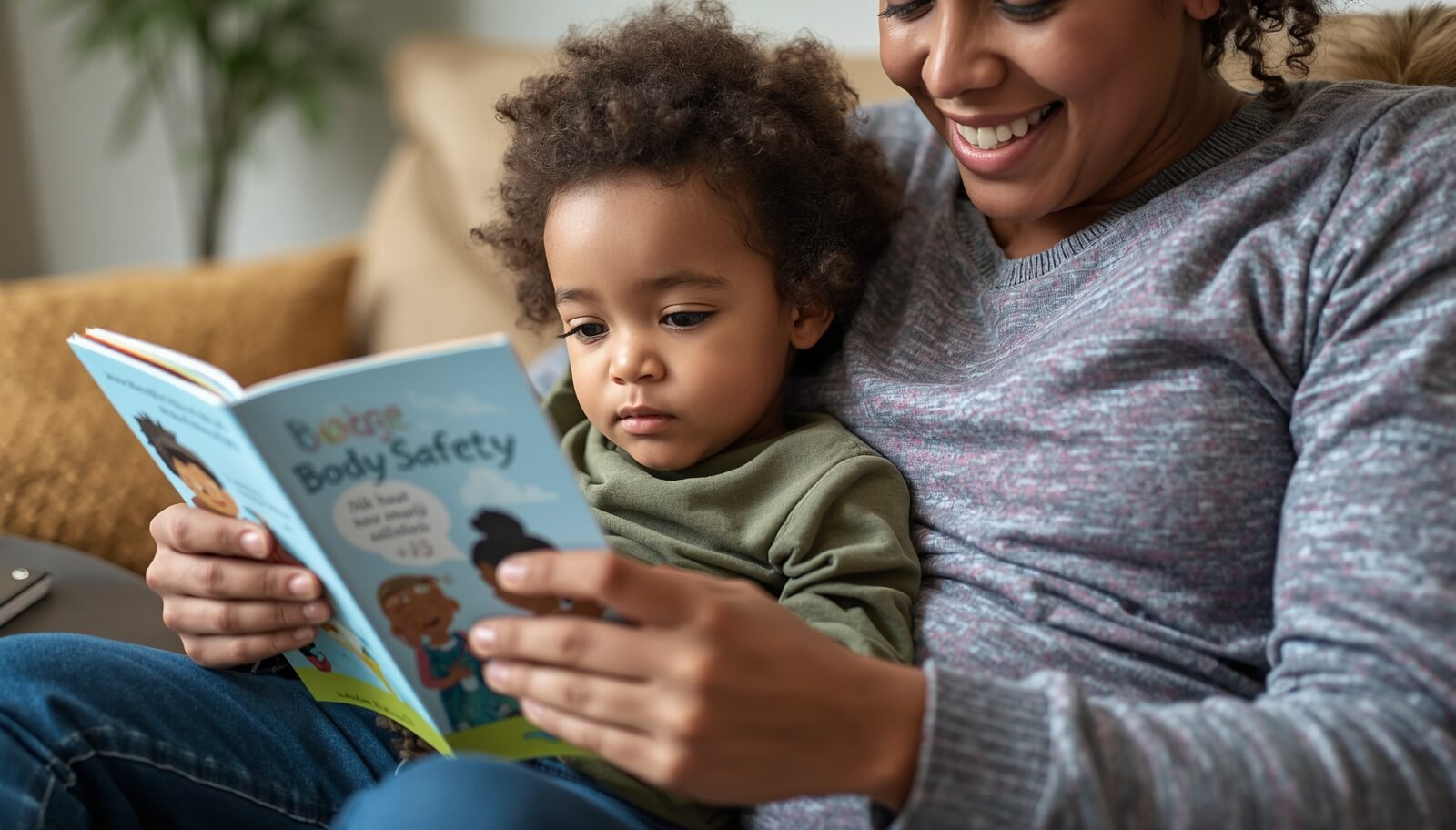
Picture books designed for body safety education (see FAQ for recommendations) can be a gentle and effective way to introduce these ideas through story, which is the natural learning medium for this age group.
Key Phrases for Ages 2–5
- ✅ “Your body belongs to you.”
- ✅ “Private parts are the parts covered by your swimsuit.”
- ✅ “If someone touches your private parts and it doesn’t feel right, tell me straight away.”
- ✅ “You can always say no to a hug or kiss if you don’t want one.”
- ✅ “I will always listen and never be angry if you tell me something makes you feel unsafe.”
📖 Related Reading: Understanding Your 4-Year-Old’s Emotional Development: What’s Normal and What’s Not — Body safety conversations are most effective when parents understand how children at each age process and communicate emotions. The emotional development context helps calibrate the tone and timing of these discussions.
Teaching Body Safety to Ages 6–9: Building Confidence
Children aged six to nine are developmentally ready for more specific and detailed body safety conversations. They have a stronger sense of personal identity, a more developed understanding of rules and fairness, and the cognitive capacity to understand the concept of trusted adults and appropriate versus inappropriate behaviour. School entry also brings new environments, new adults, and new social complexity that makes this body safety reinforcement particularly timely.
Building on Early Foundations
At this age, parents can expand conversations beyond the core private parts concept to include:
- Online safety basics: Teaching children that photos of their body — clothed or unclothed — should never be shared online, and that no one should ever ask them to take or share such images
- The secrets concept in detail: Reinforcing that unsafe secrets — particularly those involving bodies or that make them feel worried — are always to be told to a trusted adult, regardless of what anyone has asked them to promise
- Trusted adult network: Helping children identify their specific network of trusted adults (typically three to five people) and practise how they would tell each of them if something felt wrong
- The right to say no: Reinforcing that they can and should say a firm, clear no if anyone makes them feel unsafe, even if that person is an adult or authority figure
Practising Assertive Refusal
Research on child protection programmes consistently identifies assertiveness training — helping children practise saying a clear, confident no — as one of the most effective components of body safety education. Role-play in the home environment, approached lightly and positively, can give children a chance to rehearse the words and body language of assertive refusal so that these responses are available to them as automatic responses rather than cognitive decisions under stress.
Scenarios for role-play at this age should be concrete and realistic — not alarming hypotheticals, but situations that might genuinely arise: a peer who wants to play a game that makes them uncomfortable, or an adult who asks them to keep a secret they are not sure about.
Key Phrases for Ages 6–9
- ✅ “If anyone asks you to keep a secret that makes you feel worried, tell me — you won’t be in trouble.”
- ✅ “You can always say no to anyone who makes you feel uncomfortable, even if they are a grown-up.”
- ✅ “No one should ever ask you to take or send pictures of your body.”
- ✅ “If you tell me something and I don’t react the right way at first, keep telling me — I will always want to help you.”
Teaching Body Safety to Ages 10–12: Expanding Awareness
Pre-adolescence brings new dimensions to body safety education. Children aged ten to twelve are becoming more independent, spending more time with peers and in digital spaces without direct adult supervision, and beginning to encounter puberty — all of which make this a particularly important window for body safety reinforcement and expansion.
Digital Safety Becomes Central
The concept of online body safety deserves sustained, specific attention at this age. Children should understand:
- That images shared digitally cannot be fully controlled once sent — the concept of permanence in digital spaces
- That it is never acceptable for an adult to contact them online in ways that feel secretive, flattering in an uncomfortable way, or that involve requests related to their body or appearance
- That manipulation and “grooming” — the gradual process by which someone builds trust in order to exploit it — can happen online as well as in person, and that they should trust their instincts if something feels wrong in an online relationship
- That they can and must tell a trusted adult immediately if anyone online says or requests something that makes them feel uncomfortable, regardless of what that person has asked them to promise
Consent as a Two-Way Principle
At this developmental stage, body safety conversations can meaningfully expand to include the concept of consent as something that applies to all interactions — not only those involving body safety risks, but in friendships, social situations, and increasingly in the peer relationship context as children approach adolescence. Children who understand that their own boundaries deserve respect are also better equipped to respect the boundaries of others.
Introducing the concept that consent must be freely given, enthusiastic, and ongoing — and that the absence of a no is not the same as a yes — gives pre-adolescent children a framework they will need for the years ahead.
Puberty and Body Ownership
As bodies begin to change, reinforcing body ownership messages becomes particularly important. Children who have a healthy, informed relationship with their own body — who understand that their changing body belongs to them and that no one is entitled to comment on, touch, or photograph it without their consent — are better positioned to navigate the increased social and sexual attention that puberty can bring.

📖 Related Reading: Why Your 7-Year-Old Is Suddenly Anxious (and How to Help) — Children who feel anxious or unsure about their ability to say no benefit enormously from anxiety support alongside body safety education. Understanding the anxiety dimension helps parents provide a more complete foundation.
Body Safety Conversations with Teenagers (Ages 13+)
Many parents assume that body safety education is primarily for young children and that teenagers have already learned what they need to know. Research challenges this assumption clearly. Adolescence is a period of significantly increased vulnerability — to peer pressure, to online exploitation, to situations involving alcohol and impaired judgement — that makes continued, honest, and respectful body safety conversations more important than ever, not less.
The tone of these conversations must shift, however. A teenager needs to be engaged as a near-adult thinker — respected, not lectured — and the content should acknowledge the complexity of real situations they may encounter rather than relying on oversimplified rules.
Key Topics for Teenage Body Safety Conversations
- Consent in practice: What freely-given, enthusiastic, and ongoing consent actually looks and sounds like — and the reality that consent can be withdrawn at any time. Teenagers benefit from concrete scenarios and the opportunity to think through how they would respond.
- Image-based abuse: The serious legal and emotional consequences of sharing intimate images of peers — whether solicited or not — and the fact that receiving such images of a person under 18 carries significant legal liability in most jurisdictions. Many teenagers are unaware of the legal dimensions.
- Online safety for adolescents: Recognising and responding to online grooming, inappropriate contact from adults, and the risks of apps and platforms that offer anonymity or disappearing messages.
- Alcohol, substances, and consent: Clear and honest conversation about the fact that intoxication compromises the ability to give genuine consent, and the importance of looking out for one another in social situations.
- What to do if something goes wrong: Emphasising that they will never be in trouble for disclosing something that happened to them — that the responsibility for harm always lies with the perpetrator, never the victim.
Keeping the Channel Open
The single most protective factor for teenagers in this context is having at least one adult they would tell if something went wrong. The accumulated work of years of open, non-judgmental body safety conversations creates this — a teenager who has always been able to bring difficult things to a parent is far more likely to do so when it matters most.
Conversation Starters and Scripts for Parents
One of the most common barriers to body safety conversations is not knowing how to begin. The following scripts are adapted from evidence-based child protection programmes and calibrated by age. They are starting points, not scripts to be followed word for word — parents should adapt the language to their own voice and their child’s specific understanding.
For Young Children (2–5)
During bath time: “Let’s make sure you know the names of all your body parts. This is your nose, these are your shoulders, and these parts — your penis/vulva — are your private parts. Private means they belong to you, and only you and the doctor and Mum/Dad see them when we need to keep you clean and healthy.”
For Early School-Age Children (6–9)
After reading a book together or in a quiet moment: “I want to talk about something important — not to scare you, but because I want you to know that you can always come to me. If anyone ever touches your private parts in a way that feels wrong, or asks you to keep a secret about your body, you tell me straight away. I won’t be angry with you. Ever. Okay?”
For Pre-Teens (10–12)
During a car journey or walk: “Now that you’re using the internet more independently, I want to make sure you know: if anyone ever contacts you online and starts asking personal questions, wanting to see photos, or asking you to keep things secret from me — even if they seem really friendly — you tell me immediately. That’s not a normal friendship. And you’d never be in trouble for telling me.”
For Teenagers (13+)
In an honest, peer-level tone: “I know this might feel like a weird conversation, but I want to say clearly: if anything ever happens to you — if someone pressures you, makes you feel unsafe, or something goes wrong in a situation — I am always on your side. No matter what. You will never be in trouble for being honest with me. The only thing I’d be upset about is not knowing.”
Common Parent Worries — and What Research Says
“Won’t this frighten my child?”
Research consistently shows that age-appropriate body safety education delivered in a calm, matter-of-fact tone does not cause anxiety in children — it reduces it. Children who have language for body safety concepts and clear permission to speak up feel more confident, not more afraid. The fear response is associated with secrecy, shame, and the absence of information — precisely what body safety education is designed to replace.
“My child is too young.”
Child protection experts are unanimous: there is no child too young to learn the correct name for their body parts or to understand that their body belongs to them. The earlier these messages are embedded — before a child enters contexts outside the family home — the stronger the protective foundation. Starting early also normalises these conversations so that they do not feel loaded or alarming as the child gets older.
“I don’t want to undermine trust in adults.”
Effective body safety education does not teach children to distrust adults broadly — it teaches them to recognise specific behaviours that are inappropriate, regardless of who performs them. The distinction is important. Children are taught to trust and seek out safe adults, to identify their personal trusted adult network, and to rely on those relationships. The message is not “adults are dangerous” but “you have the right to be safe, and certain behaviours are not acceptable from anyone.”
“We already talked about strangers.”
The “stranger danger” model is considered outdated and insufficient by child protection researchers. Research consistently shows that the majority of children who experience harm are harmed by someone they know — a family member, family friend, neighbour, or other trusted adult — not a stranger. Body safety education expands the framework beyond stranger scenarios to address the reality that unsafe behaviour can come from anyone, and that children need permission and language to respond regardless of the relationship.

Building a Network of Trusted Adults
One of the most powerful practical tools in body safety education is helping children identify and name their specific network of trusted adults — people they could tell if something felt wrong, even if the parent was not available or if the concern involved someone in the immediate family.
Child protection research recommends that children have a trusted adult network of three to five people, including at least one person outside the immediate household. This ensures that a child is not left without a safe reporting option in any circumstance.
Helping Children Identify Their Trusted Adults
A trusted adult, for the purposes of body safety, is someone who:
- The child genuinely trusts and feels comfortable talking to
- Would believe and not minimise what the child tells them
- Would take action to help
- Would not get the child into trouble for disclosing
A useful activity for children aged five and older is to draw or list their “safety network” — three to five people they could go to if they needed help. Parents can then discuss each person on the list: why they trust them, how they would reach them, and what they might say. This rehearsal, done in a calm and positive context, helps make disclosure a more accessible response when it is needed.
What Adults in a Child’s Life Can Do
Adults who are named as trusted figures in a child’s network carry a responsibility to be approachable, to believe children who disclose, and to know how to respond appropriately. Grandparents, teachers, family friends, and coaches who are aware of body safety principles and who know they are part of a child’s trusted network are more prepared to respond helpfully when a child brings them something difficult.
If a Child Discloses: What to Do and Say
If a child discloses that something unsafe has happened to them, the adult’s response in the first moments is critically important. How an adult responds when a child first tells them something can determine whether the child continues to disclose, whether evidence is preserved, and whether the child feels supported or shamed by the experience of telling.
What to Do
- ✅ Stay calm. Your reaction is the child’s primary reference point for how bad this is and whether they are safe. A composed, caring response is more important than what you say.
- ✅ Believe them. Children very rarely fabricate disclosures of this kind. Begin from a position of belief.
- ✅ Thank them for telling you. Reinforce immediately that they did the right thing by telling: “I’m really glad you told me. You did exactly the right thing.”
- ✅ Listen more than you ask. Allow the child to tell what they choose without leading questions that could affect what they remember or say.
- ✅ Reassure them it is not their fault. Say it clearly and more than once: “This is not your fault. Nothing you did made this happen.”
- ✅ Contact the appropriate authority immediately. In most jurisdictions, you are legally required to report a disclosure of harm to a child to the appropriate authority. In the US, contact your local child protective services or call the Childhelp Hotline (1-800-422-4453). In the UK, contact the NSPCC (0808 800 5000) or local authorities. In Australia, contact your state child protection authority.
What Not to Do
- ❌ Do not express disbelief, shock, or panic
- ❌ Do not ask repeated or leading questions — this can affect a child’s account and complicate subsequent investigations
- ❌ Do not promise to keep it secret
- ❌ Do not confront the alleged person yourself before reporting to authorities
- ❌ Do not make the child feel they are in trouble or responsible
It is entirely appropriate — and strongly recommended — to seek support for yourself after a child’s disclosure. Processing this alongside professionals who specialise in child protection will help you support your child more effectively.

📖 Related Reading: How to Talk to Kids About Divorce: An Age-by-Age Guide — The communication skills that make body safety conversations effective — staying calm, listening fully, responding without judgment — are the same skills that help parents navigate all difficult conversations with children.
Frequently Asked Questions
The Conversation That Keeps Children Safer
Body safety education is not a single difficult conversation. It is a continuing practice — a series of brief, calm, age-appropriate conversations over many years that build in the child a foundation of knowledge, vocabulary, and confidence that is genuinely protective.
The parent who starts this conversation at age three with the correct name for a body part, and returns to it again at seven, and again at eleven, and again at fifteen, with each conversation appropriately more detailed and complex than the last, is building something cumulative: a child who knows their body belongs to them, who has language for what is unacceptable, who has a network of trusted adults identified by name, and who knows — without doubt — that they can bring anything to their parent without fear.
Most parents who read this article will never need anything beyond the empowerment and prevention education described here. Teaching kids about body safety is valuable not because harm is inevitable — it is not — but because the knowledge itself changes a child’s world in ways that go well beyond harm prevention. It teaches them that their body is their own, that their feelings matter, that their voice is worth using, and that there are adults in their world who will listen and act. These are not only child safety principles. They are the foundations of self-respect, confidence, and healthy human connection.
Start the conversation today. It does not have to be perfect. It just has to begin.
About the Author
Prasad Fernando
Prasad Fernando is the founder and lead writer of ParentalRing, a resource dedicated to practical, research-informed parenting guidance. With a deep commitment to child safety, child protection awareness, and the reduction of barriers that prevent parents from having important conversations with their children, Prasad draws on peer-reviewed research, evidence-based child protection frameworks, and the published guidance of leading child safety organisations. He believes that informed, empowered parents are the most effective first line of protection for their children — and that access to clear, practical, non-alarming guidance makes these essential conversations more accessible for every family.
Sources & References
- Finkelhor, D., & Dziuba-Leatherman, J. (1995). Victimization prevention programs: A national survey of children’s exposure and reactions. Child Abuse & Neglect, 19(2), 129–139.
- Topping, K. J., & Barron, I. G. (2009). School-based child sexual abuse prevention programs: A review of effectiveness. Review of Educational Research, 79(1), 431–463.
- Wurtele, S. K. (2009). Preventing sexual abuse of children in the twenty-first century: Preparing for challenges and opportunities. Journal of Child Sexual Abuse, 18(1), 1–18.
- Kenny, M. C., & Wurtele, S. K. (2012). Latino parents’ plans to communicate about sexuality with their children. Journal of Health Communication, 17(5), 574–590.
- Darkness to Light. (2015). Stewards of Children: A Prevention Training Program (Evidence-Based Programme Overview). Darkness to Light.
- Australian Centre for Child Protection. (2017). Body Safety Education: A Critical Component of Child Sexual Abuse Prevention. University of South Australia.
- World Health Organization & International Society for Prevention of Child Abuse and Neglect. (2006). Preventing Child Maltreatment: A Guide to Taking Action and Generating Evidence. WHO Press.
- Hebert, M., Lavoie, F., Piché, C., & Poitras, M. (2001). Proximate effects of a child sexual abuse prevention program in elementary school children. Child Abuse & Neglect, 25(4), 505–522.
- NSPCC. (2023). Child protection statistics: UK. National Society for the Prevention of Cruelty to Children. Retrieved from nspcc.org.uk.
- Satter, E. (2000). Child of Mine: Feeding with Love and Good Sense. Bull Publishing. [Referenced for bodily autonomy developmental framework.]
This article was last reviewed and updated in May 2026. Child protection research and safeguarding guidelines continue to evolve. The information in this article does not substitute for professional safeguarding guidance. If you have concerns about a child’s safety, contact the appropriate child protection authority immediately.