
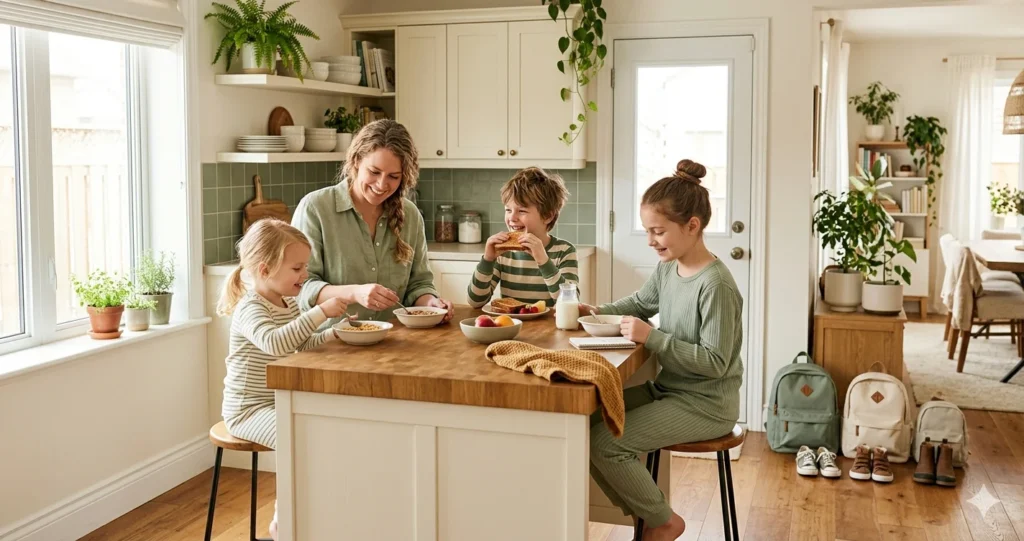
FAMILY LIFE📅 April 16, 2026 · ⏱️ 11 min read · ✅ Reviewed by child development specialists
How to Build a Family Routine That Actually Sticks (Without Military Precision)
You’ve tried the morning chart. You laminated it and stuck it on the fridge. By week two, it had a yoghurt stain on it and no one was looking at it anymore. If routine systems keep collapsing in your house, the problem isn’t you — it’s the way most routine advice is built. This guide does it differently.
📋 In This Article
- ▸ Why Family Routines Work (The Science)
- ▸ Why Most Routine Systems Fail (And How to Avoid It)
- ▸ The 4-Anchor Method: Build Routines That Stick
- ▸ Building Your Morning Routine
- ▸ The After-School Reset Routine
- ▸ The Evening Wind-Down Routine
- ▸ Weekend Routines: Structure Without Rigidity
- ▸ Getting Kids on Board (Every Age)
- ▸ When Your Routine Falls Apart (It Will)
- ▸ The Bottom Line
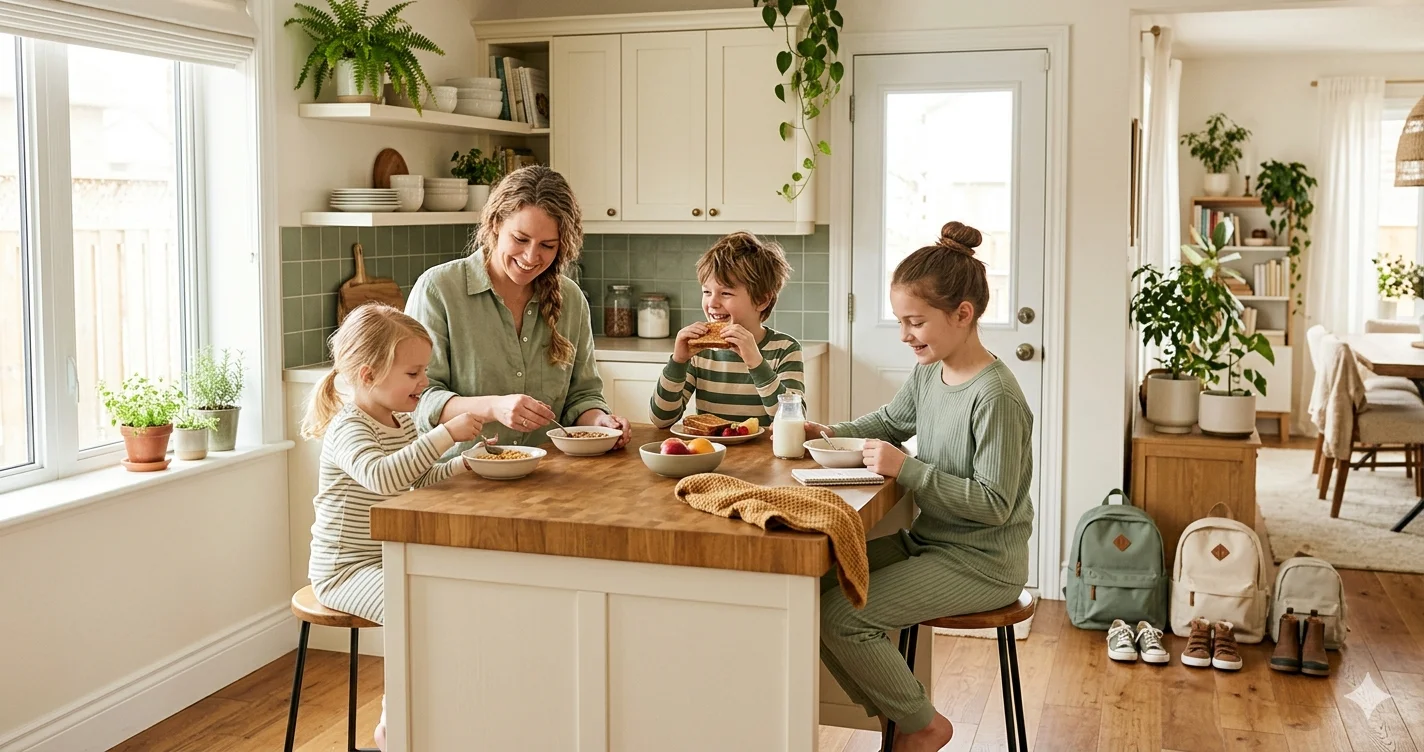
Why Family Routines Work (The Science Behind Them)
Before we get into the how, it helps to understand why routines are so powerful — because once you see the research, you’ll stop thinking of them as boring admin and start seeing them as one of the most impactful tools in your parenting toolkit.
The Harvard Center on the Developing Child identifies predictable, responsive routines as one of the foundational elements of healthy child development. Not enrichment activities. Not academic head starts. Routines.
Routines build self-regulation
When children know what comes next, they don’t spend cognitive energy on anxiety or resistance. That freed-up mental energy goes toward learning, playing, and cooperating. Predictability is the foundation of self-regulation.
Routines dramatically improve sleep
A consistent bedtime routine signals the brain to begin producing melatonin. Research from the AAP shows children with regular bedtime routines fall asleep faster, wake less often, and have fewer bedtime behavioural problems.
Routines reduce daily conflict
If Sunday dinner is always pasta night, no one argues about what’s for dinner on Sunday. If shoes always go by the door when you arrive home, no one loses shoes on Monday morning. Routines remove the need to negotiate the same micro-decisions repeatedly.
Routines build children’s independence
Children who know their routine can begin to move through it independently. The 7-year-old who knows the morning routine doesn’t need to be directed through every step — they just do it. That’s not just convenient; it builds genuine capability.
Routines strengthen family connection
Shared rituals — the bedtime story, the Friday film night, the school-run playlist — become the fabric of family identity. Research by Barbara Fiese at the University of Illinois found that family ritual quality predicts children’s emotional health and sense of belonging into adolescence.
💡 Key insight
Routines don’t restrict family life — they create the conditions for it. When the logistics run themselves, you get more of the moments that actually matter.
Why Most Routine Systems Fail (And How to Avoid It)
Most parents have tried to establish family routines and watched them collapse. This is not a willpower problem. It’s a design problem. Here’s why routine systems typically fall apart:
❌ They’re too detailed
A 15-step morning chart looks great when you’re calm on a Sunday afternoon. At 7:30am with a resistant 5-year-old, it is impossible. More steps = more failure points.
❌ Built by parents, not with kids
Routines imposed on children create resistance. Routines created with children create buy-in. This distinction makes or breaks every routine system.
❌ Abandoned after one failure
Routines break. This is normal. The parents who succeed treat a broken routine like a flat tyre — you fix it and drive on. You don’t abandon the car.
❌ Designed for best-case days
A routine that only works when everyone’s in a good mood, no one is sick, and nothing unexpected happens is not a routine — it’s a wishlist. Real routines must work on hard days too.
❌ Trying to change everything at once
Overhauling mornings, evenings, weekends and meals simultaneously overwhelms the whole family. Habits change one at a time, not five at once.
❌ No reset mechanism
Successful routine-builders have a built-in reset: “We got off track this week — we’ll restart on Monday.” Without a reset ritual, one bad week becomes permanent drift.
The 4-Anchor Method: Build Routines That Actually Stick
The single most effective framework for building family routines is also the simplest: anchor routines to 4 fixed points in the day, not to a detailed minute-by-minute schedule. Everything else attaches to these anchors.
⚓ The 4 Anchors
Anchor 1: Wake-up
The moment the day begins. Everything before leaving the house attaches here.
Anchor 2: Home arrival
The transition from the outside world back to home. Bags down, shoes off, snack — this is the reset moment.
Anchor 3: Family dinner
The gravitational centre of the family day. Even 15 minutes together at a table without screens is profoundly powerful.
Anchor 4: Bedtime
The close of the day. The most research-supported routine of all. Consistency here pays off in sleep, behaviour, and connection.
The key principle: reduce the number of decisions in each anchor period to near zero. Clothes chosen the night before. Bags packed the night before. Breakfast choice limited to two options. Fewer decisions = less friction = a routine that survives real life.
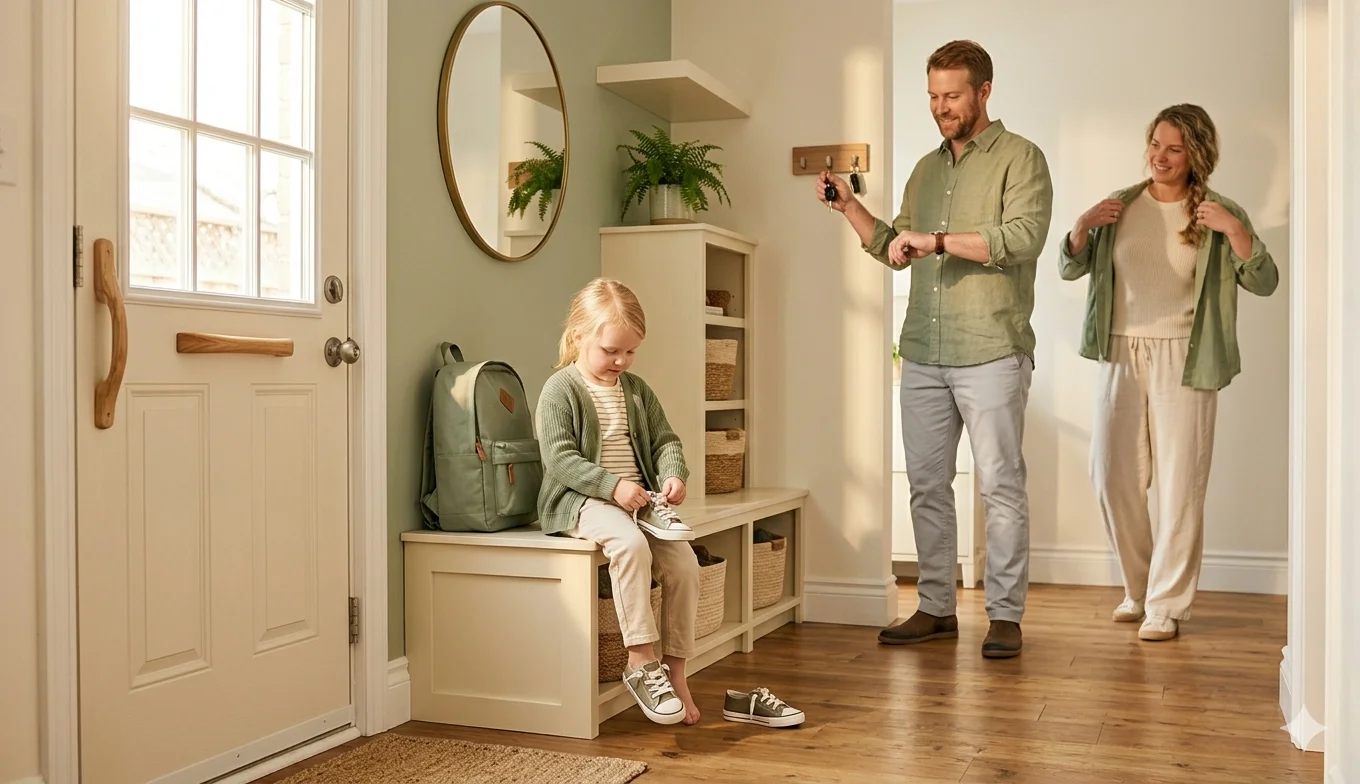
Building Your Morning Routine: The 4-Step Framework
Mornings are where most family routine systems succeed or fail. The goal is not a perfect morning — it’s a predictable morning. Here’s the structure that works consistently:
Prepare the night before (the real morning routine)
Lay out clothes. Pack bags. Fill water bottles. Put shoes by the door. These 10 minutes on Sunday evening save 30 minutes of chaos every Monday morning. The ‘morning routine’ actually starts the night before.
Wake up → one task only
The first thing after waking is one specific, non-negotiable action: get dressed. Not ‘get ready.’ Not ‘sort yourself out.’ Just: get dressed. One clear instruction that takes the thinking out of the hardest part.
Breakfast → teeth (always in this order)
The sequence matters more than the timing. Breakfast → then teeth. Always in this order, every day. This removes the argument about whether teeth are done, because the answer is always: after breakfast.
Shoes and bag by the door before screens
Make this the rule: shoes and bag are ready before any screens, any play, any asking-Mum-for-things. Everything else waits until launch readiness is achieved.
📝 The morning script that works
“What’s our morning order? Right: get dressed, breakfast, teeth, shoes and bag. Then we’re ready. What do you need to do first?”
Ask the question — don’t give the instruction. Asking activates the child’s own knowledge of the routine rather than creating a directive to resist.
For more on managing morning behaviour without conflict, see: Stop Yelling: 5 Effective Ways to Get Your Child to Listen
The After-School Reset Routine
The after-school period is one of the most emotionally volatile parts of the day for children. They have been managing themselves, following instructions, and regulating their behaviour all day. When they get home, they decompress — and the decompression is not always pretty.
⚠️ Why after-school meltdowns happen
School requires children to hold it together for 6–7 hours. Home is safe, so home is where the pressure valve releases. The child who was fine at school and falls apart at home at 3:30pm is not being difficult — they’re doing exactly what they’re supposed to do.
The after-school reset routine in 4 steps:
Bag down, shoes off, snack ready
The physical transition ritual. Every day, the same order. Having a snack ready is not indulgent — blood sugar is a significant factor in after-school emotional volatility. A snack and 15 minutes of decompression prevents more arguments than almost anything else.
20 minutes of free, unstructured time
Before homework, before chores, before anything required — 20 minutes of whatever they want. This decompression window is neurologically necessary. Asking a child to do homework the moment they walk in the door is asking a full glass to absorb more water.
Homework or reading (same time, same place daily)
The consistency of time and location is more important than the duration. ‘Homework happens at the kitchen table at 4:30pm’ requires no argument — it’s just what happens at 4:30pm at the kitchen table.
Active play or outside time before dinner
Children need physical movement after a sedentary school day. Build it in as non-negotiable, not as a reward. 30 minutes outside improves dinner behaviour, reduces bedtime resistance, and supports sleep.
The Evening Wind-Down Routine: The Most Important One
The bedtime routine is the single most research-supported family routine there is. The American Academy of Pediatrics, the CDC, and the NHS all cite consistent bedtime routines as one of the most impactful things parents can do for children’s sleep, emotional regulation, and behaviour.
The research is also clear on what makes bedtime routines work: consistency matters more than duration. A 20-minute routine done the same way every night is more powerful than a 45-minute routine that varies day to day.
⭐ The evidence-based bedtime sequence
The simplest version that works for most families aged 2–10:
🛁 Bath or wash — the physical signal that the day is ending
👕 Pyjamas — the dress rehearsal for sleep
🦷 Teeth — always here, always non-negotiable
📚 Story — the connection moment that makes every other step worth it
🌙 Lights out — the same time, every night
The screen boundary that changes everything
Screens off 60 minutes before bed is the single change that most reliably improves children’s sleep onset. Blue light from screens suppresses melatonin production — the hormone that makes children sleepy. This is not a parenting opinion; it’s physiology. A screen-free wind-down hour is the foundation of a working bedtime routine.
The pre-bed prep that saves your mornings
Build these into the evening routine, not the morning: school bag packed, clothes chosen, water bottle filled. Doing these at 8pm when everyone is calm takes 5 minutes. Doing them at 7:30am when everyone is rushed takes 20 — and usually involves at least one argument.
For detailed guidance on children’s sleep requirements by age, see: The Consistency Challenge: How to Set Limits and Actually Stick to Them

Weekend Routines: Structure Without Rigidity
Weekends don’t need the same structure as school days — and trying to impose school-day rigidity on weekends creates unnecessary tension. But a loose framework significantly reduces the weekend meltdowns that catch many parents off guard.
💡 Why weekends cause meltdowns
Children’s nervous systems don’t understand why Saturday should feel completely different from Tuesday. When structure disappears entirely, anxiety and dysregulation often fill the gap. You don’t need a rigid weekend schedule — you need predictable anchors.
The weekend anchor framework:
Keep wake-up and breakfast consistent
Sleeping in is fine for parents. But a consistent breakfast time — even 30–45 minutes later than weekdays — anchors the rest of the day. Skip this and the whole day drifts.
Build in one outdoor activity
A walk, a park visit, a bike ride, a garden session. Not a scheduled class — just movement outside. This is the anchor that keeps weekend energy manageable.
Protect family dinner even on weekends
Weekend meals often fragment as family members do different things at different times. One shared dinner — even if it’s pizza in front of a film — matters. The ritual is more important than the formality.
Maintain the bedtime routine (within 30 minutes)
A bedtime that slides 2 hours on Saturday night makes Monday morning genuinely harder. Keeping bedtime within 30 minutes of the weekday time costs very little and pays off enormously by Monday.
Getting Kids on Board: Age-by-Age Guide
The single biggest predictor of whether a family routine sticks is whether children were involved in creating it. Here’s how to do that at every age:
| Age | What They Can Do | How to Involve Them | What to Avoid |
|---|---|---|---|
| Toddlers (2–3) |
Follow a picture-based routine chart | Let them choose between two options within the routine (“bath first or teeth first?”) | Open-ended choices (“what do you want to do?”) — too much choice is overwhelming |
| Preschool (4–5) |
Follow and predict the routine sequence | Ask them to tell you what comes next — “After breakfast, what do we do?” They love being the expert | Explaining the reasons in detail — just follow the sequence |
| School-age (6–10) |
Help design the routine structure | Sit down together: “Let’s work out our morning plan. What do you think needs to happen?” Write it together | Presenting it as already decided — buy-in requires real input |
| Tweens+ (11+) |
Manage their own routine with parental oversight | Negotiate the non-negotiables (“school on time, homework done”) and give genuine flexibility on the how | Micro-managing — tweens disengage from routines that feel controlling |
📝 The family routine conversation starter
“Our mornings have been a bit chaotic lately. I want us to work out a plan together so we’re less stressed. What’s the part of our mornings that you find hardest?”
Start with their experience, not your solution. Listen to the answer before proposing anything.
When Your Routine Falls Apart (It Will — Here's What to Do)
Illness. School holidays. Guests. A particularly hard week. A new baby. House moves. Every family routine will be disrupted regularly. The families who maintain routines long-term are not the ones whose routines never break — they’re the ones who have a system for getting back on track.
The Monday Reset
The most powerful routine-recovery tool is also the simplest: declare Monday a reset day. Say explicitly to your children: ‘We got off track last week. This week we’re back to our plan.’ The Monday Reset normalises disruption and frames recovery as routine, not failure.
Start smaller when returning
After a school holiday or significant disruption, don’t try to reinstate the full routine on day one. Reinstate one anchor — usually bedtime, since it cascades into morning — and let the others follow naturally over a few days.
Name it, don’t shame it
If the routine broke because of something the children did — illness, difficult behaviour, refusal — address it without shame: ‘That was a hard week. Let’s try the morning plan again today.’ Forward-looking language keeps routines from becoming a source of guilt.
Build in a quarterly review
Routines that worked brilliantly for a 5-year-old may need updating for a 7-year-old. Every three to four months, briefly review your key routines with your family: ‘What’s working? What’s not? What do we need to change?’ This keeps routines alive rather than ossified.
✅ The rule of two weeks
Research on habit formation suggests that consistent practice for two weeks is enough to begin establishing a new routine as an expectation rather than an effort. Give any new routine at least 14 days of genuine, consistent implementation before deciding whether it’s working.
For research on how consistent family structure reduces behavioural issues, see: The Importance of Family Routines — American Academy of Pediatrics | Harvard Center on the Developing Child
The Bottom Line: Routines Are Built, Not Installed
Family routines are not a product you buy, a system you download, or a chart you laminate. They are habits — and habits are built through consistent, imperfect repetition over time. The families with the smoothest morning routines didn’t find a perfect system on week one. They built it across months of trying, adjusting, resetting, and trying again.
Start with one anchor. The bedtime routine is usually the best place to begin, because improvements there cascade into mornings. Pick the simplest version that could work on your worst day, not your best. Do it consistently for two weeks. Then add one more thing.
💚 Remember this
The goal of a family routine is not a perfectly organised household. It’s a household where everyone — including you — knows what’s coming next. That predictability is safety for your children and sanity for you. Imperfect routines done consistently beat perfect routines done occasionally, every time.
Disclaimer: This article offers general parenting guidance only. Every family is different. If you are concerned about your child’s behaviour, development, or wellbeing, please speak with your paediatrician or a qualified family professional.
ParentalRing Editorial Team
Child Development Specialists & Parenting Writers
Our content is researched by certified child development professionals and aligned with guidance from the AAP, Harvard Center on the Developing Child, and current developmental psychology literature. We write for real parents — not perfect ones.
You Might Also Like
The Consistency Challenge: How to Set Limits and Actually Stick to Them
Why consistency is the single most important factor in effective parenting — and how to build it.
Discipline & BehaviorStop Yelling: 5 Effective Ways to Get Your Child to Listen
Proven techniques to get cooperation without raising your voice.
Parenting PsychologyDiscipline vs. Punishment: Why One Builds Character and the Other Doesn’t
Understanding the critical difference that changes how you respond to any behaviour.
Discipline & BehaviorWhen Time-Outs Fail: Rethinking Your Discipline Strategy
If time-outs aren’t working in your house, here’s what child psychology recommends instead.