
Discipline & Behavior
📅 April 2026
⏱️ 13 min read
✅ Reviewed by child development specialists
Toddler Tantrum Strategies That Work (Even When You’re Exhausted)
It’s 11am on a Tuesday. You’ve already been up since 5:30. You skipped breakfast because your toddler needed you, and now — right now — they are on the supermarket floor, rigid as a plank, screaming because you picked up the wrong colour yoghurt. You are so tired you feel slightly see-through. And everyone is staring.
If that scene lives rent-free in your memory, this article is for you. Not a theoretical guide written from a calm office. A practical, honest breakdown of toddler tantrum strategies that actually work — including on the days you’re running on two hours of sleep and whatever’s left of your dignity.
We’ll cover why tantrums happen (neuroscience made simple), what to do in the moment, how to reduce their frequency over time, and what to do when nothing seems to work. Every strategy in this article is evidence-based — and real-parent tested.

📋 In This Article
- ▸ Why Toddler Tantrums Happen (It’s Not What You Think)
- ▸ The 3 Types of Tantrums (And Why It Matters)
- ▸ In-the-Moment Strategies: What to Do Right Now
- ▸ Prevention Strategies: Reducing Tantrums Before They Start
- ▸ Handling Tantrums in Public
- ▸ Word-for-Word Scripts for Common Tantrum Triggers
- ▸ When You’re Too Exhausted to Stay Calm
- ▸ When to Seek Professional Help
- ▸ The Bottom Line
Why Toddler Tantrums Happen (It’s Not What You Think)
Before we get to the strategies, this context changes everything. Your toddler is not being manipulative. They are not “testing” you for sport. They are experiencing genuine emotional overwhelm — and their brain literally cannot do better yet.
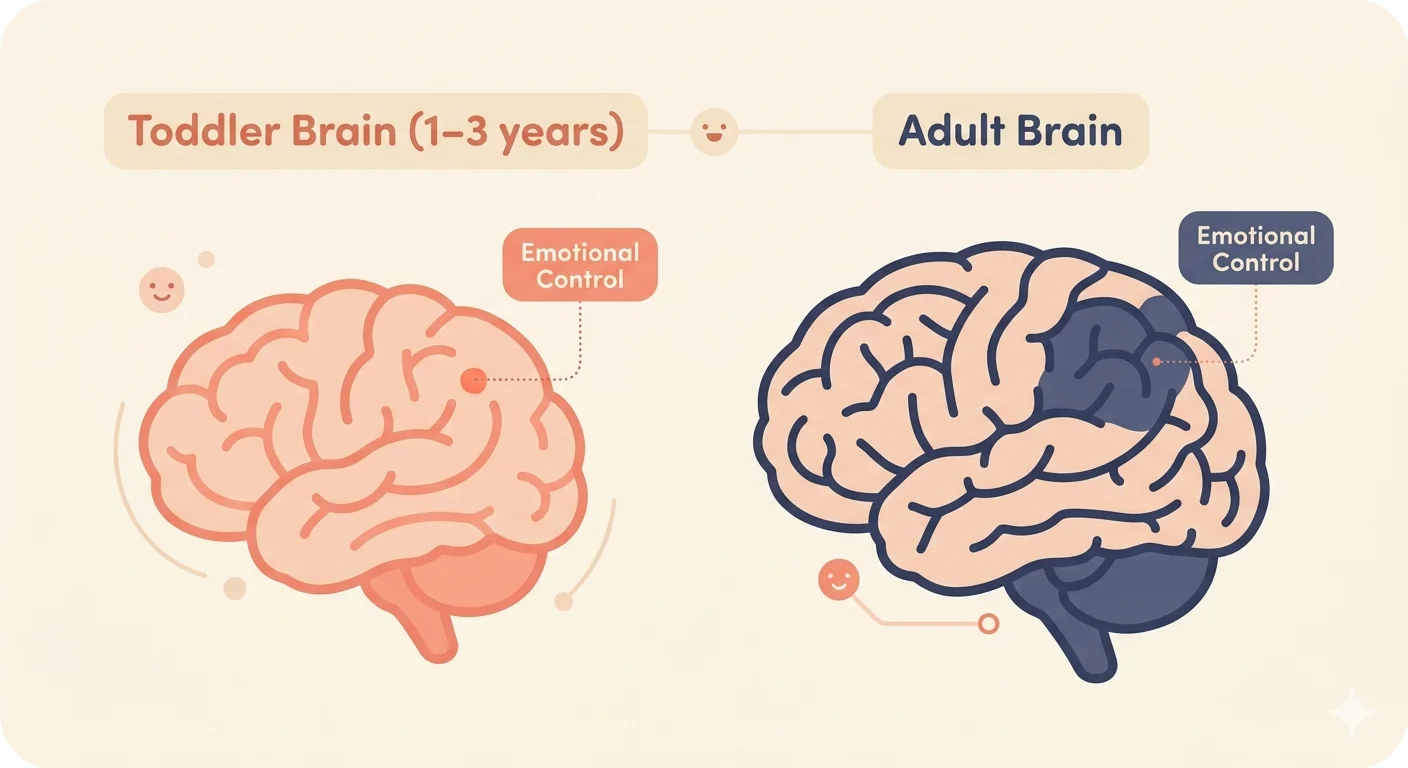
The prefrontal cortex — the part of the brain that controls impulse, reasoning, and emotional regulation — is not fully developed until the mid-twenties. In a toddler, it is barely functioning. When your two-year-old melts down over the wrong-coloured cup, they are experiencing something their small brain cannot yet manage or express any other way.
According to research published by ZERO TO THREE, toddlers aged 1–3 experience emotions at full adult intensity but have almost no capacity to regulate them. They want independence their body can’t yet achieve, language they don’t yet have, and control over a world that keeps saying no.
The result? A tantrum. Not a character flaw. Not a parenting failure. A developmental reality.
💡 Key Insight
Tantrums peak between ages 18 months and 3 years — precisely when a child’s desire for independence has outpaced their ability to communicate or self-regulate. You are not doing anything wrong. Your child is doing something developmentally right.
The 3 Types of Tantrums (And Why It Matters)
Not all tantrums are the same — and the strategy that works for one type will backfire on another. Understanding which type you’re dealing with is the first skill of effective tantrum management.
😤
Type 1: Frustration Tantrum
Trigger: Can’t do something, can’t have something, can’t communicate a need.
Best response: Validate the feeling, offer a simple choice, stay calm and present. Don’t reason — just name the emotion.
🎭
Type 2: Attention-Seeking Tantrum
Trigger: Learned that tantrums get a response — any response, including negative attention.
Best response: Withdraw attention completely while keeping them safe. Reward calm behaviour immediately after.
🌊
Type 3: Overwhelm Tantrum
Trigger: Sensory overload, overtiredness, hunger, or too many transitions in a day.
Best response: Remove from the overwhelming environment if possible. Quiet, calm presence. Physical comfort if welcomed.
Tip: Most tantrums blend elements of all three. The strategies below work across types — but knowing the primary driver helps you lead with the right response first.
In-the-Moment Strategies: What to Do Right Now
The tantrum has started. Here’s exactly what to do — in order. These strategies are drawn from guidelines by the American Academy of Pediatrics and the Child Mind Institute.
1
Stay calm first — everything else depends on this
Your nervous system is your toddler’s regulator. If you escalate, they escalate. Take one slow breath before you do anything else. You don’t need to feel calm — you just need to act calm. There’s a difference, and that difference is something you can manage even when you’re exhausted.
2
Ensure safety, then get to their level
Check they can’t hurt themselves or others. Move anything dangerous out of reach. Then kneel or sit at their eye level. This posture communicates safety and connection — not authority and threat. Standing over a tantruming toddler activates their stress response.
3
Name the feeling — briefly
Say one short, calm sentence: “You’re really upset because you wanted more time at the park.” That’s it. Don’t explain. Don’t reason. Don’t justify your decision. Validation is not agreement — it’s acknowledgement. And it consistently shortens tantrums. Research from ZERO TO THREE shows children who feel heard de-escalate faster.
4
Wait out the wave — don’t negotiate mid-storm
A tantrum has a physiological arc — it rises, peaks, and falls. Trying to talk a toddler out of a tantrum at its peak is like trying to talk someone out of a sneeze. Stay present, stay quiet, and let the wave pass. Don’t offer bribes, don’t give in, and don’t launch into explanations. The time for talking is after.
5
Reconnect when the storm passes
When the tantrum ends, your child will often be exhausted and disoriented. This is the moment for a hug, not a lecture. Say: “That was a big feeling. I’m right here. I love you.” Connection after a tantrum repairs the relationship, resets the nervous system, and — over time — teaches your child that big emotions don’t break the bond.
📌 The RIDD Framework (from NCBI)
Clinicians at the National Center for Biotechnology Information recommend the RIDD method: Remain calm · Ignore the behaviour (not the child) · Distract when possible · Don’t give in to demands. Simple enough to remember when you’re at your limit.

Prevention Strategies: Reducing Tantrums Before They Start
You can’t prevent every tantrum. But you can reduce how often they happen and how severe they are. These strategies address the root triggers rather than just the surface behaviour.
🕐 Know their window — and protect it
Every toddler has a window of time they can handle demands before they hit a wall. For most, it’s about 90 minutes to 2 hours of active engagement before they need a reset — food, rest, or quiet. The supermarket trip that turns into a meltdown at the checkout? Usually a scheduling problem, not a behaviour problem. Schedule challenging errands during their high-functioning window: mid-morning, after a nap, never right before sleep.
⏱️ Give transition warnings
Abrupt endings are a major tantrum trigger. Toddlers cannot conceptualise future time (“we’ll come back tomorrow”) but they can understand countdowns. Try: “Five more minutes at the park, then we go to the car.” Then: “Two more minutes.” Then: “Time’s up — shoes on.” The warning doesn’t always prevent the tantrum, but it consistently reduces the intensity.
🎯 Offer two genuine choices
Tantrums often stem from a child’s desperate need for autonomy in a world that’s always telling them what to do. Giving two real choices — neither of which is a problem for you — restores a sense of control. “Do you want to put your shoes on yourself, or do you want me to help?” Both options get the shoes on. The child feels heard. The power struggle dissolves. This works remarkably often.
🗣️ Build their emotional vocabulary daily
Tantrums are often communication failures. When a child learns to say “I’m frustrated” or “I’m tired,” they need tantrums less. Name emotions constantly — your own and theirs. “I’m feeling a bit stressed right now — I’m going to take three deep breaths.” “It looks like you’re really disappointed.” Research consistently shows that emotion labelling reduces the intensity of emotional outbursts over time.
📋 Keep the routine predictable
Toddlers feel safe when the world is predictable. A consistent daily rhythm — similar mealtimes, nap windows, and a dependable bedtime routine — dramatically reduces the baseline anxiety that makes tantrums more likely. You don’t need a military schedule. You need a recognisable shape to the day.
Handling Tantrums in Public
The supermarket floor. The café. The checkout queue at a busy Saturday. Public tantrums carry an extra layer of shame and pressure that makes everything harder. Here’s the honest truth: strangers are staring less than you think. And the ones who are staring either have children and feel your pain, or don’t have children and have no idea what they’re talking about.
The 4-Step Public Tantrum Protocol
Step 1
Move immediately. Get your child away from the trigger and the audience. A car, a quiet corner, outside — anywhere with fewer eyes and fewer stimuli. This is not giving in. This is managing the environment.
Step 2
Stay low and quiet. Same rules as at home. One short validation sentence, then silence. Don’t perform calm for the audience — actually be as calm as you can manage.
Step 3
Hold the boundary. Do not give them what triggered the tantrum. If you do, you have just taught them that public tantrums are effective. It is hard. Do it anyway.
Step 4
Recover together — and be kind to yourself. Once you’re both calm, reconnect. Then take a minute for yourself. Public tantrums are exhausting and a little humiliating. That’s real. Acknowledge it, breathe, move on.
Word-for-Word Scripts for Common Tantrum Triggers
Most parenting advice tells you what to do. Here’s the part that’s actually useful: exactly what to say. These scripts are kept short because in the moment, that’s all your brain can handle — and all your toddler can process.
Trigger: Wrong cup / wrong colour / wrong anything
“You really wanted the red cup. I can see that’s upsetting. We’re using this one today.”
Then: silence. Do not defend the decision. Do not swap the cup. Let the feeling pass.
Trigger: Won’t leave the park / screen time ending
“I know you don’t want to stop. Two more minutes, then we go. I’ll set the timer.”
At two minutes: “Timer’s done. Shoes on. We’re going.” Follow through without negotiation.
Mid-tantrum (peak — don’t talk, just be there)
“I’m right here. I’ve got you.”
Say it once. Then silence. Kneeling nearby, calm face. Nothing else until the wave passes.
After the tantrum (recovery phase)
“That was a big feeling, wasn’t it? I’m so glad I was here with you. Do you want a hug?”
Connection before correction. Always. The explanation comes later, in a calm moment.
Trigger: Won’t get dressed / leave the house
“You can put your shoes on yourself, or I can help you — which one?”
Wait five seconds. If no response: “I’ll help you then.” Proceed calmly. One genuine choice, then you decide.
When You’re Too Exhausted to Stay Calm
Here’s the honest part. The part most parenting guides skip because it’s uncomfortable: sometimes you’ve got nothing left. You’re running on no sleep, no food, no support, and your toddler is on the floor screaming and you feel something close to despair.
This is normal. This is parenting. And there are specific things that help on these days — not the ideal-world strategies, but the survival-mode version.
Survival-Mode Tantrum Strategies (for real hard days)
🛡️
Safe and step back. If your child is safe, it’s okay to physically take two steps back and take a breath. You don’t need to be right next to them every second. Creating tiny physical distance can regulate you enough to re-engage calmly.
🔇
Lower your voice, don’t raise it. When you want to shout, try whispering instead. It forces you to slow down, and toddlers often go quiet to hear what you’re saying. It sounds counterintuitive. It works.
📱
Text someone — even just one sentence. “Having the worst morning, sending solidarity.” Connecting with another parent, even briefly, activates your own nervous system support. Isolation makes hard days harder.
💚
Repair, don’t ruminate. If you lose your cool — if you yell, snap, or slam something — don’t spiral. Repair is one of the most powerful parenting tools there is. “I raised my voice earlier and I shouldn’t have. I’m sorry. I love you.” That sentence does more for your child’s emotional security than pretending it didn’t happen.
Remember: Good enough parenting on a hard day is still good parenting. The goal is not calm perfection. The goal is a relationship that survives the hard days — and it will. It already has.

When to Seek Professional Help
ℹ️
Medical Information: This article provides general parenting guidance only. It is not a substitute for professional medical or psychological advice. If you have concerns about your child’s behaviour or development, please speak with your GP or paediatrician.
Most toddler tantrums — even intense ones — are developmentally normal and will decrease with age and consistent responses. However, please consult your paediatrician or a child behaviour specialist if:
- ✗ Your toddler is hurting themselves, other children, or caregivers regularly and the behaviour is not reducing with consistent responses
- ✗ Tantrums regularly last more than 30 minutes and cannot be soothed by any approach
- ✗ You notice significant speech or language delays that may be contributing to frustration
- ✗ The behaviour is escalating significantly rather than following the typical decrease from age 3 onwards
- ✗ You feel you or your child are not safe during episodes, or you are experiencing significant parental distress
Useful resources: American Academy of Pediatrics — Discipline Guide · CDC Positive Parenting Tips for Toddlers · Child Mind Institute — Managing Meltdowns
The Bottom Line
Your toddler is not giving you a hard time. They are having a hard time — and they chose you to have it with, because you are their safe person. That’s not small. That’s enormous.
The strategies in this article work. Not instantly — nothing works instantly with toddlers — but consistently, over weeks and months, they shift the pattern. The tantrums reduce. The connection deepens. Your toddler learns, very slowly and very concretely, that big feelings don’t break love.
And on the days when you manage a calm response? That’s not just good parenting. That’s literally building the neural pathways your child will use to regulate their own emotions for the rest of their life. You are doing something important, even when it doesn’t feel that way.
💚
You searched for this article because you want to do better. That desire — that intention to try, even exhausted — is what separates the parent your child needs from the parent you’re afraid you’re being. You’re already that parent. Keep going.
PR
ParentalRing Editorial Team
Child Development Specialists & Parenting Writers
Our articles are researched by certified child development professionals and reviewed against current AAP, CDC, and child psychology guidelines. We believe every parent deserves practical, honest guidance — without the guilt.
You Might Also Like
Discipline & Behavior
How to Discipline a Toddler Without Yelling: What Actually Works
The companion guide to this article — covering the full discipline picture.
Discipline & Behavior
Ending Sibling Rivalry: A Step-by-Step Guide to Peaceful Conflict Resolution
When the tantrums extend to fighting with siblings.
Parenting Psychology
Natural vs. Logical Consequences: Choosing the Best Tool for Misbehaviour
What to do after the tantrum — building long-term behaviour change.
Medical Disclaimer: This article is for informational purposes only and does not constitute medical or psychological advice. The strategies described are general parenting guidance. If your child’s behaviour is causing significant concern, persistent distress, or safety issues, please consult your paediatrician or a qualified child development specialist. Early professional support is always more effective than waiting.