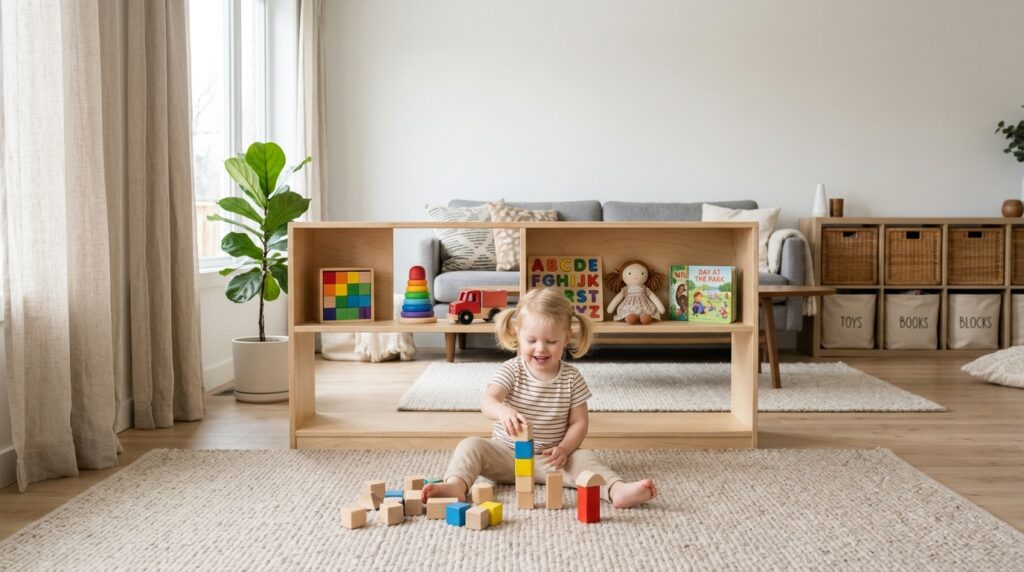
If your living room floor disappears under toys by 10am, and your toddler still wanders around saying they are bored, you are not doing anything wrong. You are running into one of the most common problems in early childhood: too many toys out at once. Toy rotation is a simple fix. You keep a small selection of toys available, store the rest out of sight, and swap them on a regular schedule.
This guide walks through what the research says, how many toys to put out, how often to rotate, and a step-by-step way to set up a system in an afternoon, even in a small home.
What Is Toy Rotation?
Toy rotation means dividing your child’s toys into several groups and only having one group available to play with at a time. Everything else is packed away in boxes, bins or a closet. Every week or two, you put the current group away and bring out a different one.
The total number of toys your child owns does not change. What changes is how many they can see and reach on any given day. To a toddler, a set of toys that has been out of sight for three weeks feels new again, which is why rotation can cut down on the constant “I want something new” pressure.
What the Research Says About Fewer Toys
The most widely cited study on this comes from occupational therapy researchers at the University of Toledo. In a 2018 study published in Infant Behavior and Development, the team observed 36 toddlers aged 18 to 30 months during play sessions with either 4 toys or 16 toys in the room.
With only four toys available, the toddlers played with each toy for longer, came back to toys repeatedly, and used them in more varied and creative ways. With sixteen toys, play was shorter and more scattered: children moved quickly from one item to the next without exploring much of what each toy could do. The lead researcher has pointed out that this was a lab setting with classic toys, so it does not translate perfectly to every home, but the pattern is a useful one for parents.
This lines up with guidance from the American Academy of Pediatrics. In its clinical report on selecting toys for young children, the AAP says the most valuable toys are often simple ones such as blocks, puzzles, balls, books and pretend-play items, and that toys work best when they encourage play between children and caregivers. Flashing lights, apps and “educational” labels are not necessary for learning.
Put together, the message is not that your child needs fewer toys in total. It is that fewer toys available at one time tends to support deeper, longer play.
Benefits of Rotating Toys
- Longer, more focused play. With fewer options competing for attention, toddlers are more likely to settle into one activity.
- More creative use of each toy. When a child has only a few things, they tend to combine them: blocks become a garage for the cars, a pot becomes a drum.
- Faster tidy-up. Putting away eight toys is a realistic job for a two-year-old. Putting away eighty is not.
- Toys feel new without buying more. A toy that comes back after a few weeks often gets played with as if it just arrived.
- You learn what your child actually uses. Rotation quickly shows you which toys get ignored every time, which makes decluttering easier.
- Better support for independent play. A calm, uncluttered play space makes it easier for toddlers to play on their own for short stretches. (See our guide to encouraging independent play in toddlers.)
How Many Toys Should Be Out at Once?
There is no single magic number, but these ranges are a practical starting point:
| Age | Toys out at one time | Rotate every |
|---|---|---|
| 12 to 18 months | 6 to 8 | 1 week |
| 18 months to 3 years | 8 to 10 | 1 to 2 weeks |
| 3 to 5 years | 10 to 12, plus art supplies | 2 weeks |
Count a set as one toy. A box of blocks, a train set or a tub of play food each counts as one item. Books are usually best kept separate and always available, with a small rotating basket of a few favorites on display.
If your child seems bored by day three, you can rotate more often. If they are still deeply engaged after two weeks, leave things alone. Your child’s interest is the real schedule.
How to Set Up Toy Rotation: Step by Step
Step 1: Gather every toy in one place
Pull toys out of every room, toy box and car seat pocket. Seeing everything together makes it obvious how much you have, and it is the best moment to remove anything broken, missing pieces or no longer age-appropriate.
Step 2: Sort by type of play
Group toys into categories based on the kind of play they encourage. A simple set of categories for toddlers:
- Building and fine motor: blocks, stacking cups, shape sorters, chunky puzzles, pegboards
- Pretend play: play kitchen items, dolls, animals, dress-up hats, toy phones
- Movement: balls, push toys, ride-ons, tunnels
- Vehicles: cars, trucks, trains, ramps
- Music and sensory: shakers, drums, xylophones, textured toys
- Art: crayons, chalk, stickers, playdough (with supervision)
Step 3: Build balanced groups
Make three or four groups. Each group should include one or two toys from most categories, so every rotation offers a mix of building, pretending and moving. Avoid putting all the vehicles in one group and all the dolls in another, or your child will spend two weeks without their favorite type of play.
Step 4: Keep a few “anchor” toys out all the time
Comfort items and true favorites (the stuffed rabbit that goes everywhere, the one truck they ask for every morning) should not rotate. Pulling away a security object can cause real distress and undermines the whole system.
Step 5: Store the rest out of sight
Use lidded bins, opaque boxes or a closet shelf. The key is that your child cannot see or reach the stored toys. Label each bin with its group number, or tape a photo of the contents on the front, so swapping takes five minutes.
Step 6: Display the current toys simply
Low, open shelves work better than a deep toy box, because toddlers can see every option without dumping everything out. Give each toy its own spot. A shelf with eight clearly separated items looks inviting rather than overwhelming.
Step 7: Rotate on a predictable day
Choose one day, such as Sunday evening after your child is asleep, and swap the groups. Some families like to involve older toddlers by letting them choose one toy from the new group to “unwrap” first.
Toy Rotation in a Small Home
You do not need a playroom. In an apartment, a single low bookshelf in the living room can hold the current rotation, and stored groups can go in under-bed bins, the top of a wardrobe or a suitcase that is not being used. The less floor space you have, the more rotation helps, because fewer toys out means less to trip over and less to tidy every night.
Common Mistakes to Avoid
- Putting out too many toys “just this once.” If everything creeps back onto the shelf, the benefits disappear. Hold the line on the number.
- Rotating while your child watches. Toddlers often protest when toys disappear in front of them. Swap after bedtime.
- Removing a toy they are deeply into. If your child is in the middle of a train obsession, keep the trains out and rotate around them.
- Making the groups too similar. If every group has the same mix of nearly identical toys, nothing feels new.
- Treating it as a punishment. Rotation is not taking toys away for bad behavior. Keep it neutral and routine.
A Quick Safety Note
Rotation is a good time to check toys for safety. For children under 3, remove anything small enough to be a choking hazard, including loose parts, small balls, button batteries and magnets. In the U.S., toys for this age must pass a “small parts” test, and any object that fits through a toilet paper tube is a reasonable at-home warning sign. Also check for cracks, sharp edges and loose seams on soft toys before putting a group back out.
Frequently Asked Questions
At what age can I start toy rotation?
You can start as soon as your baby has more toys than they can reach or attend to, often around 6 to 9 months. Rotation tends to make the biggest difference between about 12 months and 4 years, when children have lots of toys and short attention spans.
Will my toddler notice the toys are gone?
Sometimes, especially with favorites. If your child asks for a stored toy, it is fine to bring it out. Rotation is a tool, not a rule. If they ask for the same toy every time, it probably belongs with the anchor toys that stay out.
What about birthday and holiday gifts?
Big gift occasions are the easiest time to start rotating. Let your child enjoy a few new things right away, then fold the rest into your groups over the following weeks. Spreading gifts out keeps them exciting for months instead of days.
Does toy rotation work with siblings?
Yes. Many families keep a shared rotation for common toys and let each child keep a small personal shelf or basket that does not rotate. If siblings fight over the same item, see our guide to setting calm, consistent household boundaries.
Should I get rid of toys instead?
Rotation and decluttering work well together. After two or three full cycles, you will know which toys your child never chooses. Those are the easiest ones to donate or pass on.
The Bottom Line
Toy rotation is one of the simplest changes you can make at home: fewer toys out, more toys in storage, and a regular swap. Research on toddlers suggests that a smaller selection leads to longer, more creative play, and it makes your daily tidy-up far easier. Start with eight to ten toys, rotate every week or two, keep favorites out, and adjust based on what your child actually plays with.
Sources
- Dauch, C., Imwalle, M., Ocasio, B., & Metz, A. E. (2018). The influence of the number of toys in the environment on toddlers’ play. Infant Behavior and Development, 50, 78–87.
- Healey, A., Mendelsohn, A., & Council on Early Childhood. (2019). Selecting appropriate toys for young children in the digital era. Pediatrics, 143(1), e20183348.
- American Academy of Pediatrics. Best Toys Go Back to the Basics. HealthyChildren.org.
This article is for general information only and is not a substitute for advice from your pediatrician or a qualified child development professional.