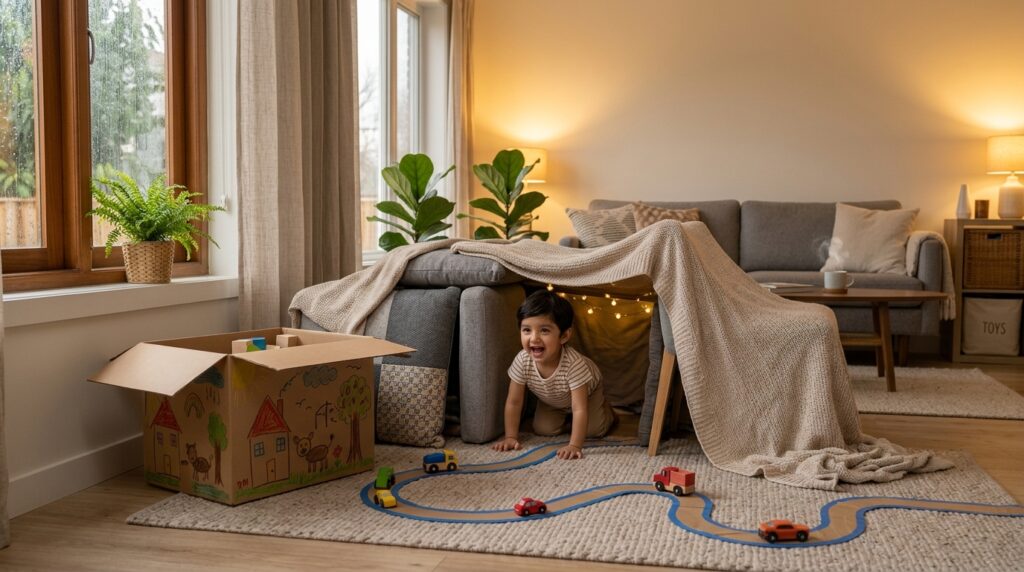
Rain, snow or a heat wave can turn a normal day with a toddler into a long stretch of “What do we do now?” The good news is that you do not need special toys, craft kits or a trip to an indoor play center. Some of the best toddler activities use things you already have in your kitchen, closet or recycling bin.
Below are 15 indoor activities for toddlers using everyday household items, grouped by the kind of play they encourage, plus safety tips and a simple way to plan a rainy day so it does not turn into a day of screens.
Why Indoor Play Still Matters
Toddlers need to move, even when they are stuck inside. World Health Organization guidelines recommend that children aged 1 to 4 spend at least 180 minutes a day in a variety of physical activities, spread across the day. The American Academy of Pediatrics also emphasizes the value of play, especially unstructured play with caregivers, for building language, problem-solving, social skills and self-control. A rainy day is a good chance to mix active play, quiet play and play together.
Active Play (Burn Off Energy)
1. Couch cushion obstacle course
Line up couch cushions and pillows on the floor to climb over, crawl through and jump onto. Add a blanket draped over two chairs as a tunnel. Keep the course on soft surfaces and away from furniture corners.
2. Painter’s tape roads and hopscotch
Use painter’s tape on the floor to make roads for toy cars, a balance-beam line to walk along, or a simple hopscotch grid. It peels off easily from most floors. Test a small area first.
3. Animal moves
Call out an animal and move like it: hop like a frog, waddle like a penguin, stomp like an elephant, slither like a snake. It builds coordination and vocabulary at the same time.
4. Freeze dance
Play music and dance. When the music stops, everyone freezes. Toddlers love the surprise, and it quietly practices self-control.
5. Balloon keep-up
Try to keep a balloon from touching the floor. It moves slowly enough for small children to succeed. Supervise closely and throw away popped balloon pieces right away, since they are a serious choking hazard for young children.
Sensory Play
6. Kitchen sink water play
Fill a plastic tub with a few inches of water and add cups, spoons, a funnel and a sponge. Put a towel underneath. Water play is calming and absorbing for many toddlers. Always stay within arm’s reach: young children can drown in very small amounts of water.
7. Dry pasta or rice bin
Pour dry pasta or rice into a large container with scoops, cups and a few small toys to “find.” This works best for children who are past the stage of putting everything in their mouths. Supervise and sweep up as you go.
8. Ice painting or melting
Freeze water with a few drops of food coloring in an ice cube tray, then let your toddler “paint” on paper as the ice melts. Or freeze small toys in a container of water and let them use warm water and spoons to rescue them.
9. Texture walk
Lay out a towel, a piece of foil, a baking tray, bubble wrap and a pillow. Let your toddler walk across barefoot and describe how each one feels.
Pretend Play
10. Cardboard box creations
A large delivery box can become a car, a boat, a house or a rocket. Let your toddler color it with crayons and climb inside. The AAP has noted that simple, open-ended items like boxes often encourage more creative play than electronic toys.
11. Pretend restaurant or shop
Use real (safe) kitchen items, empty food boxes and a toy or pretend cash register. Take turns being the customer and the server. This is great for language and social skills.
12. Stuffed animal doctor
Line up stuffed animals for a check-up. Use a toy or homemade stethoscope, bandage strips made of paper, and a pretend clipboard. It can also help children feel more comfortable before real doctor visits.
Quiet Play (For After Lunch or Before Nap)
13. Sticker lines
Draw a few straight, zigzag and curvy lines on paper and let your toddler place stickers along them. It is calming and builds fine motor skills.
14. Sorting games
Mix socks to match, sort spoons and cups, or put colored blocks into matching bowls. Toddlers love “real” jobs, and sorting builds early math thinking.
15. Blanket fort reading time
Build a simple fort with blankets and chairs, bring in a flashlight and a pile of books, and read together inside. It turns ordinary story time into an event.
How to Plan a Rainy Day
Toddlers do best with a rough rhythm, even on unexpected days at home. Try alternating types of play so energy levels stay manageable:
| Time | Activity type | Example |
|---|---|---|
| Morning | Active | Cushion obstacle course, animal moves |
| Mid-morning | Sensory | Water play or ice painting |
| After lunch | Quiet | Blanket fort books, then nap or quiet time |
| Afternoon | Pretend | Cardboard box car, pretend shop |
| Before dinner | Active, then calm | Freeze dance, then sorting socks while you cook |
You do not need to fill every minute. Some of the best play happens when you set something up and let your toddler explore on their own for a while. See our guide to encouraging independent play in toddlers for how to build that skill.
What About Screens?
On long days indoors, it is tempting to lean on screens. The AAP recommends avoiding screen media for children younger than 18 to 24 months other than video chatting, and limiting screen use to about one hour a day of high-quality programming for children aged 2 to 5, ideally watched together. Planning a few of the activities above makes it much easier to keep screens to a small part of the day. Our guide to setting screen time limits without power struggles has more ideas.
Safety Checklist for Indoor Play
- Stay within arm’s reach during any water play.
- Keep small items such as dry beans, beads, coins and balloon pieces away from children who still mouth objects.
- Pad hard corners and move breakable items before active games.
- Check that heavy furniture and TVs are anchored to the wall, since climbing increases on indoor days.
- Use non-toxic, washable art supplies.
Frequently Asked Questions
How long will a toddler stay interested in one activity?
Often only 5 to 15 minutes, sometimes less. That is normal. Have two or three ideas ready and rotate between them.
Do I need to play with my toddler the whole time?
No. Playing together for some of the day is valuable, but toddlers also benefit from short stretches of independent play while you stay nearby.
What if my toddler just wants to make a mess?
Choose a contained area, put a towel or old sheet down, and set clear limits (“Rice stays in the bin”). Mess is part of how toddlers learn, but limits help keep it manageable.
The Bottom Line
A rainy day with a toddler does not need special equipment. Couch cushions, painter’s tape, a tub of water, a cardboard box and a pile of books can fill a whole day with active, sensory, pretend and quiet play. Alternate types of activity, keep safety in mind, leave room for independent play, and keep screens to a small part of the day.
Sources
- World Health Organization. (2019). Guidelines on physical activity, sedentary behaviour and sleep for children under 5 years of age.
- Yogman, M., et al. (2018). The power of play: a pediatric role in enhancing development in young children. Pediatrics, 142(3), e20182058.
- Healey, A., Mendelsohn, A., & Council on Early Childhood. (2019). Selecting appropriate toys for young children in the digital era. Pediatrics, 143(1), e20183348.
This article is for general information only. Always supervise young children during play.