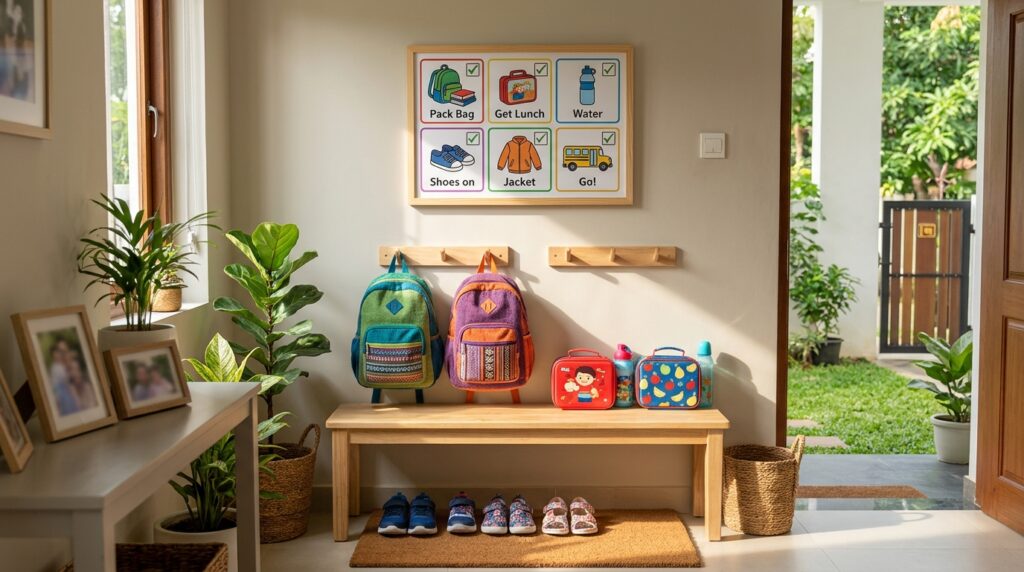
Shoes missing, breakfast half-eaten, someone in tears, and everyone shouting at the door at 7:52am. School mornings are one of the most stressful times of day for many families, mostly because so many tasks have to happen in a short, fixed window. A good morning routine does not need to be complicated. It needs to start the night before, follow the same order every day, and leave a little buffer for the unexpected.
This guide gives you a step-by-step framework, a sample schedule with times, and age-by-age tips to help kids take on more of their own morning.
Why School Mornings Fall Apart
- Not enough sleep. Tired children move slowly, melt down faster and resist every step. The American Academy of Sleep Medicine, in guidance endorsed by the American Academy of Pediatrics, recommends 10 to 13 hours of sleep a day for children aged 3 to 5, 9 to 12 hours for ages 6 to 12, and 8 to 10 hours for teenagers.
- Too many decisions. What to wear, what to eat, which bag, where the shoes are. Every decision at 7am is a chance for a standoff.
- Screens. Turning a screen on “just while they eat” often makes the transition to leaving the house much harder.
- Adults directing every step. When a parent has to say every instruction out loud, children stop listening. A routine they can see and follow themselves works better.
- No buffer. If the schedule only works when everything goes perfectly, it will fail most days.
Step 1: Win the Morning the Night Before
The single most effective change for most families is moving tasks from the morning to the evening:
- Clothes laid out, including socks and shoes. For younger children, offer two outfits and let them choose the night before.
- Backpacks packed and by the door, with homework, signed forms and library books inside.
- Lunches made or prepped. Even packing the dry items and leaving the lunchbox ready in the fridge saves several minutes. (See our guide to lunch box ideas for picky eaters.)
- Breakfast planned. Decide what it will be so no one is negotiating at 7am.
- A consistent bedtime that gives your child enough sleep for their age. Mornings are built at bedtime. (See our bedtime routine guide.)
Step 2: Use the Same Order Every Morning
Children cope better with a predictable sequence than a list of demands. A simple order that works for many families:
- Wake up and get dressed before coming downstairs. Getting dressed first removes the biggest stalling point.
- Breakfast. Sit down together if you can, even for 10 minutes.
- Teeth, hair, face.
- Shoes, coat, backpack.
- Free time if everything is done. This is the reward for finishing: a few minutes of play, reading or drawing before leaving.
Putting free time at the end, rather than at the start, gives children a natural reason to move through the routine on their own.
Sample School Morning Schedule
This example is for a family that needs to leave at 7:45am. Shift the times to fit your school day.
| Time | Kids | Parent |
|---|---|---|
| 6:30 | Parent up, coffee, get ready | 15 to 30 quiet minutes before children wake |
| 6:50 | Wake up, use bathroom, get dressed | Gentle wake-up, open curtains |
| 7:05 | Breakfast at the table | Serve breakfast, sit down if possible |
| 7:25 | Teeth, hair, sunscreen if needed | Check lunchboxes and water bottles |
| 7:35 | Shoes, coat, backpack on | Final check at the door |
| 7:40 | Free time if ready early | Five-minute buffer |
| 7:45 | Out the door |
Step 3: Make a Visual Checklist
A morning chart at your child’s eye level lets them see what comes next without you saying it. For young children, use pictures: clothes, bowl, toothbrush, shoes, backpack. For readers, a simple checklist works. Some families laminate the chart and let children tick off each step with a dry-erase marker. Instead of “Have you brushed your teeth?” you can ask, “What’s next on your chart?”
What Kids Can Do on Their Own, by Age
Ages 3 to 5
With some help: get dressed in clothes laid out the night before, put on shoes with Velcro, carry their own bag, clear their plate. Expect to supervise and help with most steps.
Ages 6 to 8
Get dressed independently, brush teeth with a check, put their lunchbox in their backpack, follow a picture or word checklist. Many children this age can do most of the routine with a reminder or two.
Ages 9 to 12
Set their own alarm, pack their bag the night before, make a simple breakfast, check the weather and choose a coat. Your role shifts to checking in rather than directing.
Fixing Common Morning Problems
“My child won’t get out of bed”
Look at bedtime first. If your child consistently struggles to wake, they may not be getting enough sleep. Open curtains to let in light, and try a consistent wake-up ritual such as a song or a short cuddle.
“They dawdle over breakfast”
Offer simple, quick breakfasts on school days and keep screens and toys away from the table. A kitchen timer can help: “When the timer rings, breakfast is finished and it’s time for teeth.”
“We always lose something”
Create a “launch pad” by the door: a basket or hook for each child where shoes, coats and backpacks always live. Everything goes back there after school.
“Everyone ends up shouting”
Shouting usually means the routine is too tight or too dependent on adult instructions. Add 10 minutes of buffer, move more tasks to the night before, and let the chart do the reminding. For calm ways to hold limits when children resist, see how to discipline without yelling.
Should Screens Be Allowed on School Mornings?
Many families find mornings run far more smoothly with no screens until everyone is ready to leave, or with no screens at all on school days. If you allow them, make screen time the very last step, only after everything else on the chart is done, and use a timer to end it. Our guide to setting screen time limits without power struggles has more ideas.
Frequently Asked Questions
How long should a school morning routine take?
For most families, 45 to 60 minutes from wake-up to leaving the house works well, including a 5 to 10 minute buffer. Younger children usually need more time than you expect.
Is it okay to skip breakfast if we’re running late?
Try not to make it a habit. A quick option such as a banana with yogurt, toast with peanut butter, or a make-ahead breakfast you can grab from the fridge or freezer is better than nothing.
How long does it take for a new routine to stick?
Give a new routine at least two to three weeks of consistent use before deciding whether it works. The first few days are often bumpy while children test the new order.
The Bottom Line
Calm school mornings start the night before. Move as many tasks as possible to the evening, follow the same order every day, use a visual checklist so children can manage their own steps, keep screens out until everyone is ready, and leave a 5 to 10 minute buffer. For more on building routines across the whole day, see our guide to building a family routine that actually sticks.
Sources
- Paruthi, S., et al. (2016). Recommended amount of sleep for pediatric populations: a consensus statement of the American Academy of Sleep Medicine. Journal of Clinical Sleep Medicine, 12(6), 785–786.
- American Academy of Sleep Medicine. Child Sleep Duration Health Advisory.
This article is for general information only and is not a substitute for advice from your pediatrician.